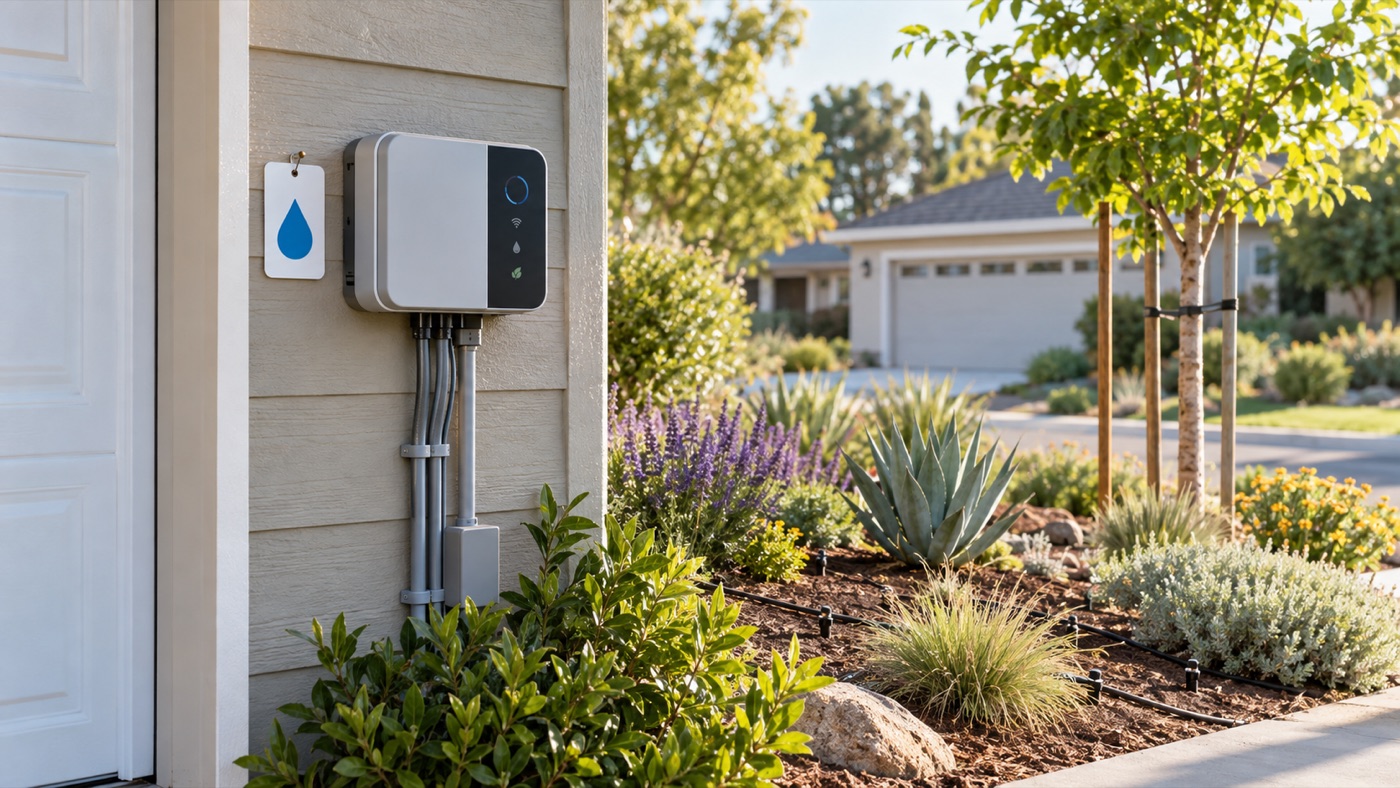
A WaterSense label on an irrigation controller means the product has been independently certified to meet U.S. Environmental Protection Agency criteria for water efficiency and performance. It is useful evidence that a controller can adjust watering without simply sacrificing landscape needs—but it is not a promise that every yard will save the same amount of water.
The label also does not tell you whether a controller has the right number of zones, works with your wiring, qualifies for your local rebate, or offers the app features you want. Those decisions still require checking the exact model and your irrigation system.
If you are still deciding between controller technologies, start with our comparison of weather-based and soil-moisture irrigation controllers. This guide focuses on what the WaterSense label confirms—and what it does not—once you begin shopping.
WaterSense irrigation controller label: what it confirms
WaterSense is an EPA program for water-efficient products, homes, and professional certification programs. According to the EPA’s explanation of what the WaterSense label means, labeled products must meet efficiency and performance requirements and be backed by independent, third-party certification.
For a smart irrigation controller, the most important points are:
- the exact eligible product or controller combination has been certified;
- it must meet the applicable WaterSense performance specification;
- certification considers both efficient scheduling and adequate irrigation;
- the manufacturer does not certify its own product; and
- the model should appear in EPA’s current WaterSense Product Search.
That last point matters. Marketing pages and retailer listings can contain mistakes, and certification may apply to a specific model rather than every controller sold under the same brand name.
| The label helps confirm | The label does not guarantee |
|---|---|
| Independent certification to EPA criteria | A specific reduction in your water bill |
| Tested irrigation efficiency and performance | Correct installation or programming |
| Eligibility of an exact model or approved combination | Compatibility with every valve, sensor, pump, or base controller |
| The ability to respond using weather or soil-moisture data under the relevant specification | Reliable Wi-Fi, a good mobile app, or free cloud service forever |
| A credible starting point for some utility rebate programs | Automatic eligibility for your local rebate |
Which irrigation controllers can earn the label?
EPA currently labels two main smart-irrigation technologies.
Weather-based irrigation controllers
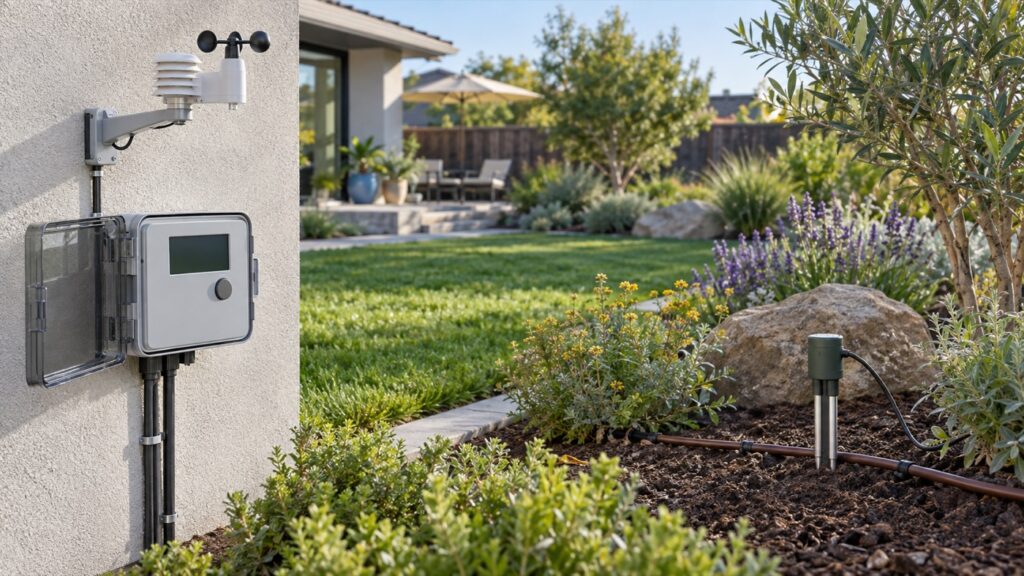
Weather-based controllers use local weather information and landscape settings to create or modify watering schedules. Depending on the model, weather information can come from an on-site sensor, a remote signal, or a combination.
EPA says labeled weather-based controllers are evaluated for irrigation adequacy, irrigation excess, and supplemental capabilities intended to support long-term savings. In practical terms, a certified controller must demonstrate that it can meet landscape water needs while avoiding unnecessary watering. The EPA weather-based controller page explains the applicable performance criteria and specification.
Soil-moisture-based irrigation controllers
Soil-moisture controllers use one or more in-ground sensors to determine whether scheduled watering should occur. The system may be a standalone controller or an add-on or plug-in device connected to an existing base controller.
For these products, certification depends on the controller responding consistently when soil moisture crosses a selected threshold. Sensor placement and setup still matter: a certified product can make poor decisions if its probe is installed in an unusually wet or dry location.
Controllers that use both technologies
Some controllers use weather and soil-moisture information concurrently. EPA states that a controller using both types of data must be certified under both relevant specifications to bear the label for that combined operation.
Do not assume that a product is dual-certified merely because it accepts an optional sensor. Confirm the exact model and configuration in the product database.
How independent certification works
WaterSense is not a self-declared marketing claim. Products bearing the label must be certified by an independent organization licensed by EPA and accredited for the relevant product category. The certifying body tests or evaluates conformity with the applicable specification and authorizes label use for certified products.
EPA also describes periodic market surveillance as part of protecting the label’s integrity. Its list of licensed product certifying bodies shows which organizations can certify each WaterSense product category.
Certification does not mean EPA has ranked the controller against every competing model or endorsed one manufacturer. It means the product met defined criteria. Price, interface quality, warranty, connectivity, and suitability for your yard remain separate buying decisions.
How to verify a controller before buying
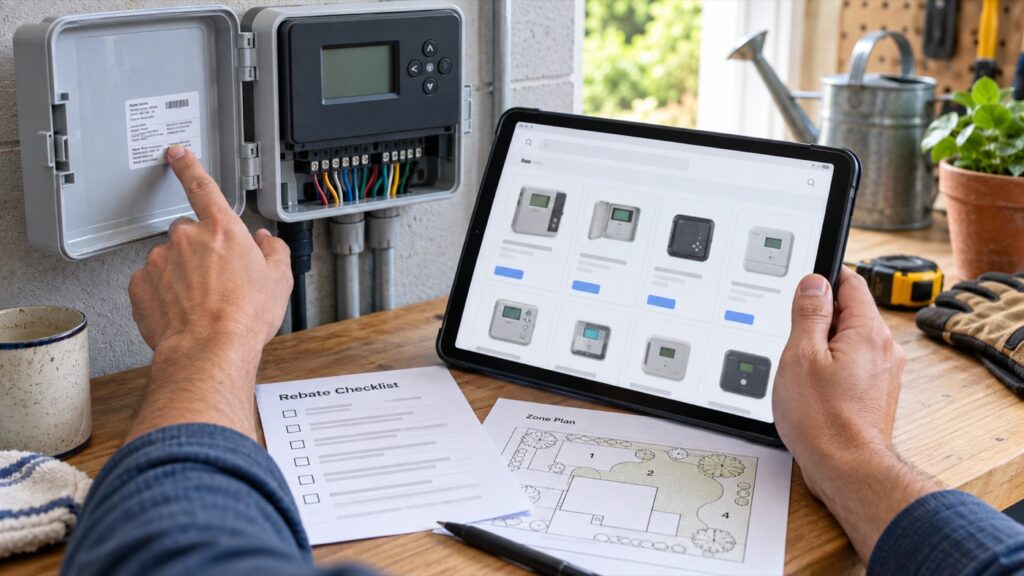
Use the exact model number rather than relying on a product title such as “smart,” “water-saving,” or “WaterSense compatible.”
1. Identify the exact model number
Find the model number on the manufacturer’s specification sheet, packaging, controller label, or retailer listing. A product family can contain multiple station capacities and hardware versions, so a general series name may not be enough.
2. Search the EPA database
For a weather-based product, use the official WaterSense Product Search for weather-based irrigation controllers. For a soil-moisture product, use the soil-moisture controller search.
Start with a distinctive part of the model number if the full number returns no result. EPA notes that model listings can contain wildcard characters representing variations.
3. Confirm the controller type
Check whether the listing describes a standalone controller, add-on device, or plug-in device. A standalone model contains the smart-control function. An add-on or plug-in device modifies a compatible base controller.
4. Check compatibility for add-ons
An add-on device is not automatically WaterSense labeled with every conventional controller. EPA maintains compatibility information for approved combinations. Confirm both the smart device and your existing base-controller model before purchasing.
5. Match the zone capacity
The EPA database includes maximum station or zone capacity. Count the zones currently connected and allow for realistic expansion. Some controllers reach their advertised maximum only after adding an expansion module.
What the label does not tell you
It does not guarantee a fixed saving
EPA estimates that replacing a standard clock-based controller with a properly installed and operated WaterSense labeled controller can save an average home up to 15,000 gallons of water annually. That is a program estimate, not a promise for an individual property.
Actual savings depend on the previous schedule, climate, landscape size, sprinkler condition, water price, controller settings, and homeowner behavior. A yard already watered carefully may save less than one routinely overwatered by a fixed timer.
It does not repair the irrigation system
A smart controller cannot correct broken heads, leaks, clogged emitters, poor pressure, mixed sprinkler types, or overspray. Audit every zone before treating controller replacement as the solution to high water use.
It does not prove every feature is good
WaterSense certification is not a review of app usability, wireless range, smart-home integration, customer support, cybersecurity, or subscription terms. Read the current manufacturer documentation and independent user feedback for those questions.
It does not guarantee rebate approval
WaterSense provides product and rebate information but does not administer local incentives. Utilities can require a particular model, preapproval, proof of purchase, professional installation, photographs, or removal of an old controller.
EPA’s WaterSense FAQ advises contacting the local water provider or government for current rebate requirements. Verify the rules before purchasing—not after installation.
A practical buying checklist
| Check before purchase | Why it matters |
|---|---|
| Exact model appears in EPA Product Search | Confirms certification rather than relying on advertising |
| Weather-based, soil-moisture, or dual operation | Determines what information drives watering decisions |
| Standalone versus add-on or plug-in | Affects installation and base-controller compatibility |
| Number of supported zones | Prevents buying a controller that cannot run the complete system |
| Master-valve and pump-start support | Important for systems using this equipment |
| Sensor inputs and approved combinations | Determines whether rain, soil, freeze, or flow hardware will work as expected |
| Indoor or outdoor enclosure rating | Protects equipment in the intended installation location |
| Wi-Fi and offline behavior | Determines what happens during an internet or cloud-service outage |
| Utility rebate approval | Avoids losing an incentive because of the wrong model or process |
| Warranty, subscription, and expansion costs | Reveals the real cost beyond the controller’s shelf price |
Watch for incorrect label claims
EPA warns that non-certified products are sometimes advertised as WaterSense labeled. This can happen because of mistaken retailer copy, confusion between a promotional logo and the product label, or an unsupported claim about an entire product family.
The agency maintains information about ineligible and incorrectly labeled products. If a retailer’s claim conflicts with EPA Product Search, treat the official database as the better source and ask WaterSense or the manufacturer to clarify the exact model.
Also distinguish between these concepts:
- WaterSense labeled: the eligible product has passed the applicable certification process.
- WaterSense partner: an organization participates in promoting water efficiency; partnership alone does not certify every product it sells.
- Compatible with a labeled device: the base controller may work in an approved combination, but the base controller is not necessarily labeled by itself.
- Smart or water-saving: marketing language that does not by itself prove WaterSense certification.
Final verdict
The WaterSense irrigation controller label is a valuable buying filter because it confirms independent certification for efficiency and performance. It is more meaningful than an unsupported “eco” or “smart” claim, and it can simplify product research or rebate eligibility.
But the label is the beginning of the decision, not the end. Verify the exact model, controller type, approved compatibility, zone capacity, installation requirements, and local rebate rules. Then repair and map the irrigation system before programming the new controller.
Used that way, WaterSense helps you narrow the market to credible options while leaving the yard-specific decisions where they belong: with the homeowner, installer, and actual conditions on the property.
Frequently asked questions
Is every smart irrigation controller WaterSense labeled?
No. “Smart” is a broad marketing term. A controller must meet an applicable EPA specification and complete independent certification before the eligible product can bear the WaterSense label.
Does a WaterSense controller need Wi-Fi?
Not necessarily. Certification focuses on irrigation efficiency and performance, not on requiring a particular connection method. Models can use on-site sensors, weather signals, or other approved configurations. Check the exact model’s data source and offline behavior.
Can I receive a rebate for any labeled controller?
No. Rebate rules are local and can change. Your utility may limit eligible models, purchase dates, customer classes, installation methods, or application steps. Confirm eligibility before buying.
Does the label apply to an entire brand?
No. Certification applies to eligible products and configurations. Search the exact model number in EPA Product Search rather than assuming every controller from a brand is labeled.
Should I replace a working clock timer only for the label?
Not automatically. First inspect the irrigation system and estimate whether scheduling is causing waste. A labeled controller can be worthwhile when a fixed schedule is routinely overwatering, but repairs and correct zone settings may be the more urgent investment.
Editorial note: This guide provides general information for U.S. homeowners and was reviewed against EPA WaterSense resources on September 25, 2026. Product certifications, compatibility lists, rebates, water restrictions, and manufacturer services can change. Confirm current information with EPA, the manufacturer, and your local water provider before purchasing or installing equipment.