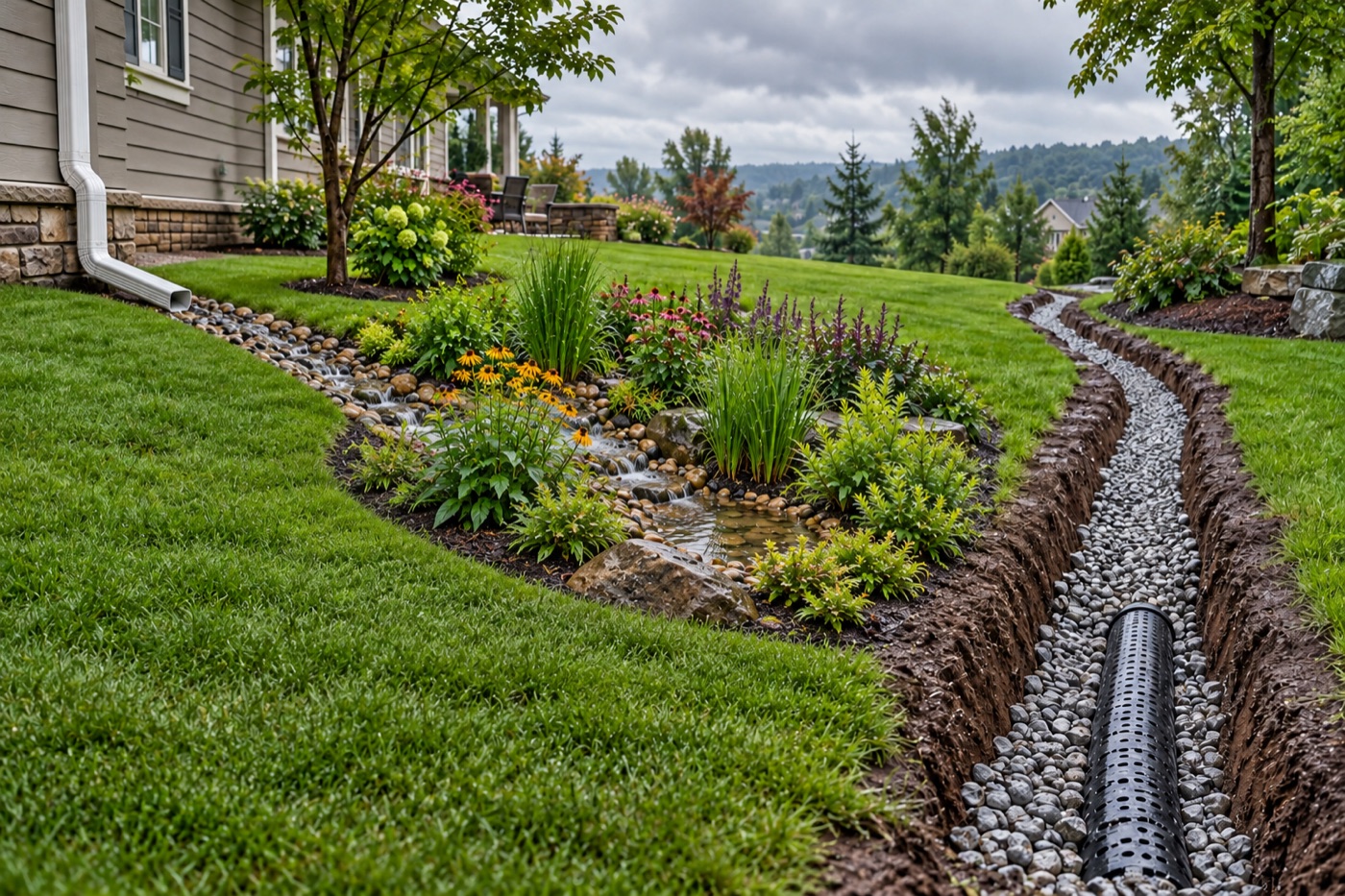
A rain garden and a French drain solve different drainage problems. A rain garden temporarily holds clean runoff and lets it soak into planted soil. A French drain intercepts water in a gravel-filled trench and carries it through a perforated pipe to a safe outlet. Choose a rain garden when you can infiltrate roof or driveway runoff on-site; choose a French drain when you need to move persistent surface or subsurface water away from a problem area.
The right answer depends less on appearance than on where the water comes from, how quickly the soil drains, and where excess water can legally go. In some yards, a planted basin with an underdrain combines the strengths of both systems. In others—especially near a wet foundation, failed septic system, high water table, or unstable slope—a homeowner-scale project is not the right starting point.
Rain garden vs. French drain: the short answer
| Choose this | Best fit | What it does not fix well |
|---|---|---|
| Rain garden | Roof, patio, driveway, or compacted-lawn runoff that can be spread into a shallow planted basin and drain within roughly 24–48 hours | Water against a foundation, sewage, a continuously high water table, or a site with no adequate infiltration or overflow route |
| French drain | A linear soggy area, hillside seep, or water that must be intercepted and conveyed underground to a lawful, stable outlet | Runoff pollution treatment, habitat, or any installation without enough slope and a suitable discharge point |
| Rain garden with underdrain | A site that benefits from planted filtration but has soil too slow for a simple infiltration-only garden | A substitute for engineering where buildings, groundwater, contaminated soil, or major storm flows are involved |
If you are trying to dry a basement or stop water entering a crawl space, begin with gutters, downspouts, grading, and a qualified drainage or foundation professional. Do not intentionally send more water toward a building just because a rain garden is the more attractive option.
What a rain garden actually does
A rain garden is a shallow, planted depression that receives runoff from an impervious surface such as a roof, driveway, or sidewalk. Water ponds briefly, filters through vegetation and soil, and then infiltrates or leaves through a designed overflow or underdrain. The U.S. Environmental Protection Agency describes rain gardens as small sunken areas that collect stormwater and filter it through soil, sand, or gravel.
A homeowner rain garden is not a permanent pond and should not stay wet all the time. Penn State Extension recommends a site that drains within about 24 hours and advises considering another location when a test hole takes longer than 24 hours to empty. University of Minnesota Extension uses a 48-hour site test. Those different thresholds are a useful reminder that local design guidance, soil, climate, mosquito concerns, and plant selection matter.
A typical rain garden includes:
- an inlet from a downspout, swale, curb cut, or sheet-flow path;
- stone or dense vegetation where water enters to limit erosion;
- a level basin bottom that spreads water rather than concentrating it;
- soil and plants suited to alternating wet and dry conditions;
- a low berm on the downhill edge; and
- a stabilized overflow that sends exceptional storms somewhere safe.
The plants are part of the drainage system, not decoration added at the end. Their stems slow flow, roots maintain soil structure, and foliage can support pollinators and other wildlife. Native species are often a strong choice, but “native” alone does not guarantee success: each plant still has to match the site’s sun, soil, winter conditions, and wet-to-dry zone.
What a French drain actually does
A French drain is a narrow trench containing clean, free-draining aggregate and, commonly, a perforated pipe wrapped or protected with permeable geotextile. Water enters along the trench, reaches the pipe, and travels downhill to a suitable outlet. University of Minnesota Extension describes the same basic arrangement for intercepting surface water and shallow groundwater: a gravel-filled trench with a perforated pipe that drains away from the problem area.
The outlet is not optional. A trench can store a modest amount of water, but its primary job is conveyance. Without a positive discharge point—or a separately designed infiltration structure—the pipe can remain full, sediment can accumulate, and the wet problem may simply move to the trench or a neighbor’s property.
Common components include:
- a planned trench line that intercepts rather than follows the unwanted flow;
- continuous fall toward the outlet;
- perforated pipe of an appropriate diameter;
- washed drainage aggregate rather than soil-contaminated fill;
- geotextile that separates soil from aggregate while allowing water through;
- accessible cleanouts where the design needs them; and
- a lawful, erosion-resistant outlet with enough capacity.
A French drain should not be confused with a solid downspout extension. A solid pipe moves roof water from a known inlet without collecting water along its length. A perforated French-drain pipe collects water from the surrounding trench. Combining them carelessly can dump concentrated roof flow into already saturated soil.
The seven differences that decide the project
1. Infiltration versus conveyance
A rain garden tries to keep manageable stormwater on the property long enough for soil and plants to treat and absorb it. A French drain primarily transports water. This is the central distinction: soak it in safely or move it to a safe outlet.
Infiltration can reduce the rapid surge of runoff reaching a street or storm drain. EPA guidance notes that green infrastructure can slow, spread, filter, and infiltrate runoff. Conveyance may be necessary when infiltration is unsafe or inadequate, but it must not create a new downstream erosion or flooding problem.
2. Type of water problem
A rain garden works best with relatively clean, intermittent runoff from roofs and other residential hard surfaces. A French drain fits a linear seep, a persistently wet strip, or shallow subsurface water that needs interception. Neither should receive sewage, graywater, or an illicit sump-pump discharge.
Be cautious with runoff from gas stations, vehicle-repair areas, salt-storage areas, industrial sites, or contaminated soils. The EPA warns that infiltration at stormwater “hot spots” can move pollutants toward groundwater unless the system is professionally designed with suitable pretreatment or a liner.
3. Soil and groundwater
A simple rain garden depends on adequate infiltration below the basin. Run a percolation test using the method and acceptance time specified by your local extension office or stormwater program. Test more than one point, because fill soil and compaction can vary across a yard.
Slow soil does not automatically make planted bioretention impossible. A designed soil mix and underdrain may provide filtration and controlled discharge. But that is a more engineered system, not permission to excavate blindly into a high water table. Persistently saturated test holes, hydric-soil indicators, or water close to grade call for local professional advice.
4. Space and appearance
A rain garden needs surface area proportional to the contributing roof, driveway, or other drainage area, plus room for side slopes and overflow. It becomes a visible landscape bed and requires plant establishment. A French drain has a much narrower footprint and can be covered with gravel or, in suitable designs, soil and turf.
Do not undersize a rain garden just to fit an empty corner. Penn State notes that sizing depends on runoff volume, soil infiltration, and ponding depth; its homeowner example uses roughly 10–20% of the contributing impervious area, while other programs use different local methods. Follow the calculator or worksheet issued for your jurisdiction.
5. Maintenance
A rain garden needs weeding, watering during establishment, inlet and overflow inspection, sediment removal, mulch management where used, and replacement of failed plants. Check it after major storms for erosion channels, buried crowns, exposed roots, or ponding that persists beyond the local design time.
A French drain needs less visible horticultural care but is not maintenance-free. Leaves and sediment must be kept out of connected inlets, outlets must remain open and protected from erosion, and accessible components may need flushing or cleaning. Fine sediment entering through unsuitable fabric or aggregate can shorten service life.
6. Cost drivers
A DIY rain garden can be material-efficient when excavation is shallow, soil infiltrates well, and plants are bought small. Its costs rise with hauling excavated soil, amended media, an underdrain, stone protection, a large plant count, or professional design.
A French drain cost is driven by trench length and depth, access for excavation equipment, disposal, pipe and aggregate volume, utility conflicts, outlet construction, restoration, and whether hardscape must be crossed. Comparing only the price of plants with the price of pipe misses most of the project.
Instead of using a national “cost per foot,” request a scope that identifies the drainage area, materials, pipe elevations, outlet, restoration, and exclusions. A low bid with no verified outlet is not a complete drainage solution.
7. Environmental benefit
When correctly sited, a rain garden can provide more than drainage: it can filter sediment and pollutants, reduce runoff peaks, replenish soil moisture, and create habitat. A French drain is infrastructure for water movement. It may prevent erosion or protect a usable area, but it does not automatically provide the same filtration or habitat.
A five-step yard drainage diagnosis
Step 1: Observe at least one real storm
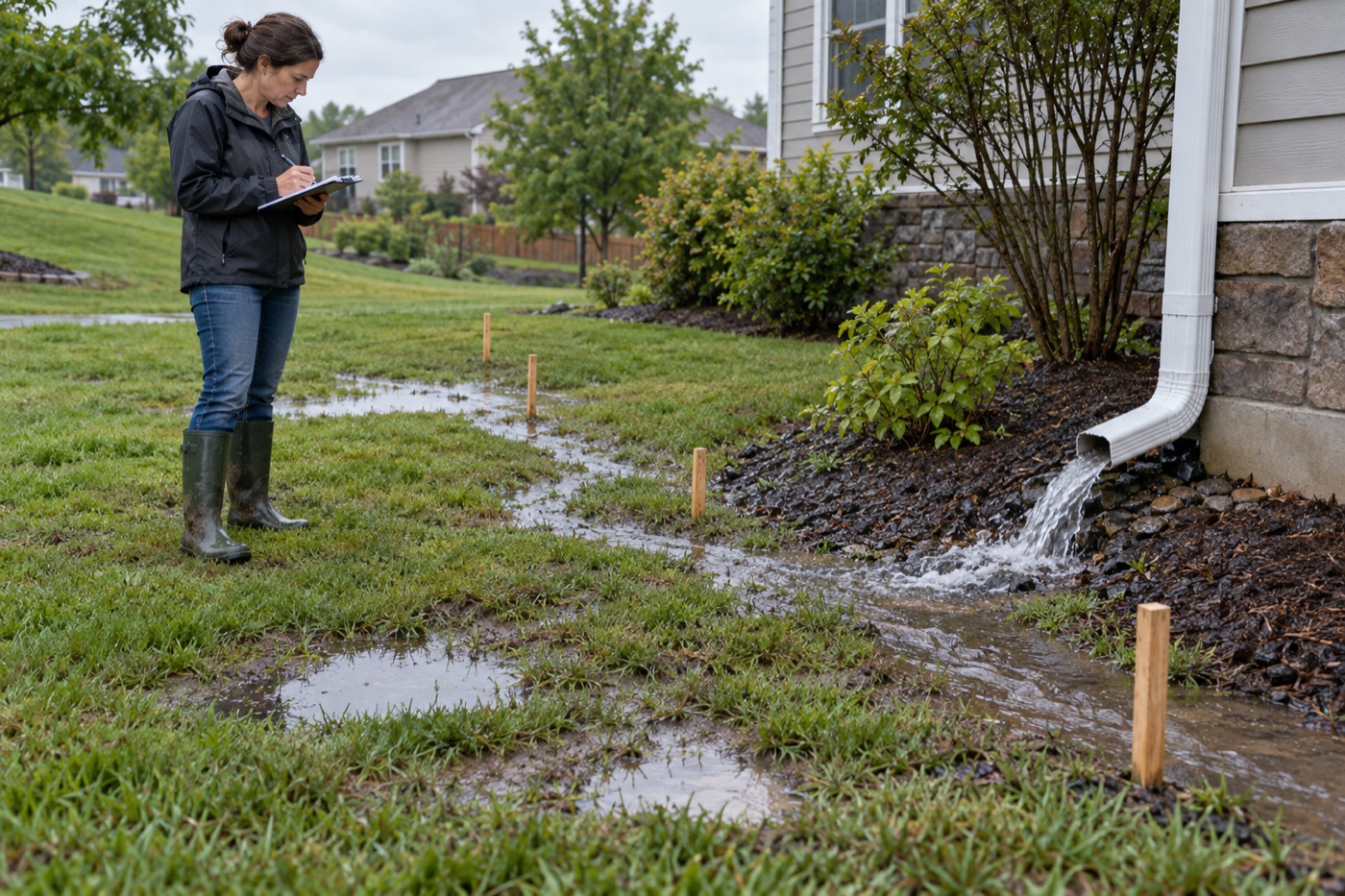
Photograph the yard at the beginning, peak, and several hours after rainfall. Mark roof downspouts, irrigation discharge, neighboring runoff, pavement flow, low spots, and seep lines. Record how long each puddle remains. A dry-day guess often mistakes the lowest visible spot for the true source.
If the wet area appears only after irrigation, first run a zone-by-zone sprinkler audit. A leaking valve, broken lateral, blocked head, or excessive runtime should be corrected before building stormwater infrastructure.
Step 2: Classify the source
| What you observe | Likely first investigation | Possible solution |
|---|---|---|
| Fast flow from a roof or driveway during rain | Contributing area, flow path, soil test, safe overflow | Rain garden, swale, rain barrel/cistern overflow, or solid conveyance pipe |
| A narrow strip stays wet downslope | Hillside seep, irrigation leak, neighboring discharge, groundwater | French drain or professionally designed interceptor after source confirmation |
| Water ponds in compacted lawn | Compaction, grade, soil texture, irrigation rate | Source correction, aeration/soil improvement, shallow grading, lawn depression, or rain garden |
| Water touches foundation or enters building | Gutters, downspouts, grade, cracks, footing drainage | Building-drainage/foundation evaluation; do not start by adding an infiltration basin nearby |
| Standing water is constant in dry weather | Leak, spring, high water table, septic or sewer issue | Professional diagnosis; a basic rain garden is inappropriate |
Step 3: Test soil and check constraints
Before choosing a rain garden, perform the locally recommended infiltration test and check the seasonal water table, slope, wells, septic system, property boundaries, easements, and buried utilities. Penn State recommends keeping a rain garden at least 10 feet from a building foundation and away from septic systems, wells, utilities, tree roots, and already waterlogged areas. Local setbacks may be larger and take precedence.
Before any excavation in the United States, contact 811 and allow the required local notice time. Utility marks do not necessarily locate private irrigation, lighting, propane, well, or septic lines, so investigate those separately.
Step 4: Identify the overflow or outlet
Every rain garden needs a controlled overflow for storms larger than its design event. Every conventional French drain needs a workable outlet. Confirm that discharge is permitted and will not erode soil, ice a sidewalk, flood a neighbor, overload a septic area, or connect illegally to a sewer or storm system.
If no lawful outlet exists and the soil cannot infiltrate the design volume, stop. A deeper trench is not a substitute for a drainage plan.
Step 5: Match the smallest intervention to the cause
Redirecting one downspout, repairing an irrigation leak, correcting a small grade defect, or using cycle-and-soak irrigation may solve the problem with less excavation. Build a rain garden or French drain only after simpler source controls are considered.
When a hybrid rain garden with an underdrain makes sense
A hybrid system uses a planted bioretention basin above a gravel drainage layer and perforated underdrain. Runoff still passes through plants and engineered soil, but water that does not infiltrate into native soil is collected and released through a controlled outlet. EPA distinguishes these more engineered bioretention systems from simpler rain gardens.

A hybrid can be appropriate when:
- local guidance allows underdrained bioretention;
- the site has enough surface area and a safe outlet;
- native soil is too slow for a simple rain garden but the water table and contamination risks are acceptable;
- the design includes suitable media, elevations, overflow, and maintenance access; and
- the owner wants runoff filtration and planting benefits in addition to reliable drainage.
Do not improvise the soil mix or pipe elevation. If the underdrain is too high, the basin may remain saturated; too low, and it may drain too quickly to support plants or provide treatment. Follow a local bioretention specification or use a qualified designer.
When neither option is the right DIY project
Seek professional or local-agency guidance when:
- water enters a basement, crawl space, retaining wall, or occupied building;
- the ground stays saturated through dry weather or a high water table is suspected;
- the site is on or above a steep, eroding, or unstable slope;
- runoff may contain fuel, solvents, heavy industrial contamination, or concentrated deicing chemicals;
- sewage odor, surfacing wastewater, or a failing septic system is possible;
- the proposed outlet crosses a property line, easement, sidewalk, curb, or public drainage system;
- the project could affect a well, wetland, stream, floodplain, or protected area; or
- the contributing drainage area or expected flow is larger than a residential practice can safely handle.
Local grading, stormwater, plumbing, building, environmental, HOA, and right-of-way rules vary. Obtain required approvals before excavation, not after a complaint or failed inspection.
Installation mistakes to avoid
- Building at the lowest swampy spot. A rain garden belongs where it can receive runoff and still drain, often upslope of the chronically wet area.
- Ignoring roof area. A small decorative bed can be overwhelmed by a large roof and intense storm.
- Sending water toward the house. Maintain the locally required foundation setback and positive building drainage.
- Installing a French drain without an outlet. Gravel alone does not make water disappear.
- Using solid pipe where collection is needed—or perforated pipe for concentrated roof flow. The pipe type should match its job.
- Skipping erosion protection. Stabilize inlets and outlets so concentrated flow does not cut channels.
- Covering a drain with sediment-laden soil. Keep fine particles out of the aggregate and pipe.
- Overwatering the new rain garden. Establish plants carefully, then adjust irrigation to actual need using a seasonal watering schedule.
- Assuming “native” means zero maintenance. Weed control, inspection, and selective replanting are essential during establishment.
A practical decision checklist
| Question | If yes | If no |
|---|---|---|
| Is the water intermittent runoff from a roof, drive, walk, or lawn? | Continue evaluating a rain garden | Investigate leaks, groundwater, septic, or another source |
| Can the proposed basin drain within the local design time? | Infiltration rain garden may fit | Consider another site or a designed underdrain—not a deeper hole by default |
| Do you need to intercept water along a narrow line? | Evaluate a French drain | A basin, grading, or source correction may fit better |
| Is there a legal, stable outlet with adequate fall? | Conveyance or underdrain is possible | Do not install an outlet-dependent system |
| Are foundations, septic, wells, utilities, slopes, and contaminated areas clear? | Proceed with local design checks | Relocate or obtain professional guidance |
| Can you maintain plants, inlet, overflow, pipe, and outlet? | Choose based on site performance and preferred landscape | Simplify the design or arrange maintenance |
Frequently asked questions
Can a rain garden replace a French drain?
Sometimes, but only when the water is suitable runoff, the soil can infiltrate it, setbacks are adequate, and a safe overflow exists. A rain garden is not a direct substitute for an interceptor drain handling groundwater or water threatening a structure.
Can a French drain empty into a rain garden?
It can be part of a professionally or locally approved design, but concentrated flow must not overwhelm or erode the basin. The garden must be sized for the contributing area, and the French drain must not carry contaminated water or continuously saturate the planting soil.
Will a rain garden attract mosquitoes?
A correctly designed rain garden drains between storms rather than holding permanent water. Investigate any ponding that remains beyond the local 24–48 hour target; slow drainage can harm plants and create mosquito habitat.
Do French drains work in clay soil?
They can collect and convey water through clay if they have correct elevations, suitable aggregate and fabric, and a reliable outlet. A dead-end gravel trench in clay may simply fill and stay wet. Determine whether the problem is surface runoff, perched water, or deeper groundwater before designing the drain.
How far should a rain garden be from a house?
Penn State and University of Minnesota Extension both recommend at least 10 feet from buildings in their general homeowner guidance. Your local code, soil, slope, foundation type, basement, and drainage plan may require more. Never use a generic minimum to override site-specific advice.
Which option adds more value to a yard?
The system that reliably solves the diagnosed problem without creating another one adds the most functional value. A rain garden can also add seasonal planting and habitat; a French drain can preserve usable turf or hardscape. Neither adds value when undersized, clogged, illegally discharged, or poorly maintained.
Editorial note: This general U.S. guide was reviewed on October 14, 2026 using official guidance from the U.S. EPA, EPA groundwater-protection guidance, Penn State Extension, University of Minnesota Extension rain-garden guidance, and University of Minnesota Extension French-drain guidance. Site conditions, permits, setbacks, and discharge rules vary. Confirm requirements with the relevant local authority and use a qualified professional for structural water, complex drainage, contamination, steep slopes, or high groundwater.