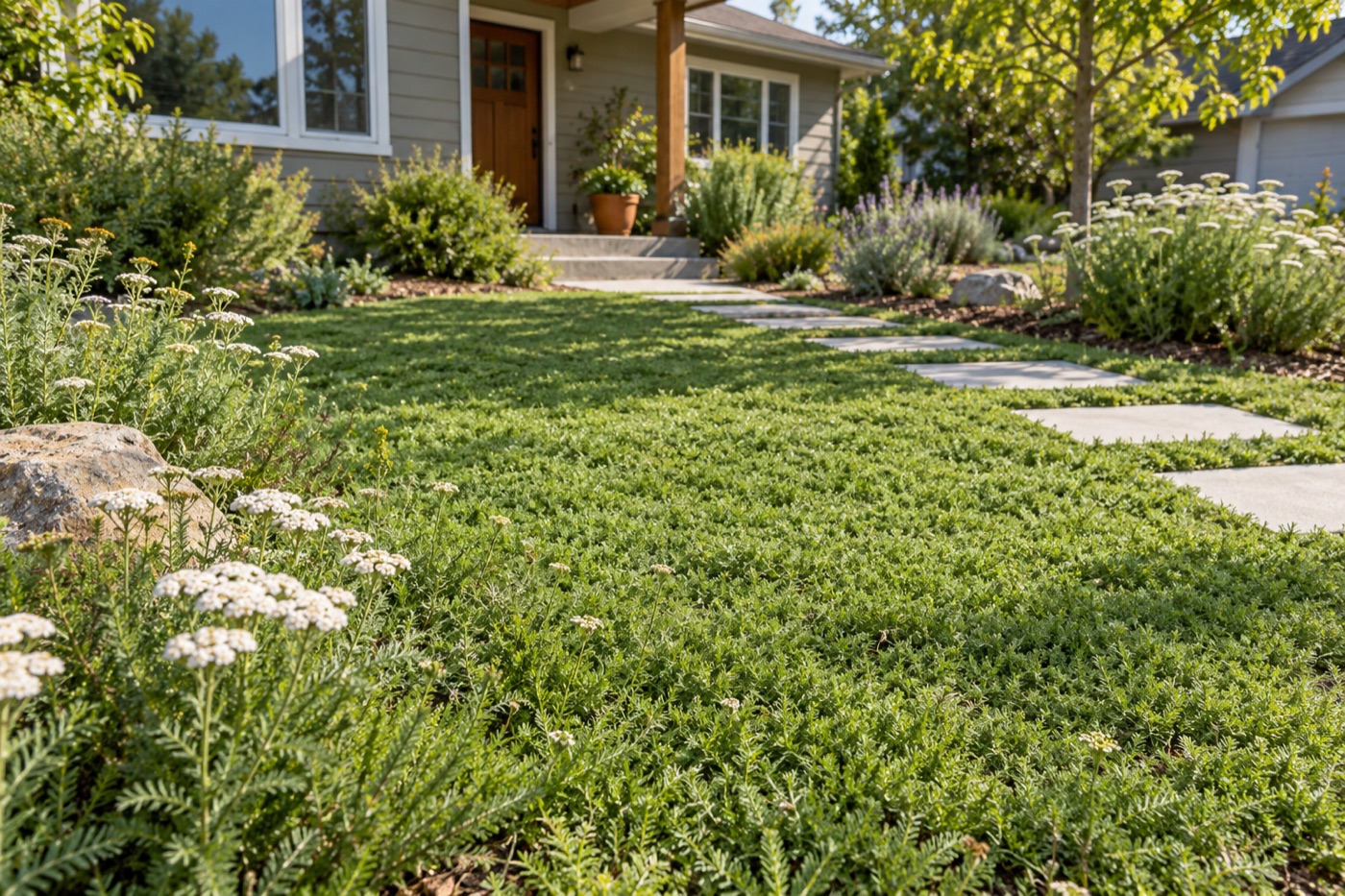
A yarrow lawn can be a practical low-water surface in a sunny, well-drained yard with light foot traffic, but it is not a direct substitute for recreational turf. Common yarrow (Achillea millefolium) spreads through rhizomes, tolerates mowing and stays green through dry periods in some climates. It can also escape its intended area, lose flowers when mown, irritate sensitive skin and perform poorly in wet soil.
For many homes, the lower-risk design is not a wall-to-wall pure yarrow lawn. It is either a small yarrow-dominant panel with paths carrying regular traffic or an ecolawn that combines yarrow with compatible fine grasses and, sometimes, clover. The choice depends on climate, drainage, desired appearance, pets, pollinator goals and how the space is actually used.
Yarrow lawn: the short answer
| Question | Practical answer |
|---|---|
| Can yarrow replace grass? | Yes in selected sunny, draining, low-traffic areas. A grass-yarrow ecolawn is usually more resilient and familiar-looking than a pure stand. |
| How much water does it need? | Seedlings need regular moisture. Established yarrow can tolerate drought, but the amount needed to remain green varies sharply by climate and soil. |
| How often is it mown? | Occasional mowing keeps foliage low. Oregon State describes 1–2 monthly cuts at 2.5–3 inches for a regional ecolawn mix, not as a nationwide prescription. |
| Does it tolerate foot traffic? | Light, dispersed walking is reasonable. Daily routes, dogs running a fence line, play and sports require pavers or durable turf. |
| Will it flower when mown? | Frequent mowing removes flowering stems. Leave edges or islands unmown if pollinator flowers are part of the goal. |
| Can it become invasive? | It can spread aggressively by rhizomes and seed. Use edging, mow before seed set and avoid sites where escape would be difficult to manage. |
| Is it a pet lawn? | Do not assume so. Extension sources warn about pets eating yarrow; ask a veterinarian if ingestion is possible and provide a separate durable pet area. |
| Is it native? | Achillea millefolium is a highly variable species complex with native and introduced lineages. Buy regionally identified seed rather than relying on the common name. |
North Carolina Extension recommends common yarrow as a lawn alternative only in low-foot-traffic areas and notes its preference for full sun and well-drained soil. Oregon State University has stronger evidence for yarrow as one component of an ecolawn in western Oregon. These are compatible conclusions: yarrow is useful, but the site and planting system determine whether it behaves like a durable lawn or an aggressive garden plant.
What a yarrow lawn actually is
The phrase “yarrow lawn” can describe three different landscapes. Confusing them leads to unrealistic expectations.
Pure or yarrow-dominant lawn
This surface is planted mostly with common yarrow and mown to keep its fern-like basal foliage low. Rhizomes can knit plants together into a green cover. It may suit a small ornamental panel, a sunny side yard or an area that receives occasional footsteps. It will not look or behave exactly like Kentucky bluegrass, tall fescue or bermudagrass.
Grass-and-yarrow ecolawn
An ecolawn combines compatible, low-input grasses and broadleaf plants. Oregon State describes mixes that include dwarf perennial ryegrass or hard fescue, yarrow and clover. The grass supplies familiar turf structure, yarrow contributes summer color and drought persistence, and clover can add nitrogen. The mix distributes risk: one species can maintain cover when another is stressed.
Flowering meadow or groundcover
Unmown yarrow sends up flower stalks that commonly reach 1–3 feet. That is a meadow or pollinator planting, not a walkable lawn. It can be valuable habitat, but it needs different placement and maintenance. A useful compromise is to mow the central surface and leave a contained perimeter or island to bloom.
Where a yarrow lawn works best
Sunny sites with drainage and lean soil
Common yarrow tolerates dry and relatively infertile soil once established. It performs best where water does not remain around crowns and roots. A sunny bank, a broad parking strip, a dry side yard or an open front-yard panel can be a reasonable trial site. Rich fertilizer programs and frequent irrigation can create excessive growth without improving resilience.
Areas where a relaxed, mixed texture is acceptable
A yarrow surface has finely divided leaves, seasonal variation and occasional taller stems. A homeowner who expects a perfectly uniform, dark-green carpet may interpret those traits as weeds. It fits better with a naturalistic, water-wise landscape than with a formal lawn that must match a conventional neighborhood standard.
Lawns with light, distributed use
Walking across an established stand occasionally is different from following the same route every day. Use stepping stones between doors, gates, play areas and sheds. Keep a durable grass or hardscape surface under furniture, goal posts, dog runs and other concentrated loads.
Sites where spread can be contained
Hard edging, paving or a mown buffer makes rhizomatous spread easier to inspect. Avoid placing yarrow beside a delicate perennial bed or an unmanaged natural area unless a local native-plant specialist considers the selected seed appropriate. UC Integrated Pest Management notes that common yarrow can be desirable in natural communities yet weedy in turf and landscapes.
Where yarrow is likely to disappoint
Wet soil and overirrigated zones
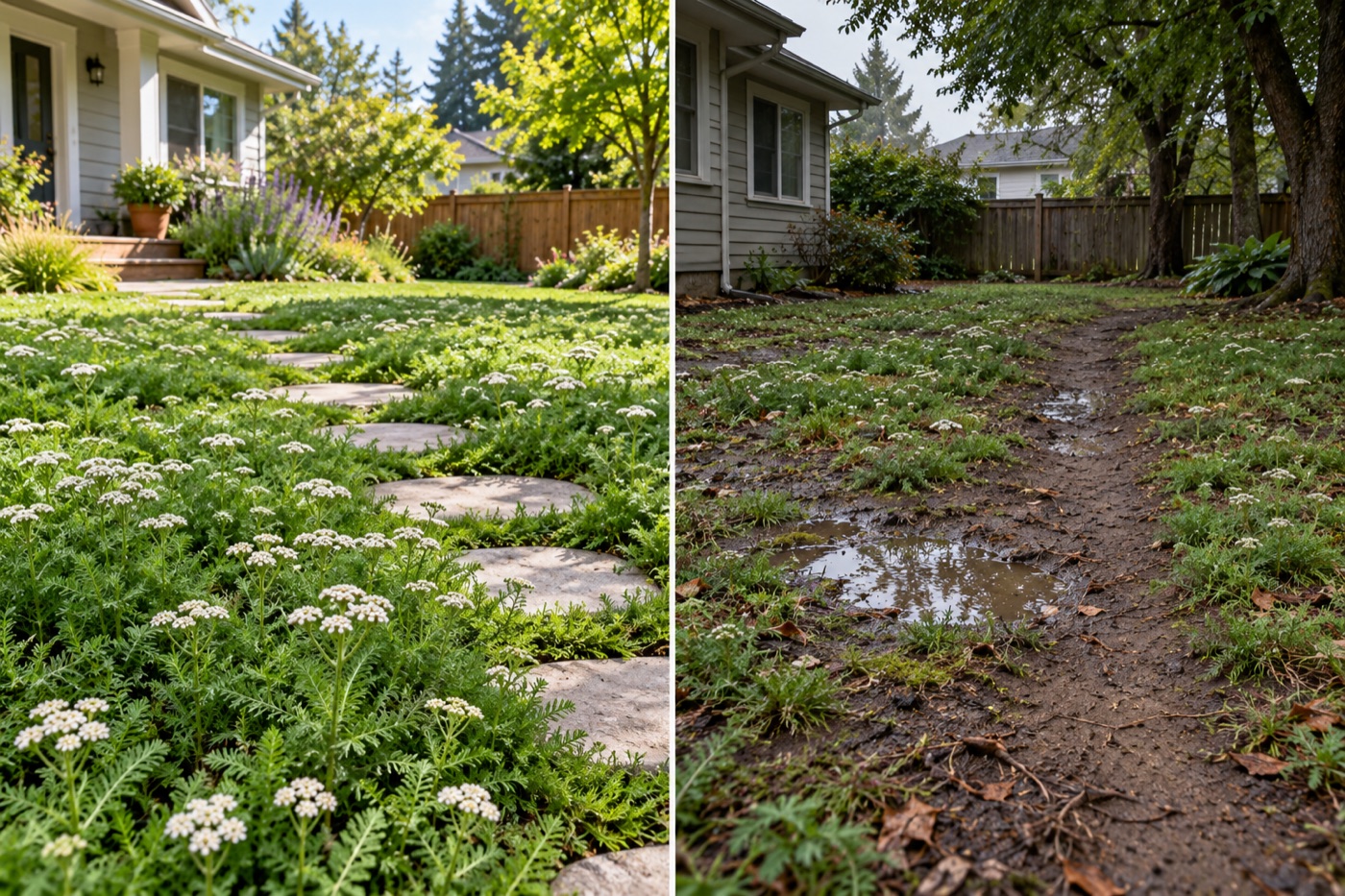
Yarrow is not a cure for poor drainage. North Carolina Extension lists root rot in overly wet soil, while Oregon State notes that the plant does not do well in wet locations. Investigate a low spot, leak or overspray before planting. Our guide to dry spots, runoff and sprinkler overspray can help distinguish a plant problem from an irrigation problem.
Heavy or concentrated traffic
A family play lawn needs rapid recovery from abrasion, twisting and compaction. A pure yarrow stand is not the conservative choice. For mixed-use yards, reserve durable turf or a surfaced path for activity and place yarrow in the ornamental, low-traffic hydrozone.
Deep shade
Common yarrow can survive some partial sun, but full sun produces the most dependable dense growth. Deep shade can create open foliage and increase competition from shade-adapted weeds. Do not compensate by keeping the soil constantly wet. A regionally suitable sedge or woodland groundcover is normally a better solution.
Formal borders where escape is unacceptable
Rhizomes and seedlings can move beyond the planned line. Oregon State describes yarrow as potentially too aggressive for some borders, and USDA-NRCS advises containing it or growing it with competitive plants. If the neighboring bed contains slow-growing specimens, use a physical break and inspect the edge regularly.
Homes where exposure creates a health concern
UC Agriculture and Natural Resources reports that yarrow can rarely trigger allergic skin rashes or photosensitivity, especially when wet skin contacts freshly cut yarrow and grass. Wear gloves, long sleeves, long pants, closed shoes and eye protection during mowing or trimming if sensitivity is a concern. Keep clippings away from children and animals.
Several Extension resources also warn that ingestion can harm dogs, cats and horses. That does not prove every animal will eat or react to the plant, but it means a yarrow lawn should not be presented as automatically pet-safe. Ask a veterinarian about the household animal and choose a nonplant or durable turf surface for a pet toilet or run.
Pure yarrow vs. an ecolawn mix
| Decision factor | Pure or yarrow-dominant | Grass-yarrow ecolawn |
|---|---|---|
| Appearance | Fine, fern-like broadleaf texture; visibly unlike turfgrass | More familiar lawn texture with visible broadleaf diversity |
| Traffic | Best for light, dispersed use | Compatible grasses can improve surface resilience, but it is still not sports turf |
| Drought response | Yarrow can remain green after establishment in suitable climates | Yarrow may hold summer color while some cool-season grasses go dormant |
| Mowing | Occasional mowing suppresses flower stalks and maintains a low surface | Periodic mowing keeps species at a shared height; frequency rises if overwatered or fertilized |
| Spread | Rhizome spread is more visually and physically dominant | Competition can moderate dominance, but yarrow can still move beyond edges |
| Establishment risk | A failed stand can leave broad bare areas | Multiple compatible species provide functional redundancy |
| Pollinator value | High only where some plants are allowed to flower | Can include several flowering species, but regularly mown areas produce fewer blooms |
For a first project, a small ecolawn trial is usually the most forgiving option. It also creates internal links to other choices: compare the nitrogen, bee and traffic tradeoffs in our clover vs. microclover lawn guide, or review a region-first approach in native lawn vs. traditional turf.
Climate and regional limits
| Condition | What to expect | Best next step |
|---|---|---|
| Western Oregon or a similar mild, dry-summer climate | Best-documented ecolawn use; yarrow can extend summer green color | Use OSU guidance as a starting point, then adapt to local utility rules and soil |
| Interior California with hot, dry summers | Established plants can be low-water, but some irrigation may be needed for a green lawn appearance | Trial the exact seed source through peak heat before converting a large area |
| Cold-winter region | The species is widely hardy, but winter color and spring recovery vary | Confirm seed provenance and expected dormancy with local Extension |
| Hot, humid region | Drainage, airflow, rust, mildew and stem rot become more important | Use a small test plot and avoid frequent overhead irrigation |
| Desert heat | “Drought tolerant” does not mean a green surface without water | Compare expected irrigation with warm-season native or adapted grasses |
| Wet clay or a drainage basin | High risk of thinning and root problems | Correct the water problem or select a moisture-adapted groundcover |
Do not turn one regional figure into a national schedule. Oregon State reports that an established ecolawn may use one-quarter to one-third as much water as a conventional lawn and describes monthly summer irrigation in western Oregon. That is evidence for that system and climate—not a promise for Phoenix, Atlanta, Minneapolis or a compacted coastal clay yard.
Choosing seed and plant material
“Common yarrow” covers a complex, geographically widespread group. Some material in commerce has been selected for tall ornamental flowers rather than low mowing. Some colored garden hybrids may not be the best choice for a lawn or a native-habitat claim.
Before buying, ask:
- Is the botanical name Achillea millefolium, and is a subspecies or cultivar identified?
- Was the material selected for turf, ecolawn or restoration use?
- Is it appropriate and nonrestricted in the destination state?
- Is the seed native or regionally sourced if ecological restoration is part of the goal?
- What percentage of each species is present in a mix?
- Does the label list germination, purity, weed seed and testing date?
- Will the supplier provide establishment instructions for the region?
USDA-NRCS notes that yarrow can become weedy in disturbed or poorly managed land and recommends consulting local NRCS, Extension and state authorities about status and use. The phrase “native to North America” is too broad to replace that check.
How to establish a yarrow lawn
1. Map use before removing turf
Mark daily walking routes, pet zones, play areas, shade, downspouts and irrigation coverage. Keep yarrow out of functions it cannot reliably serve. A phased conversion preserves a usable yard while the new surface is tested.
2. Check drainage and soil, not just pH
A laboratory soil test can guide amendments, but it does not reveal where irrigation or rain ponds. Observe the yard after a normal watering and storm. Correct leaks, compaction and grading before seeding. Never create a shallow layer of loose soil over an impermeable base and assume the problem is solved.
3. Remove or suppress incompatible vegetation
Existing turf can outcompete tiny seedlings, while perennial weeds can become entangled with yarrow rhizomes. Choose a renovation method appropriate to the site and season. Follow pesticide labels and local law if an herbicide is used; a broadleaf herbicide intended for a grass lawn can also kill the yarrow you are trying to establish.
4. Use the seed supplier’s regional rate and timing
Do not transplant a restoration seeding rate directly into a residential lawn. A pure stand and a multi-species ecolawn require different proportions. Planting windows also change with winter temperature, summer heat and irrigation availability. Local Cooperative Extension and the seed producer are better sources than a national calendar.
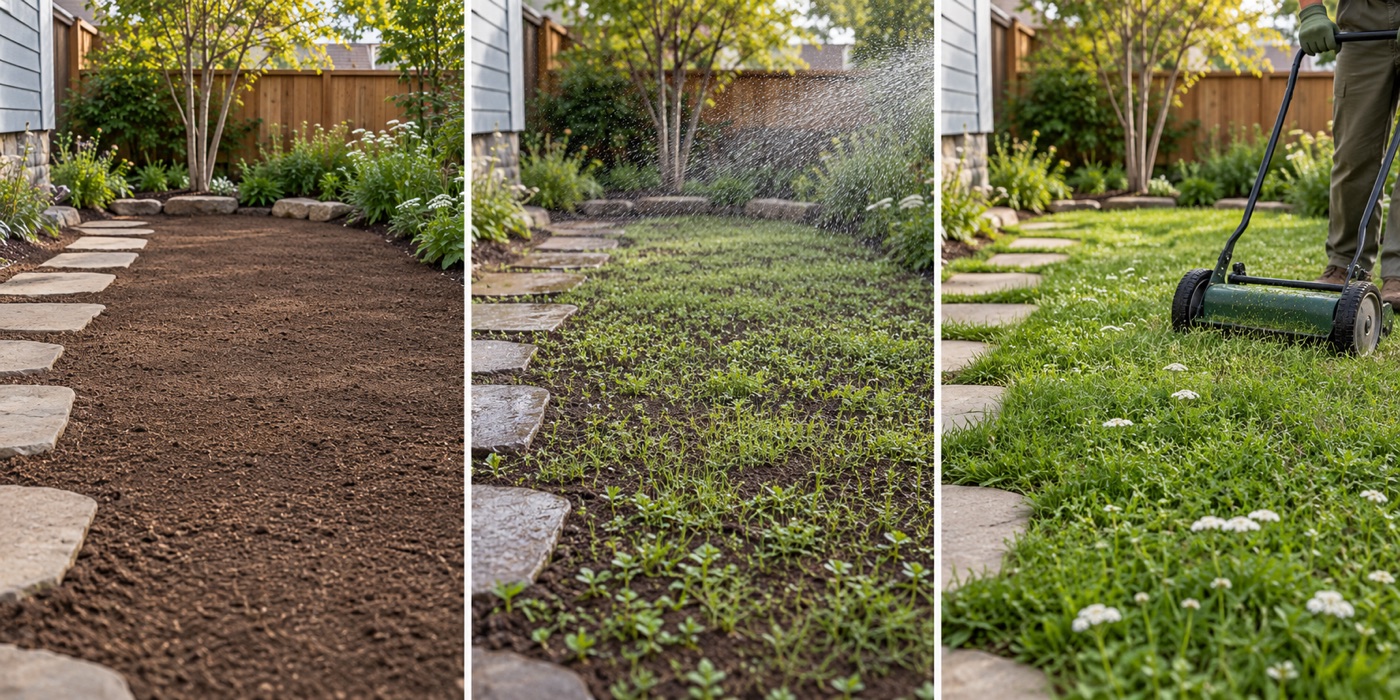
5. Keep the seedbed moist—not saturated
Established yarrow may be drought tolerant; germinating seed is not. Use light applications often enough to prevent the surface from drying during germination, then reduce frequency as roots develop. Stop if water puddles or runs off. A seasonal watering schedule by climate explains why controller minutes must be adjusted to soil and application rate.
6. Delay traffic and mow only after anchoring
Keep people and pets off the seedbed. Begin mowing when plants are rooted strongly enough not to pull from moist soil. Use a sharp blade and remove no more foliage than the young stand can replace. The first-year goal is establishment, not forcing an instant putting-green appearance.
Watering and mowing after establishment
Replace the turf schedule with observation
Reduce irrigation gradually after establishment. Check several inches into the soil rather than watering because the old turf program says so. Wilting, thinning and dry soil can signal a need for water; softness, persistent dampness and disease can signal too much. Heat reflected from pavement and shallow soil can make one edge need different management from the center.
Mow for the result you want
For a lawn-like ecolawn in western Oregon, OSU describes mowing 1–2 times per month at about 2.5–3 inches. A pure yarrow stand, another climate or a flowering design may need a different approach. Shorter and more frequent cutting favors a low surface but removes blooms; less frequent cutting produces taller stems and more pollinator activity.
Never mow wet foliage if contact sensitivity is a concern. Wear protective clothing and clean equipment after cutting. Mow before seed matures when containment matters, and use a separate unmown strip if flowers are desired.
Avoid unnecessary fertilizer
Yarrow tolerates lean soil. High nitrogen can increase mowing, favor grasses in a mix and encourage soft growth. Follow a soil-test recommendation rather than treating the area like a high-input turf lawn. If the mix contains clover, its nitrogen contribution further changes the fertilizer decision.
Cost and maintenance tradeoffs
There is no useful national “cost per square foot” without a defined project. Seed price is only one component. Compare:
- turf removal or suppression;
- soil testing and drainage correction;
- seed, plugs or a branded ecolawn mixture;
- temporary establishment irrigation;
- path and edging installation;
- weeding during establishment;
- mowing and edge containment;
- repair after pets, traffic or winter damage; and
- long-term water and fertilizer reductions.
A yarrow-dominant lawn can reduce irrigation and mowing after establishment, but it trades some conventional-lawn work for monitoring spread and managing mixed texture. Start with a defined test panel. One full year reveals summer color, winter appearance, flowering, traffic response and whether the plant respects the chosen boundaries.
Common yarrow-lawn claims checked
| Claim | More accurate expectation |
|---|---|
| “A yarrow lawn never needs water.” | Seedlings require regular moisture. Established demand varies with climate, soil and desired summer color. |
| “It handles the same traffic as turf.” | Use it for light, dispersed walking; provide paths or durable turf for repeated activity. |
| “It is maintenance-free.” | Mowing may decline, but edging, spread control, early weeding and occasional repair remain. |
| “It will flower and stay lawn-short.” | Flowering stems are taller. Regular mowing removes most flowers. |
| “All common yarrow seed is locally native.” | Seed origin, lineage and cultivar matter. Verify provenance if habitat value is a goal. |
| “It is automatically safe for pets and children.” | Extension sources identify ingestion and contact concerns. Plan exposure conservatively. |
| “More irrigation makes it denser.” | Persistent wetness can promote root and foliar problems. Correct site limitations instead. |
Who should choose a yarrow lawn?
Choose a small yarrow-dominant area when the site is sunny and well drained, traffic is light, a natural texture is welcome, spread can be contained and the household has no relevant exposure concern.
Choose a grass-yarrow ecolawn when you want a recognizable lawn surface with lower-input potential and regional evidence supports the mixture. Confirm species, seed proportions and irrigation guidance for your climate.
Choose another surface for a dog run, daily walkway, sports space, wet depression, deep shade or formal border where rhizomes cannot be tolerated. A creeping thyme lawn has different strengths but also requires sun, drainage and low traffic; neither plant fixes a site whose function and conditions have not been diagnosed.
Frequently asked questions
Is yarrow good for a low-water lawn?
It can be. Established common yarrow is drought tolerant and has helped mixed ecolawns remain green during dry summers in Oregon research and Extension demonstrations. Results elsewhere depend on heat, humidity, soil depth, rainfall and the amount of irrigation needed to meet appearance expectations.
How often should a yarrow lawn be mown?
There is no universal interval. Oregon State describes 1–2 monthly cuts at 2.5–3 inches for a grass, clover and yarrow ecolawn in western Oregon. Mow according to growth and intended height, avoid removing excessive foliage, and remember that mowing suppresses flowers.
Can children play on a yarrow lawn?
Occasional walking is different from repeated play. For frequent running, sliding or ball games, use durable turf or another designed play surface. Also consider the rare skin-sensitivity warning for contact with freshly cut, wet yarrow and grass.
Will yarrow take over flower beds?
It can move by rhizomes and seed. A hard edge, mown buffer, flower removal before seed set and regular inspection reduce escape. Do not install it next to a delicate border unless you are willing to remove runners.
Can yarrow grow in shade?
Common yarrow can tolerate some partial sun, but a dense lawn-like surface is more reliable in full sun. Deep shade usually calls for a regional sedge or woodland groundcover rather than more irrigation.
Is a yarrow lawn good for pollinators?
The flowers attract bees, butterflies and beneficial insects, but a frequently mown lawn produces few flowers. Leave contained edges or islands unmown and place them away from barefoot play or areas used by someone with a serious sting allergy.
Should I sow pure yarrow or an ecolawn mix?
A mix is generally more forgiving for a first lawn conversion because compatible grasses maintain turf structure while yarrow contributes drought persistence. Pure yarrow is better reserved for a small, controlled trial where its texture and spread are acceptable.
Editorial note: This general U.S. guide was reviewed on October 23, 2026 using Oregon State University’s ecolawn guidance, its Practical Lawn Care for Western Oregon and common-yarrow plant profile; the North Carolina Extension Gardener Plant Toolbox; the USDA-NRCS Common Yarrow Plant Guide; UC Integrated Pest Management; and UC ANR’s plant-safety guidance. Seed origin, invasive status, watering restrictions and planting dates vary locally. Confirm the exact material and plan with Cooperative Extension, a native-plant program, the water utility and a veterinarian when pets may ingest plants.