
A seasonal watering schedule should change with local weather, rainfall, plant type, soil, and the measured output of each irrigation zone. There is no reliable nationwide calendar that says every U.S. yard should run a certain number of days or minutes per week. The useful approach is to build a measured summer baseline, reduce it as demand falls, pause for effective rain, and check the soil before making another adjustment.
The U.S. Environmental Protection Agency (EPA) recommends watering only when plants need it, adjusting schedules with the seasons, and following local watering restrictions. Use the climate patterns below as starting logic, not as permission to ignore drought rules, freeze conditions, or guidance from your local utility and Cooperative Extension office.
The short answer
| Step | What to do | Why it matters |
|---|---|---|
| 1. Check local rules | Confirm permitted days, hours, drought stages, and seasonal shutoffs | Local requirements override any general guide |
| 2. Separate hydrozones | Schedule turf, shrubs, trees, drip beds, and containers independently | Different plants and devices need different amounts and runtimes |
| 3. Measure output | Catch-test sprinklers and inventory drip-emitter flow | Controller minutes alone do not tell you how much water is applied |
| 4. Establish a baseline | Find a runtime that wets the active root zone without runoff | This becomes the 100% reference for peak demand |
| 5. Adjust seasonally | Reduce or increase the baseline as weather and plant demand change | A fixed summer program commonly wastes water in spring and fall |
| 6. Credit rainfall | Skip or reduce irrigation after useful rain | Natural precipitation has already supplied part of the need |
| 7. Verify in the soil | Probe several representative locations after watering and before the next event | Soil moisture and plant response reveal whether the schedule works |
For most established landscapes, deeper, less frequent irrigation is a better starting principle than frequent shallow watering. Exceptions include new seed, new sod, recent transplants, containers, very shallow soil, and certain vegetables. Those need separate establishment or crop-specific schedules.
What changes from season to season?
Plant water use rises and falls mainly with solar radiation, temperature, wind, humidity, growth stage, and day length. Rainfall then supplies some, or occasionally all, of that demand. Evapotranspiration, usually abbreviated ET, combines evaporation from soil and surfaces with water released by plants. Weather-based controllers use ET-related data to adjust irrigation, while soil-moisture controllers respond to conditions in the root zone. Our comparison of weather-based and soil-moisture irrigation controllers explains the difference.
The landscape also changes. Cool-season turf may actively grow in spring and fall but struggle or go dormant during summer heat. Warm-season turf usually peaks in summer and slows or turns dormant after temperatures fall. Deciduous plants lose leaves, vegetables complete their season, and newly planted trees need different attention from established trees. A controller does not know all of this unless zones and settings accurately describe the site.
Soil controls how quickly water enters and how much is stored. Sandy soil accepts water quickly but often holds less. Fine-textured or compacted soil may store more yet accept it slowly, causing runoff during a long cycle. On slopes or slow-infiltration soil, use cycle-and-soak irrigation rather than increasing the total just because water runs away.
Build your seasonal watering schedule in seven steps
1. Start with local rules and a local reference
Search your city or water utility website for watering days, prohibited hours, drought stages, rain-sensor requirements, and winter shutoff guidance. Then look for your state Cooperative Extension service. These local sources know the region’s rainfall pattern, turf species, soils, and typical growing season better than a national chart.
Rules often define a maximum, not a target. If two days per week are allowed, that does not mean two days are always needed. Water only when the landscape and soil indicate a need.
2. Map zones by plant and equipment
List every controller station and note what it serves: cool-season turf, warm-season turf, shrub beds, mature trees, vegetables, containers, or new plantings. Also record the irrigation method. Spray heads, rotors, rotary nozzles, and drip emitters have very different application rates and should not share a schedule simply because they appear in the same yard.
If a zone mixes turf and shrubs or combines drip and spray, scheduling will always be a compromise. Our guide to drip irrigation versus spray sprinklers explains why those devices normally belong on separate valves.
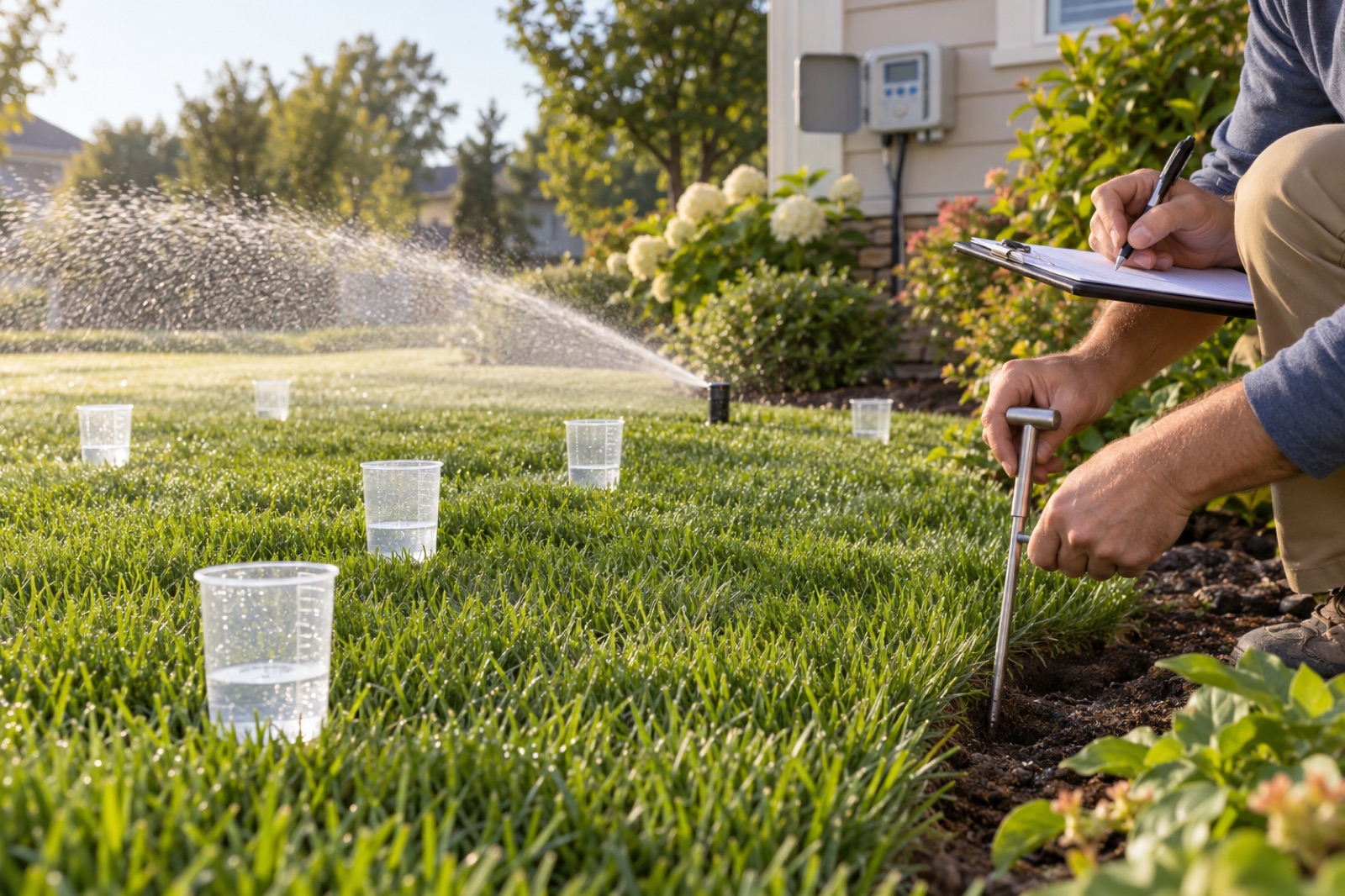
3. Measure sprinkler output
Place identical straight-sided catch cups across a sprinkler zone, run it for a measured period, and average the collected depth. Before using the result, fix broken, blocked, tilted, or mismatched heads. A zone-by-zone sprinkler audit prevents a bad distribution pattern from being hidden behind a longer runtime.
Calculate the precipitation rate:
precipitation rate (inches/hour) = average catch depth / test minutes x 60
If the cups average 0.25 inch after 15 minutes, the zone applies approximately 1 inch per hour under those test conditions. To apply 0.50 inch, the theoretical total runtime is 30 minutes:
runtime (minutes) = target depth / precipitation rate x 60
That is a starting calculation, not proof that every part of the lawn receives the same depth. Compare individual cups and correct poor coverage. Split the 30 minutes into shorter cycles if runoff begins before the soil can absorb the total.
4. Measure drip by flow and wetting pattern
For drip zones, record emitter flow in gallons per hour, emitter count, spacing, and the plants served. Two 1-gallon-per-hour emitters deliver a nominal 2 gallons during a one-hour run if pressure is correct and neither emitter is clogged. But gallons alone are not enough: probe the soil to confirm the wetted area reaches a useful portion of the roots rather than forming one narrow, overly deep column.
5. Establish the peak-demand baseline
Use local guidance to choose an initial target, apply it with the measured zone rate, and inspect the soil. The target should wet the active root zone without prolonged saturation or runoff. Do not force every zone to match a broad rule such as “one inch per week.” EPA notes that a typical landscape may need about an inch per week including rainfall, but actual need varies substantially by climate, plant, soil, exposure, and season.
Record the successful runtime as the zone’s 100% or peak-season baseline. For example, if a turf zone needs 30 total minutes during a representative hot, dry period, 30 minutes becomes its 100% reference, not a permanent weekly promise.
6. Use seasonal adjustment instead of rebuilding every start time
Many controllers have a seasonal-adjustment or water-budget percentage. It multiplies the programmed runtime while preserving the zone structure:
| Baseline runtime | Seasonal adjustment | Adjusted total |
|---|---|---|
| 30 minutes | 100% | 30 minutes |
| 30 minutes | 80% | 24 minutes |
| 30 minutes | 60% | 18 minutes |
| 30 minutes | 35% | 10.5 minutes |
| 30 minutes | 0% | Off |
Change percentages gradually and verify results. A smart controller can automate some adjustment, but only if zone type, soil, slope, nozzle rate, sun exposure, and allowed watering windows are entered correctly. A WaterSense-labeled controller has met EPA performance criteria; the label does not fix incorrect site data or damaged equipment.
7. Credit rain and verify before the next cycle
Rainfall is not automatically useful irrigation. A brief storm may wet only the surface, while an intense storm may run off compacted soil. After rain, check several locations and depths. Pause the controller when the root zone has received enough water, and resume only as it begins to dry to an appropriate level for the plants.
Seasonal patterns by U.S. climate
The following table describes broad patterns. Mountain elevation, coastal influence, rain shadows, hurricanes, monsoons, snow cover, soil depth, and local species can change the answer within the same state.
| Broad climate pattern | Typical scheduling logic | Major cautions |
|---|---|---|
| Hot-arid and desert Southwest | Demand can be high in hot dry periods; use separate drip hydrozones, expand tree wetting areas, and respond to monsoon rain | Do not copy turf runtimes to desert-adapted plants; inspect for salt buildup, heat stress, leaks, and local drought rules |
| Summer-dry Mediterranean West | Increase toward the dry summer peak, then reduce as temperatures and day length fall; pause for meaningful winter rain | Fire-season rules, water restrictions, sloped sites, and regional plant palettes require local guidance |
| Humid subtropical and Southeast | Use rainfall and soil condition to skip events; summer irrigation may be intermittent despite heat because rainfall is frequent | Sandy soil can dry quickly, but humidity and storms increase disease and overwatering risk; tropical systems alter weekly patterns |
| Humid continental and cold-winter regions | Increase through active spring growth and summer demand, reduce in fall, then shut down and winterize where freezing requires it | Cool-season turf may need support in hot droughts; do not run irrigation on frozen soil or over dormant landscapes without local reason |
| Cool maritime and high-elevation areas | Start later, monitor rainfall and short growing seasons, and use conservative adjustments | Wind, shallow mountain soils, frost dates, and rapid weather changes can make regional averages misleading |

Hot-arid yards
In the desert Southwest, high summer ET does not mean every plant needs daily water. Group plants by need, use drip for spaced trees and shrubs, and allow established drought-adapted plants to dry appropriately between irrigations. The University of Arizona watering guide shows why frequency changes by plant type and season. Increase the wetted area as trees mature instead of keeping one emitter beside the trunk.
Summer-dry western yards
Much of coastal and interior California has cool-season rain and dry summers. The seasonal curve may rise toward midsummer even when the lawn or plants look green in spring. University of California guidance recommends adjusting monthly or at least seasonally. Local ET reports, utility tools, and controller data are more useful than copying another city’s monthly percentages.
Humid and subtropical yards
Heat does not always equal an irrigation requirement. In Florida and other humid regions, rainfall can supply much of the summer need and local restrictions often limit watering days. University of Florida IFAS recommends responding to visible turf stress and rainfall rather than irrigating by habit. Sandy soil may require careful timing because it stores less water, while frequent leaf wetness and saturated soil can increase disease and root problems.
Cold-winter yards
In northern climates, irrigation demand usually falls as temperatures and day length decline. Established turf and landscape zones may be shut off for winter, and freezing systems often require correct winterization. Do not assume that blowing out a system is a universal do-it-yourself task: incorrect pressure can damage equipment or cause injury. Follow the manufacturer, local utility, and qualified irrigation professional guidance.
A practical four-season playbook
| Season | Controller action | Field check |
|---|---|---|
| Spring | Start below the summer baseline; enable rain or soil sensors; update plant and nozzle settings | Inspect every zone, repair freeze damage, check coverage, and probe soil before adding days |
| Summer | Increase only as demand rises; obey drought rules; water during permitted low-wind hours | Watch for runoff, clogged emitters, uneven turf, heat stress, and irrigation during rain |
| Fall | Reduce the seasonal percentage as nights cool and days shorten | Confirm roots are moist but not saturated; distinguish seasonal dormancy from drought |
| Winter | Pause or shut down where plants are dormant or soil freezes; use local guidance in warm climates | Protect exposed components, inspect after freezes, and avoid watering frozen or saturated soil |
Schedule different landscape zones differently
| Zone | Scheduling priority | Common mistake |
|---|---|---|
| Established turf | Measured depth, uniform coverage, deep roots, and stress-based timing | Short daily cycles that keep only the surface wet |
| Established shrubs and perennials | Group similar species; wet a broad root area; extend intervals when appropriate | Using the turf program or leaving emitters against stems |
| Mature trees | Water across the active root area, generally beyond the trunk zone | One emitter at the trunk or relying only on shallow lawn watering |
| New plantings | Use an establishment schedule, then taper as roots expand | Leaving the frequent establishment program on permanently |
| Vegetables | Adjust for crop stage, rooting depth, heat, mulch, and harvest period | Treating every crop and season identically |
| Containers | Check frequently; group by pot size, material, sun, and plant need | Connecting unlike pots to equal-flow emitters without observation |
Signs that the schedule is too wet
- Water runs into streets, gutters, or downhill beds.
- Soil remains saturated long after irrigation or has a sour odor.
- Turf feels spongy or develops persistent mushrooms, algae, or disease.
- Plants yellow or wilt even though the root zone is wet.
- Weeds that prefer wet conditions expand.
- The system operates during or shortly after substantial rain.
Wilting is not always drought. Roots in saturated soil can lack oxygen and produce similar symptoms. Check below the surface before adding runtime.
Signs that the schedule may be too dry
- Turf footprints remain visible and blades fold or develop a dull blue-gray cast.
- Soil is dry at the active root depth before the next planned irrigation.
- Leaves lose turgor during the cooler morning period, not only during temporary afternoon heat.
- Only plants at the end of a drip line decline, suggesting a hydraulic or clogging problem.
- Catch cups reveal dry areas even though the average depth appears adequate.
First distinguish a scheduling problem from a distribution problem. A longer runtime will overwater the rest of a zone if one head is blocked or one emitter is clogged.
Monthly controller and yard checklist
- Review current local restrictions and recent rainfall.
- Run each zone manually while you watch it.
- Repair leaks, broken heads, clogged nozzles, and displaced emitters.
- Check that water stays on plants and soil, not pavement or structures.
- Probe representative sunny, shaded, high, low, sandy, and compacted areas.
- Compare plant condition with actual root-zone moisture.
- Adjust seasonal percentage or zone runtime gradually.
- Confirm rain, freeze, or soil sensors are enabled and unobstructed.
- Record the change, date, weather, and result.
A simple log prevents random adjustments. If the yard responds well after a 20% reduction, that observation becomes a useful local reference for the same season next year.
Frequently asked questions
How many days per week should I water?
There is no valid nationwide number. Established landscapes often benefit from fewer, deeper events, but the correct frequency depends on climate, rainfall, soil storage, root depth, plant type, irrigation method, and local rules. Water based on need, not merely because a day is permitted.
Is one inch of water per week always correct?
No. It is a broad reference sometimes used for actively growing turf and includes rainfall. It can be too much, too little, or irrelevant for a particular climate, season, plant, or drip zone. Use local guidance and verify soil moisture.
What time of day is best?
Early morning is generally preferred because wind and evaporation are often lower and foliage has time to dry. Always follow local permitted hours. Avoid routine midday watering and do not irrigate when wind carries water off target.
Should I turn the system off after rain?
Pause it when rain has supplied useful moisture to the root zone. A functioning rain shutoff or smart controller can help, but inspect the soil because rainfall amount and infiltration vary across a property.
How often should I change seasonal adjustment?
Review it at least when seasons change and more often during rapid weather transitions. Monthly adjustment is useful where local ET or utility recommendations are available. Inspect the landscape after every meaningful change.
Can I use the same percentage for every zone?
Only when the zones have comparable plants, exposure, soil, and irrigation equipment. Turf, trees, containers, new plants, and drip beds normally require independent logic. Apply zone-specific adjustments when the controller supports them.
Do smart controllers eliminate manual checks?
No. They can improve scheduling, but leaks, blocked heads, incorrect plant data, bad flow rates, failed sensors, and changed landscapes still require inspection. Smart scheduling cannot compensate for poor irrigation design.
Editorial note: This general guide for U.S. homeowners was reviewed on October 2, 2026 against resources from EPA WaterSense, Colorado State University Extension, University of Minnesota Extension, University of Florida IFAS, and University of California IPM. Local restrictions, plant species, weather, soil, freezing conditions, and irrigation equipment vary. Follow current local requirements and obtain qualified help for regulated plumbing, electrical work, unsafe slopes, or complex system design.