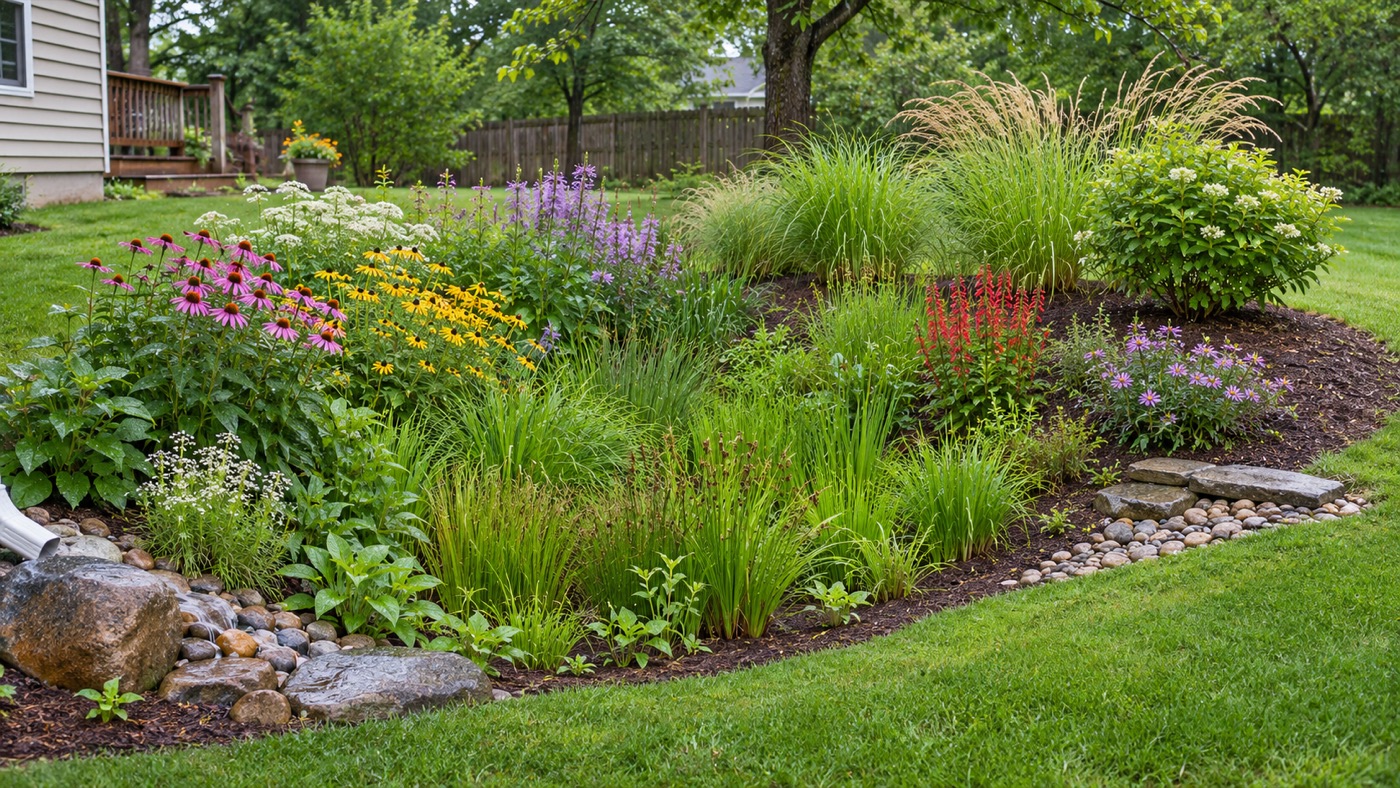
The best rain garden plants are not simply the species that tolerate wet soil. They must survive two opposite conditions: short periods of inundation after a storm and dry soil between storms. They also need to fit the garden’s bottom, side slope or upper berm—and be native or well adapted to your specific part of the United States.
This guide provides 37 regional starting points. Treat each plant as a candidate, not an automatic recommendation. Confirm its native range at the county or ecoregion level, sunlight needs, mature size, soil preference and local availability before buying it.
What makes a plant suitable for a rain garden?
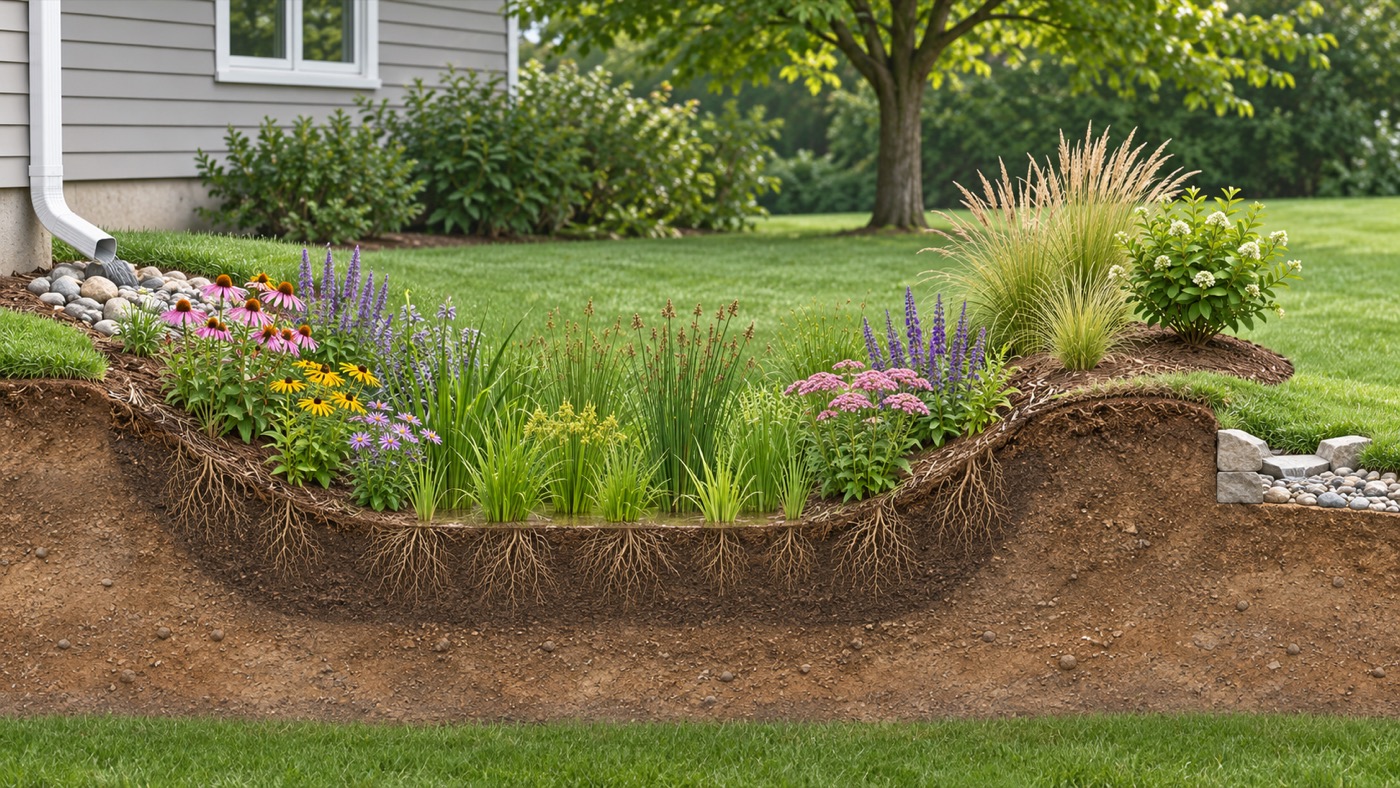
The best rain garden plants must tolerate the basin’s hydrologic cycle. A rain garden is not a pond or permanent wetland. A properly designed residential basin temporarily stores runoff and then drains. Therefore, plants in the lowest zone may experience saturated soil after a storm but drought days later. University and municipal guides commonly divide the planting area into three moisture zones.
| Planting zone | Typical moisture pattern | Useful plant traits | Common mistake |
|---|---|---|---|
| Bottom | Floods first and drains last; usually dry between storms | Tolerates brief inundation, moving water and later dry periods; fibrous or clumping roots | Choosing a bog plant that needs permanently wet soil |
| Side slope | Moist during larger storms but drains sooner | Handles alternating moist and moderately dry soil; stabilizes the slope | Planting only showy flowers and leaving soil exposed |
| Upper berm | Usually the driest zone; may receive splash or occasional overflow | Drought tolerance, dense cover and roots that hold the berm | Putting moisture-loving plants above the normal water line |
However, zone labels do not replace site testing. Before choosing plants, check the basin’s drawdown, the native soil and the planned ponding depth. Our guides explain how to size a rain garden and how to select a rain garden soil mix without assuming that imported material fixes every site.
Best rain garden plants by U.S. region
The regions below are deliberately broad. A plant native to coastal South Carolina may not belong in an Appalachian county, and a Pacific Northwest species may fit the Willamette Valley but not an inland high-desert site. Use the examples to build a shortlist, then narrow it with a county Extension office, conservation district, native-plant society or local stormwater manual.
1. Northeast and Mid-Atlantic
Rain gardens in this region often need to tolerate cold winters, humid summers and strong seasonal variation. Penn State Extension organizes its plant guidance by wet/moist, moist, moist/dry and dry zones—an approach that is more useful than treating the entire basin as one habitat.
| Plant | Scientific name | Best starting zone | Why consider it |
|---|---|---|---|
| Tussock sedge | Carex stricta | Bottom | Dense clumps slow water and protect soil; confirm space and local range. |
| Northern blue flag | Iris versicolor | Bottom / lower slope | Handles moist soils and seasonal inundation in much of the Northeast. |
| Cardinal flower | Lobelia cardinalis | Lower slope | Provides vivid late-season color and supports hummingbirds; dislikes a chronically dry placement. |
| Foxglove beardtongue | Penstemon digitalis | Middle / upper slope | Adaptable white-flowered perennial for moist-to-dry transitions. |
| Butterfly weed | Asclepias tuberosa | Upper berm | Prefers the drier edge and supports specialist insects; do not put it in the flooded bottom. |
For shady sites, avoid transferring a full-sun list unchanged. Moist woodland-edge plants may fit, but the basin must still drain. Penn State’s regional list includes separate moisture categories and should be cross-checked against the plant’s light requirements.
2. Southeast and Gulf Coast
The Southeast includes Piedmont clay, Appalachian slopes, sandy Coastal Plain soils and subtropical areas. Clemson Extension recommends plants that tolerate both dry and wet conditions and encourages a mix of grasses, perennials and woody plants for season-long structure.
| Plant | Scientific name | Best starting zone | Regional caution |
|---|---|---|---|
| Virginia iris | Iris virginica | Bottom / lower slope | Especially relevant to appropriate southeastern wetland margins; verify the locally native iris. |
| Soft rush | Juncus effusus | Bottom | Strong structural plant for periodic inundation; native status and variety should be checked locally. |
| Swamp sunflower | Helianthus angustifolius | Lower / middle slope | Late flowers and tall growth; allow enough room and avoid small sight-line areas. |
| River oats | Chasmanthium latifolium | Side slope, part shade | Useful beneath open tree canopies; can self-sow where conditions suit it. |
| Pink muhly | Muhlenbergia capillaris | Upper slope / berm | Provides fine texture and fall color; place above the wettest zone. |
| American beautyberry | Callicarpa americana | Berm / outer edge | Wildlife-friendly shrub that needs mature-size clearance. |
Salt exposure changes the palette near tidal or coastal roads. A species described as southeastern is not automatically salt tolerant. Use a coastal Extension list and confirm whether runoff carries deicing salt, brackish spray or vehicle pollutants.
3. Midwest and Great Lakes
Cold winters, wet springs and summer dry periods favor plants with broad moisture tolerance. Minnesota Extension notes that rain-garden plants should tolerate standing water for up to 48 hours, while Iowa and Great Lakes guidance emphasizes deep-rooted native sedges and prairie species.
| Plant | Scientific name | Best starting zone | Why consider it |
|---|---|---|---|
| Swamp milkweed | Asclepias incarnata | Bottom / lower slope | Tolerates moist soil and supports monarchs; not a substitute for locally sourced habitat planting. |
| Great blue lobelia | Lobelia siphilitica | Lower slope | Late blue flowers for moist sun or partial shade. |
| Palm sedge | Carex muskingumensis | Lower / middle slope | Architectural sedge that works well in moist transitions and partial shade. |
| Sneezeweed | Helenium autumnale | Middle slope | Late-season flowers; select a placement that does not stay permanently flooded. |
| New England aster | Symphyotrichum novae-angliae | Middle / upper slope | Important fall bloom; can become tall and benefits from thoughtful spacing. |
| Little bluestem | Schizachyrium scoparium | Upper berm | Deep-rooted dry-edge grass; performs poorly in a repeatedly saturated bottom. |
If road runoff enters the basin, choose salt-tolerant plants from a local municipal list. Also check whether a species spreads aggressively in garden conditions even when it is native to the wider region.
4. Central and Southern Great Plains
Plains rain gardens must handle heat, wind, drought and episodic intense storms. K-State Research and Extension recommends native sedges, irises, milkweeds, blue stars, lobelias and mallows according to sun and moisture. A dense matrix is more resilient than isolated specimen plants separated by bare mulch.
| Plant | Scientific name | Best starting zone | Design note |
|---|---|---|---|
| Fox sedge | Carex vulpinoidea | Bottom / lower slope | Fibrous clumps help slow inflow; verify local nativity and expected height. |
| Halberdleaf rosemallow | Hibiscus laevis | Bottom / lower slope | Large flowers and stature suit roomy sunny gardens. |
| Shining bluestar | Amsonia illustris | Middle slope | Adaptable regional perennial with durable foliage and spring flowers. |
| Sweet coneflower | Rudbeckia subtomentosa | Middle / upper slope | Handles moist prairie conditions and adds late-season bloom. |
| Switchgrass | Panicum virgatum | Upper slope / berm | Strong roots and winter structure; use a locally suitable selection and allow for mature size. |
In the drier western Plains, a basin designed for passive rainwater harvesting may need a different palette from an eastern Kansas bioretention bed. Verify both the plant’s native range and the amount of supplemental establishment water available.
5. Pacific Northwest
West of the Cascades, plants may experience wet winters followed by dry summers. Portland-area stormwater guidance separates the bottom, slope and top and lists plants proven in local facilities. Inland and high-desert parts of Oregon and Washington require different choices.
| Plant | Scientific name | Best starting zone | Regional caution |
|---|---|---|---|
| Spreading rush | Juncus patens | Bottom | Useful in western rain gardens; obtain the correct species from a reputable nursery. |
| Slough sedge | Carex obnupta | Bottom | Robust wet-zone sedge that can outgrow a small basin. |
| Tufted hairgrass | Deschampsia cespitosa | Bottom / lower slope | Check local provenance and summer moisture needs. |
| Coastal strawberry | Fragaria chiloensis | Slope / top | Low groundcover primarily suited to appropriate coastal settings. |
| Pacific ninebark | Physocarpus capitatus | Slope / berm | Large native shrub for spacious facilities, not a narrow foundation bed. |
Do not transfer this list east of the Cascades without checking local guidance. Frost, summer heat, rainfall and native distributions change rapidly across the region.
6. Coastal and Mediterranean California
California rain gardens often fill during cool wet months and remain dry through a long summer. UC Agriculture and Natural Resources therefore recommends bottom plants that tolerate winter flooding and summer dryness, with increasingly drought-tolerant plants toward the berm.
| Plant | Scientific name | Best starting zone | Design note |
|---|---|---|---|
| Creeping wildrye | Elymus triticoides | Bottom | Rhizomatous native grass for appropriate sites; allow room for spread. |
| Torrent sedge | Carex nudata | Bottom | Best matched to local riparian conditions and verified nursery stock. |
| Saltgrass | Distichlis spicata | Middle slope | Tolerates salt and periodic moisture but spreads strongly. |
| California fuchsia | Epilobium canum | Upper berm | Summer-dry hummingbird plant for the basin’s driest zone. |
| Common yarrow | Achillea millefolium | Upper berm | Use a locally appropriate native form and avoid placing it in prolonged saturation. |
California’s native ranges are especially local. A plant native somewhere in the state may still be ecologically inappropriate in your county. In addition, many California natives need irrigation during establishment even when they become drought tolerant later.
7. Arid Southwest and Intermountain West
In Arizona, New Mexico, Nevada, Utah and adjacent dry regions, the useful model is often a passive rainwater-harvesting basin rather than a continuously lush eastern rain garden. University of Arizona Extension notes that the principles can be combined, but the planting must accommodate intense runoff, long dry intervals and limited establishment water.
| Plant | Scientific name | Best starting zone | Local verification |
|---|---|---|---|
| Alkali sacaton | Sporobolus airoides | Bottom / inlet zone | Consider where locally native and where soil salinity and space suit it. |
| Deergrass | Muhlenbergia rigens | Bottom / lower slope | Useful in parts of the Southwest; verify native range, winter hardiness and mature width. |
| Torrey’s rush | Juncus torreyi | Bottom | Candidate for episodically moist sites where confirmed native; can spread. |
| Scarlet bugler | Penstemon barbatus | Upper slope | Dry-edge perennial for appropriate elevations and local populations. |
| Apache plume | Fallugia paradoxa | Upper berm | Drought-tolerant shrub; keep out of the repeatedly flooded bottom. |
This is the region where a national plant list is least useful. Elevation can matter as much as latitude. Confirm species with a local water-harvesting guide, Extension office or conservation district, and design overflow for cloudburst conditions.
How to verify a rain garden plant before buying it
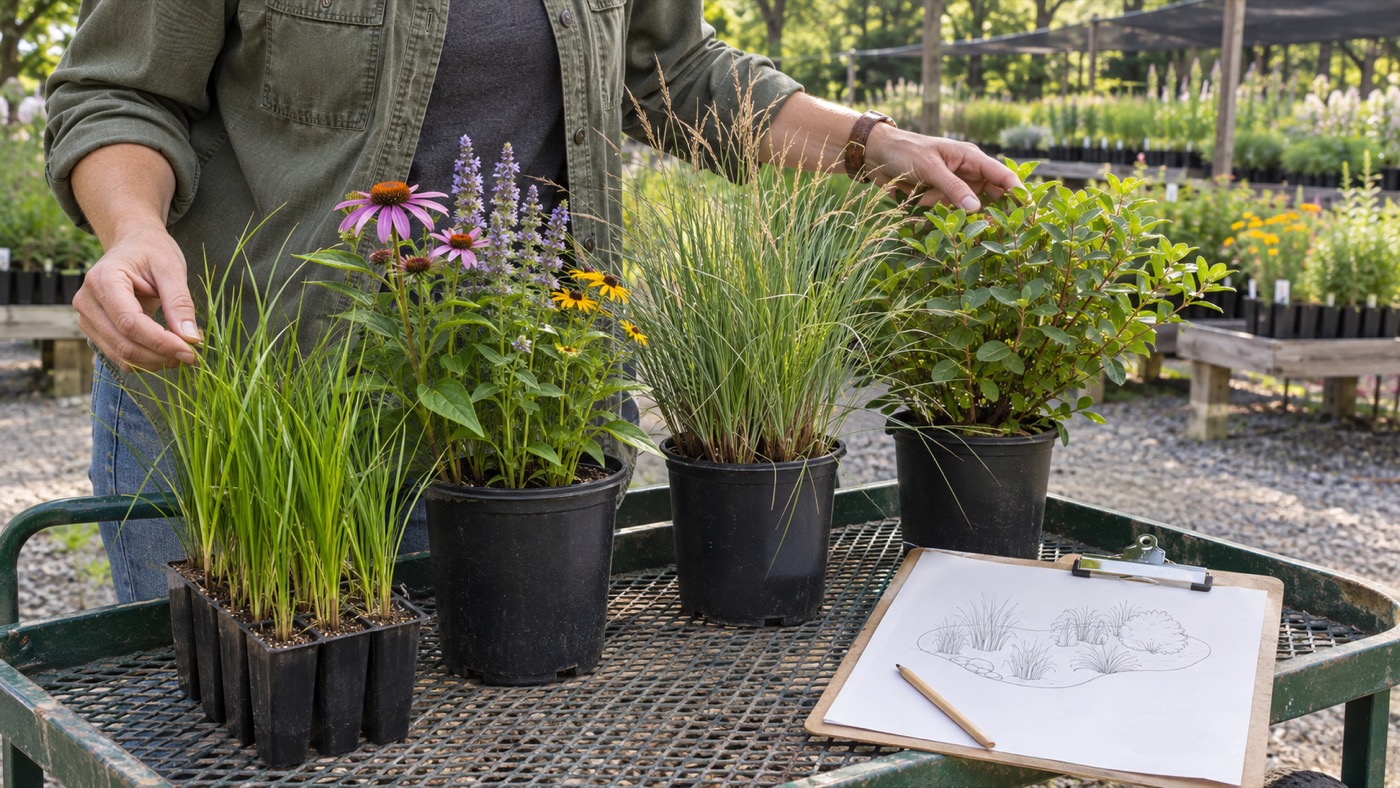
- Confirm the scientific name. Common names can refer to several plants. Check the genus, species and—where relevant—subspecies or variety.
- Check county-level native status. Use USDA PLANTS, a state flora, herbarium or local native-plant database. “Native to North America” is too broad.
- Match the moisture zone. Ask whether the plant tolerates short inundation, moist soil, ordinary garden soil or only a dry berm.
- Check sun and soil. Record daily sun, texture, pH, salinity and whether runoff carries road salt.
- Measure mature size. Keep tall plants away from driveways and sight lines. Give shrubs access for pruning and sediment removal.
- Reject invasive substitutes. A nursery’s “water plant” section may include invasive species or plants suited to ponds rather than rain gardens.
- Ask about source and genetics. Locally propagated straight species or regional seed sources may offer better ecological fit than distant stock.
Native species, cultivars and “nativars”
A named cultivar of a native species can be useful when compact size, disease resistance or predictable form is necessary. However, changes in flower shape, bloom time, leaf color or fertility may also change wildlife value. A highly double flower, for example, may provide less accessible pollen or nectar than the straight species.
Therefore, use straight species or local ecotypes when ecological restoration is the primary goal. Consider a cultivar when a documented landscape constraint requires it, and avoid assuming that every selection retains all the functions of the wild type.
How many plants does a rain garden need?
The best rain garden plants need enough room to mature, yet dense cover protects soil, competes with weeds and slows runoff. The exact number depends on each species’ mature spread, the size of the non-planted inlet and overflow, and whether you install plugs, quarts or larger containers.
For a simple first estimate, divide the plantable area by the square of the on-center spacing in feet:
Approximate plant count = plantable square feet ÷ (spacing in feet × spacing in feet)
| On-center spacing | Approximate plants per 100 plantable sq. ft. | Typical use |
|---|---|---|
| 12 inches | 100 | Small plugs or fast initial coverage |
| 15 inches | 64 | Mixed small-to-medium perennials |
| 18 inches | 44 | Many medium perennials and sedges |
| 24 inches | 25 | Large grasses or broad perennials |
This is a quantity estimate, not a spacing prescription. Follow mature spread and local design guidance. Shrubs should be counted separately, and spreading species may need wider spacing.
A resilient planting pattern
Instead of buying one of everything, repeat a limited number of compatible species in drifts. A practical small-garden palette might contain:
- one or two sedges or rushes repeated through the bottom;
- two to four flowering perennials for the lower and middle slopes;
- one bunchgrass or dry-zone perennial repeated on the upper edge;
- zero to two compact shrubs, only where their mature size fits; and
- flowers distributed across spring, summer and fall rather than concentrated in one month.
Maintain a clear inlet, overflow and inspection path. Plants should stabilize the system, not hide erosion, sediment buildup or blocked flow. Also check the constraints described in where not to put a rain garden before investing in plants.
Establishment and first-year watering
“Native” does not mean “needs no care.” Nursery plants have limited root systems and require regular watering until they establish. Plant during the region’s favorable season, water deeply enough to wet the root ball and reduce frequency gradually as roots expand.
In humid regions, the first growing season may be enough for many plugs, although drought can extend the schedule. In Mediterranean California and arid western regions, reliable supplemental water may be needed through one or two dry seasons. Follow local Extension advice and each plant’s response rather than a nationwide calendar.
Use coarse, non-floating organic mulch where local guidance recommends it, but keep the crown of each plant clear. Inspect after storms and replace plants that repeatedly fail with species thriving in the same moisture zone.
Best rain garden plants: FAQs
Can I plant the entire rain garden with one species?
A single sedge or rush can provide effective cover in a formal design, but diversity improves seasonal interest and reduces the risk that one pest, disease or weather event removes all vegetation. Use several compatible species unless a local engineered plan specifies otherwise.
Should cattails or other pond plants go in the bottom?
Usually not in a small residential rain garden. The basin should drain, and large wetland plants can spread aggressively or require persistent moisture. Choose plants recommended for temporary inundation rather than permanent standing water.
Are seeds cheaper than plugs?
Seed can reduce material cost on a large site, but establishment is slower and weed control, erosion protection and seed-source expertise become more important. Plugs provide faster, more predictable cover in a small homeowner garden. A combination can work when a regional specialist designs the mix.
Can I use non-native plants?
A non-invasive adapted plant may function hydraulically, but locally native plants usually provide stronger habitat connections. Never use a species prohibited or invasive in your state, and do not allow seeds or fragments to wash into natural waterways.
Will rain garden plants attract mosquitoes?
Plants do not create the mosquito problem; prolonged standing water does. A correctly sized and draining rain garden should empty before common mosquitoes complete their aquatic development. Investigate clogged inlets, compacted soil or an undersized overflow if water remains.
Do deer-resistant plants stay deer-proof?
No. Browsing changes with hunger, season and local deer pressure. Use several regionally appropriate species, protect young plants where necessary and treat “deer resistant” as a relative rating.
Sources and regional plant lists
- Penn State Extension: Rain Garden Plant Resources
- University of Minnesota Extension: Building a Rain Garden
- K-State Research and Extension: Native Plants for Rain Gardens
- Clemson Cooperative Extension: Rain Garden Manual
- Oregon State University Extension: Stormwater Facility Field Guide
- UC Agriculture and Natural Resources: Coastal California Rain Gardens
- University of Arizona Cooperative Extension: Rain Gardens in the Arid West
- USDA PLANTS Database
Last reviewed: November 14, 2026. This guide offers regional starting points, not a planting prescription for every state or county. Verify native status, invasiveness, hardiness, moisture tolerance, mature size, nursery source and any municipal stormwater requirements with local authorities and qualified regional specialists.