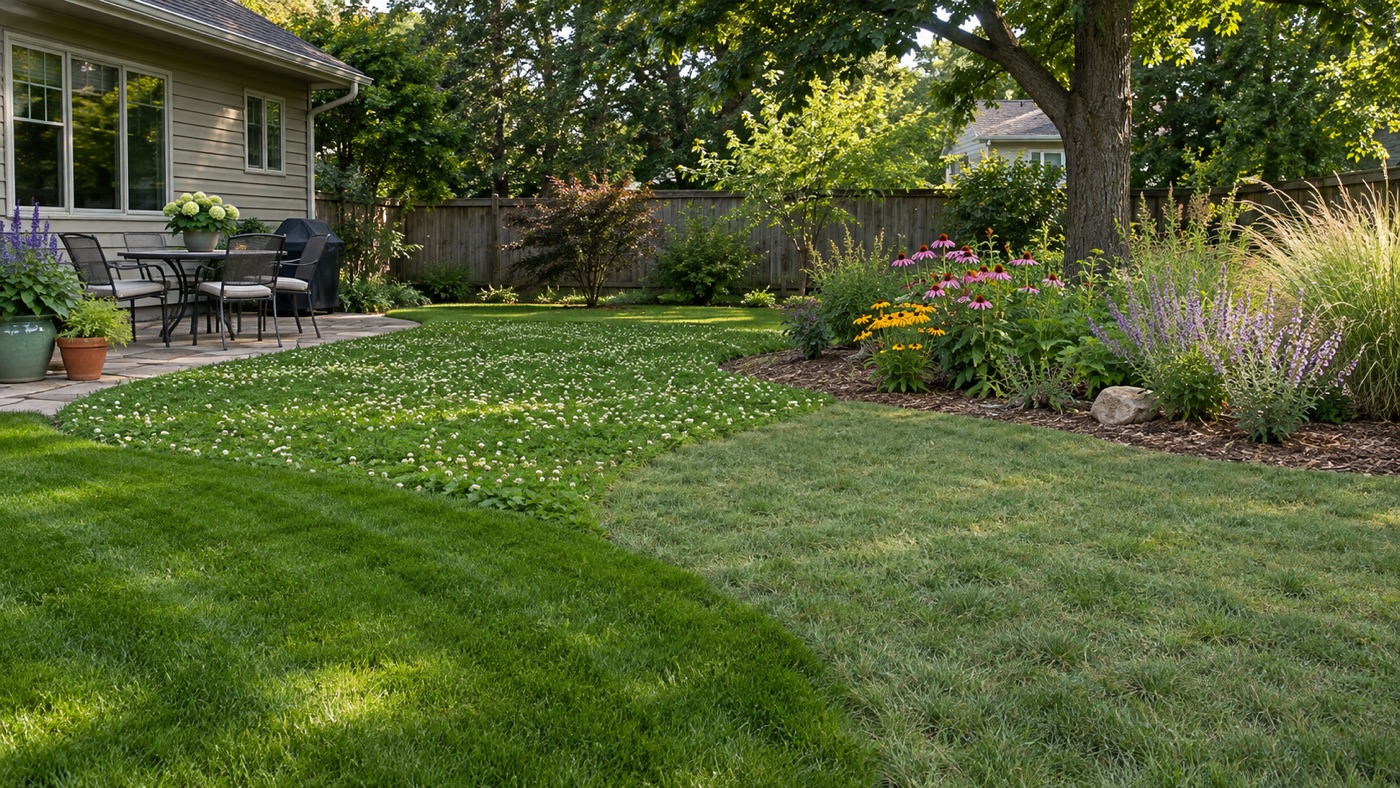
A lawn alternatives cost comparison can show a lower five-year total than conventional turf—but only when the replacement fits the site and the math includes labor, establishment water, repairs and conversion. For example, overseeding an existing lawn with clover may pay back quickly. Likewise, a seeded ecolawn or buffalograss can reduce recurring inputs in the right climate. However, a fully planted bed often costs more during the first five years because plants, mulch and installation arrive before the savings.
Therefore, this lawn alternatives cost comparison uses one transparent 1,000-square-foot example, then gives you the formula to replace every assumption with local prices. However, it does not present the example as a national quote. After all, water rates, labor, plant prices, rainfall, rebates and the condition of the existing lawn vary too much for one national dollar figure to be honest.
What belongs in a five-year lawn cost comparison
First, a fair comparison begins with the same area, the same starting condition and the same value for your time. Add costs that occur only once to those that repeat every year:
Five-year cost = removal and site preparation + planting material + installation + irrigation changes + establishment water + five years of routine water, labor and supplies + repairs − confirmed rebates.
Next, use after-tax prices and the actual tiers on your water bill. If you do the work yourself, labor is still a resource. Enter either zero dollars and track the hours separately, or assign an hourly value to compare DIY options consistently. If you will hire the work, use written local quotes instead.
| Cost bucket | What to include | Often missed |
|---|---|---|
| Removal and preparation | Sod cutting, sheet mulch, grading, soil test, disposal and weed follow-up | Equipment delivery, dump fees and a second pass for regrowth |
| Planting | Seed, plugs, sod, plants, mulch and erosion protection | Extra material for patching and losses |
| Irrigation | Moved or capped heads, drip conversion, controller changes and repairs | Pressure regulation, filters and professional backflow work |
| Water | Establishment plus mature irrigation, priced at the correct utility tier | Sewer charges may not apply equally to irrigation water |
| Labor | Mowing, edging, weeding, pruning, fertilizing, irrigation checks and repairs | Travel, cleanup, blade sharpening and seasonal start-up |
| Supplies | Fertilizer, seed, mulch top-ups, mower energy or fuel and replacement emitters | Annual overseeding and plant replacement |
Finally, do not subtract a rebate until the utility has confirmed that the address, materials, inspection sequence and project date qualify. Some programs require approval before turf is removed.
Lawn alternatives cost comparison at a glance
| Option | Upfront cost | Recurring water | Recurring labor | Best financial fit |
|---|---|---|---|---|
| Keep serviceable turf | Low | Moderate to high; climate and quality target matter | Frequent mowing; fertilizer and repair vary | A useful play or traffic area that already performs well |
| Clover-turf overseed | Low | Potentially lower, but not zero | Still mowed; fewer nitrogen inputs may be possible | An existing cool-season lawn where white clover is appropriate |
| Ecolawn or bee-lawn mix | Low to moderate | Lower after establishment in a proven region | Less frequent mowing; seasonal weed work | A lawn-like surface with lighter traffic and tolerance for flowers |
| Seeded buffalograss | Moderate | Low to moderate once established | Infrequent mowing and fertilizer | Sunny Great Plains or nearby sites that accept winter dormancy |
| Planted groundcover or native bed | High | Can be low once established and correctly hydrozoned | No mowing, but weeding, pruning and mulch remain | Unused slopes, edges and beds—not concentrated play |
However, these are directional ratings, not price promises. University of Maryland Extension notes that garden maintenance can take about as much time as lawn care, even though the tasks differ. A no-mow planting is not a no-maintenance planting.
A worked lawn alternatives cost comparison for 1,000 square feet
The table below is a calculation example, not a national cost estimate. Specifically, it assumes a 1,000-square-foot yard, DIY installation, no new mower or major irrigation system, water priced at $7 per 1,000 gallons and homeowner time valued at $20 per hour. Here, “water” means the metered irrigation attributed to this area in the example. Likewise, materials are rounded planning allowances, not retail quotes.
| Option | Conversion | 5-year water | 5-year labor | Supplies and repair | Illustrative total |
|---|---|---|---|---|---|
| Keep existing turf | $0 | $900 | $2,400 | $650 | $3,950 |
| Overseed clover into turf | $180 | $700 | $1,480 | $400 | $2,760 |
| Seed an ecolawn mix | $450 | $460 | $1,080 | $300 | $2,290 |
| Seed buffalograss | $550 | $570 | $1,080 | $400 | $2,600 |
| Install planted beds | $2,400 | $440 | $1,500 | $750 | $5,090 |
For example, why does the planted bed lose this five-year comparison? First, plants and mulch create a large first-year bill, and weeding and plant replacement still count. Why do the seeded options perform better? In contrast, their assumed mowing and water decline after establishment. If you change labor to zero, the ranking becomes much closer. Similarly, hire every task and it may change again. Ultimately, that sensitivity is the point.
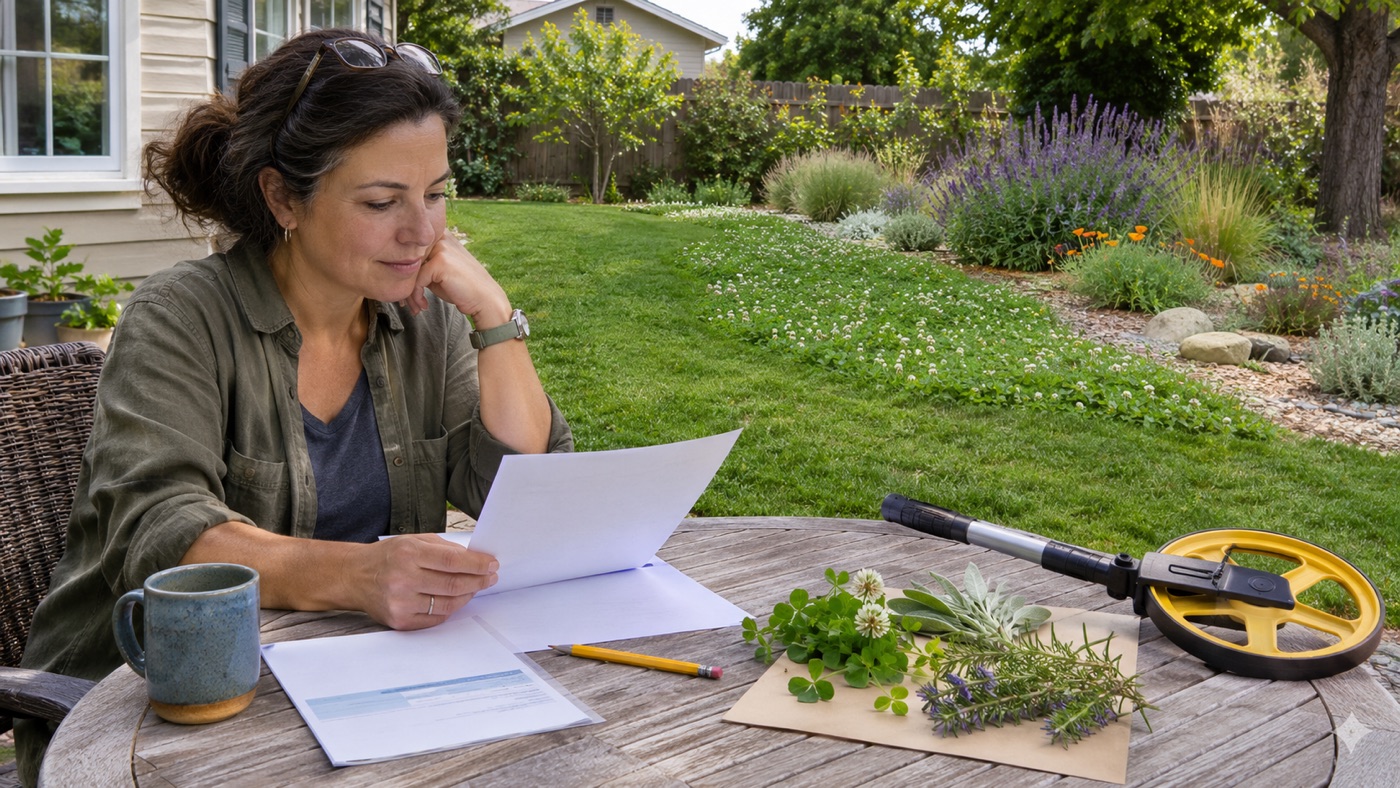
Moreover, this lawn alternatives cost comparison contrasts keeping functional turf with converting it. If the current lawn is dead, compacted or poorly matched to the site, the turf column needs its own renovation cost. If the lawn is healthy and you only need a small play area, removal may never repay itself financially.
Option 1: keeping a smaller conventional lawn
In contrast, existing turf has one financial advantage no replacement can erase: its installation cost is already sunk. Therefore, where it provides a durable surface for children, pets or frequent walking, maintaining a smaller lawn may cost less than replacing it with a fragile alternative and repairing that alternative repeatedly.
For example, the recurring costs are mowing, edging, irrigation, fertilizer where soil testing and species guidance support it, overseeding or patching, and equipment. Specifically, Colorado State University Extension notes that actively growing bluegrass or fescue can need mowing every three to four days in spring and every seven to ten days when growth slows. However, local species and climate change that schedule.
In addition, water can dominate the cash cost in a dry climate. EPA WaterSense reports that outdoor use averages about 30 percent of household water nationally and can be much higher in dry regions. Use the EPA Water Budget Tool or a local utility calculator rather than importing another city’s gallons.
Therefore, the cost-saving move is to retain only the turf that earns its space. Correct sprinkler overspray, return clean clippings, mow at the recommended height and convert unused edges separately. A phased design avoids paying to replace the most useful part of the yard.
Option 2: clover or microclover overseeding
For instance, overseeding white clover into compatible existing turf is usually cheaper than full removal because the soil surface, irrigation and part of the living cover remain. Clover fixes nitrogen, so a successful mix may reduce purchased nitrogen. It still needs mowing, establishment moisture and occasional reseeding.
However, microclover is a selected form of white clover, not a maintenance-free species. Moreover, seed often costs more, and under low mowing or stress it may not retain the tiny-leaf appearance shown in marketing photographs. White clover also has weak points: University of Minnesota Extension describes poor traffic and shade tolerance. Finally, flowers attract bees, which may conflict with barefoot play or a household with a serious sting allergy.
Read our full clover vs. microclover lawn comparison before pricing seed. A mixed lawn is usually a better financial risk than pure clover because turf provides winter cover and recovery where clover thins.
Option 3: an ecolawn or bee-lawn mix
Meanwhile, an ecolawn combines compatible grasses with low-growing broadleaf plants such as clover and yarrow. A bee lawn adds flowers selected for pollinator forage. Both can reduce inputs, but the recipe is regional.
For example, Oregon State University Extension reports that an established western Oregon ecolawn may be mowed every two to three weeks and can use roughly one-quarter to one-third of the water of a conventional lawn in that regional system. Specifically, its practical lawn guide describes one or two monthly cuts, limited summer irrigation and no fertilizer for a tested perennial-ryegrass, microclover and yarrow mix. However, those figures are useful evidence for western Oregon—not a promise for Florida, Arizona or Minnesota.
However, establishment is the hidden cost. For example, seed needs a prepared surface, consistent moisture and protection from traffic. Meanwhile, weeds may require hand work while the mix fills in. Consequently, a failed sowing can erase the expected savings. Therefore, consult our bee lawn seed-mix guide and yarrow lawn guide for climate and use limits.
Option 4: seeded buffalograss
Similarly, buffalograss can be inexpensive to maintain after establishment in a sunny, suitable Great Plains climate. Specifically, Colorado State University Extension reports that newer cultivars may remain green with 50–75 percent less irrigation than Kentucky bluegrass, need less frequent mowing and perform with only one or two fertilizer applications per year.
However, the first year is not low-input. In fact, CSU warns that establishment water can equal or exceed that of bluegrass or tall fescue, while seed establishment can be labor-intensive. Although sod produces faster cover, it costs more than seed or plugs. In addition, buffalograss goes brown from the first hard frost until late spring, dislikes shade and does not suit constant concentrated traffic.
Our buffalograss lawn guide explains seed, plug and sod tradeoffs. Price the method you will actually use; substituting the seed price for a sod project understates the conversion cost.
Option 5: groundcovers and planted beds
By contrast, groundcovers, shrubs, sedges and native perennials can eliminate mowing and create more habitat. They can also be the most expensive option to install. Plant count rises quickly when plugs are spaced closely, and bare gaps need mulch and weeding until the canopy closes.
Therefore, University of Maryland Extension recommends matching plants to moisture, light and region, and cautions that groundcovers need weeding and mulch during establishment. Avoid invasive species even if they appear cheap and fast. On shaded sites, a correctly selected sedge or woodland groundcover may succeed where repeated turf renovation keeps failing; see our guide to sedges and groundcovers for shade.
Consequently, a planted bed saves money only if the design is maintainable. Group plants by water need, install the correct irrigation, leave access for weeding, and budget for replacement. Mature shrubs are not a walkable lawn and should not be compared as though they provide the same function.
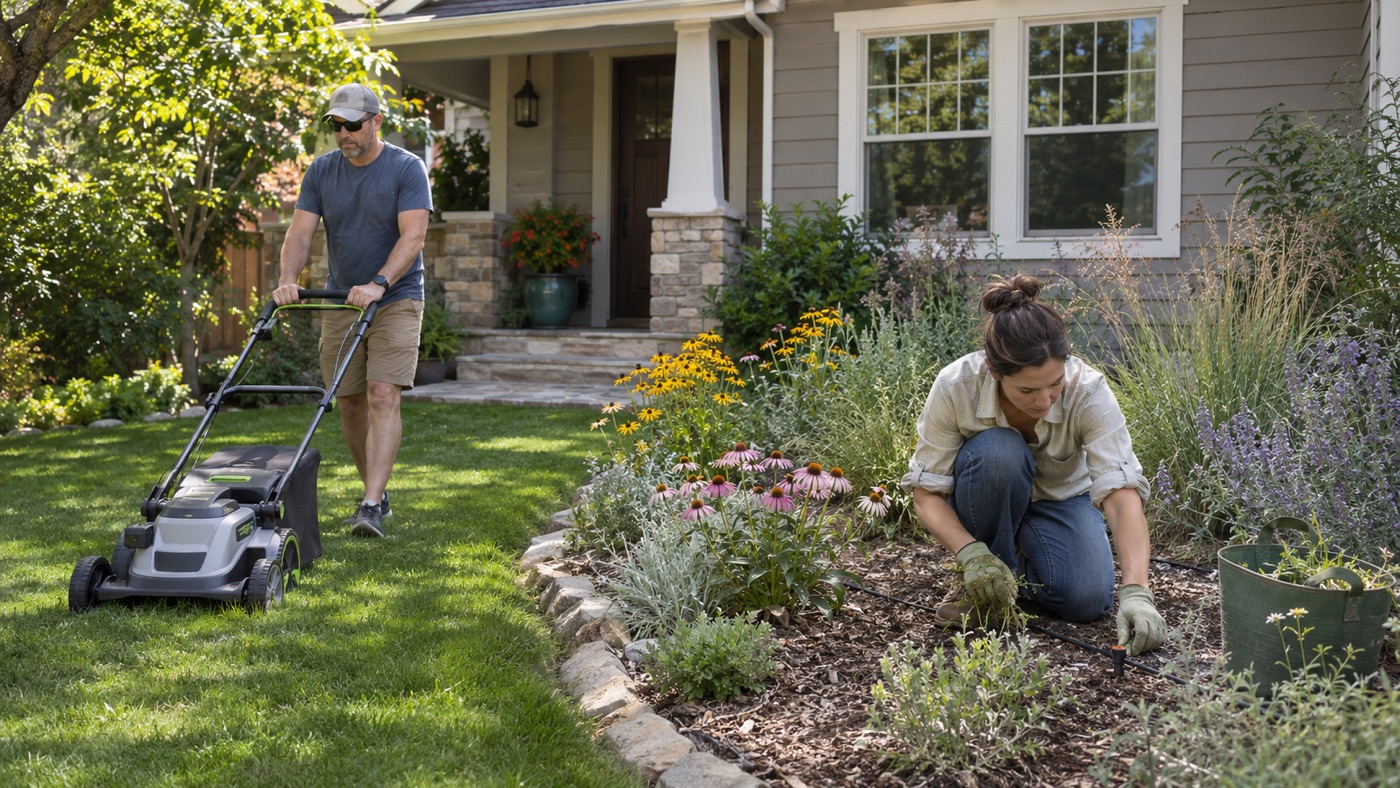
How water changes a lawn alternatives cost comparison
However, water savings depend on climate, rainfall, plant maturity, irrigation efficiency and the appearance you expect. A lawn allowed to go dormant may use less than a lush “low-water” planting that is overirrigated. Establishment water belongs in year one for every seeded or planted option.
Therefore, convert a water estimate into cost with this formula:
Annual irrigation cost = estimated gallons ÷ 1,000 × the applicable price per 1,000 gallons.
For example, if your utility uses tiers, calculate each tier separately. Compare two years of summer bills with winter indoor use, but account for pools, leaks and household changes. A dedicated irrigation meter or controller flow data may provide a cleaner baseline.
In addition, EPA’s tool uses local climate data, plant type, plant water need, precipitation and irrigation design to compare landscapes. It is a design estimate, not a watering schedule. Use current local weather and Extension guidance for actual scheduling.
How labor changes the result
In the worked lawn alternatives cost comparison, labor is the largest cost for turf. Set its value to zero and the five-year turf total falls from $3,950 to $1,550. That does not mean the work disappeared; it means the comparison stopped pricing it.
Therefore, choose one of these approaches and use it across every option:
- Cash-only: count hired labor and supplies, but show DIY hours in a separate column.
- Opportunity cost: multiply every DIY hour by the same hourly value.
- Hybrid: use contractor quotes for conversion and your hourly value for routine maintenance.
Finally, record actual time for one month during the growing season. Include mowing setup, edging, cleanup, watering checks and trips for supplies. For a planting bed, include weeding, pruning, dividing plants and replacing mulch.
Use this worksheet for your own five-year comparison
| Input | Current turf | Alternative A | Alternative B |
|---|---|---|---|
| Area in square feet | _____ | _____ | _____ |
| Removal and preparation | $_____ | $_____ | $_____ |
| Seed, sod, plugs, plants and mulch | $_____ | $_____ | $_____ |
| Irrigation changes | $_____ | $_____ | $_____ |
| Year-1 water | $_____ | $_____ | $_____ |
| Years 2–5 water | 4 × $_____ | 4 × $_____ | 4 × $_____ |
| Year-1 labor hours × rate | $_____ | $_____ | $_____ |
| Years 2–5 labor × rate | 4 × $_____ | 4 × $_____ | 4 × $_____ |
| Five-year supplies and repairs | $_____ | $_____ | $_____ |
| Confirmed rebate | − $_____ | − $_____ | − $_____ |
| Five-year total | $_____ | $_____ | $_____ |
Finally, add a second line beneath the total for nonfinancial differences: usable season, traffic tolerance, shade, dormancy, flowers, pet use and habitat. The cheapest surface that cannot serve the household is not the least-cost solution.
Ways to improve your lawn alternatives cost comparison
- Convert in phases. Start with an unused edge, not the whole yard. Divide suitable plants later.
- Keep functional turf. A smaller durable play zone can prevent repeated groundcover repairs.
- Choose seed only when the site and season support it. Cheap seed is expensive after two failed sowings.
- Reuse sound infrastructure. Adapt irrigation deliberately instead of burying active heads.
- Prepare before buying plants. Identify spreading grass and correct drainage first. Our guide to replacing turf without herbicides compares removal methods.
- Verify rebates before work. Confirm the eligible area, plants, materials, inspections and deadline with the utility.
- Buy for mature spacing. Do not crowd shrubs to make the first month look finished.
When a lawn alternatives cost comparison will not show savings
- The current turf is healthy, useful and inexpensive to maintain.
- The replacement does not tolerate the actual shade, traffic or winter conditions.
- A “low-water” bed remains on the old lawn schedule.
- Persistent turf or weeds were not controlled before planting.
- The project requires dense plugs or large plants for an immediate finished appearance.
- You compare a hired conversion with DIY turf care but do not price labor consistently.
- You assume a rebate without confirming eligibility.
- You omit establishment water, failed seed, replacement plants or mulch renewal.
Lawn alternatives cost comparison: frequently asked questions
What is the cheapest option in a lawn alternatives cost comparison?
For a serviceable cool-season lawn, overseeding a compatible clover or ecolawn component may have the lowest conversion cost because it keeps existing cover. The cheapest suitable option still depends on climate, use and site. Pure clover, thyme and groundcovers can fail when chosen only by seed price.
Does a no-mow yard cost less?
Not automatically. Eliminating mowing can reduce recurring labor, but planted beds need weeding, pruning, mulch and replacement plants. University of Maryland Extension notes that garden and lawn maintenance can take similar amounts of time.
How long does a lawn conversion take to pay back?
Divide the net conversion cost by the expected annual savings. A $1,200 conversion that reliably saves $300 per year has a simple four-year payback. Recalculate if maintenance, water rates or plant losses change. Do not treat projected savings as guaranteed.
Should I count my own labor?
Yes—either give it an hourly value or report hours separately. Use the same method for every option. Otherwise a labor-intensive DIY conversion can look artificially free beside hired lawn care.
Does buffalograss always cost less than turfgrass?
No. It can reduce mature irrigation, mowing and fertilizer in a suitable sunny region, but establishment needs water and labor. Sod and plugs raise the initial cost, while shade, constant traffic or an unsuitable climate can cause costly failure.
Are rebates included in the example?
No. Programs are local and change frequently. Enter only a rebate your utility has confirmed for your address and project. Apply or schedule required inspections before removing turf.
Sources and further reading
- EPA WaterSense: Water Budget Tool
- EPA WaterSense: Outdoor Water Use
- Colorado State University Extension: Buffalograss Lawns
- Colorado State University Extension: Lawn Care Basics
- Oregon State University Extension: Ecolawn—Less Work and Water
- Oregon State University Extension: Practical Lawn Care for Western Oregon
- University of Maryland Extension: Lawn Alternatives
- Iowa State University Extension: Lawn Alternatives
Last reviewed: November 6, 2026. The example is an educational calculation, not a quote, appraisal or promise of savings. Confirm plant suitability, water rates, local rules, rebates and installation costs with your Extension program, water utility, municipality and qualified local professionals.