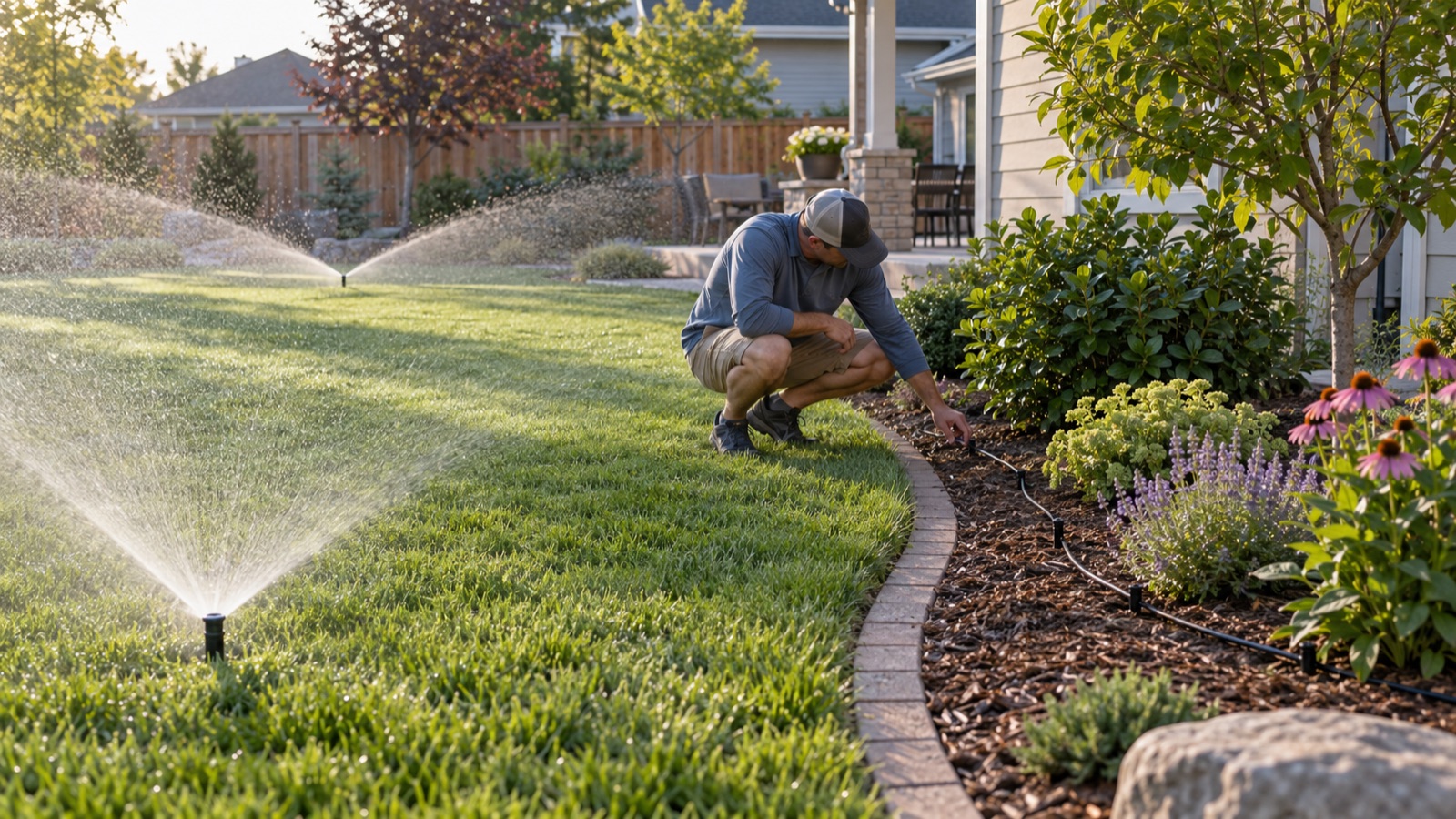
Drip irrigation and spray sprinklers are not interchangeable versions of the same system. They apply water at different rates, wet different portions of the soil, and suit different types of planting. For most residential yards, the practical answer is not to choose one method for the entire property. It is to use sprinklers for broad, uniform turf and drip or other microirrigation for beds, shrubs, trees, containers, and narrow or irregular spaces—on separate zones with separate schedules.
The U.S. Environmental Protection Agency says microirrigation delivers water slowly and directly to plant root zones, reducing evaporation and runoff. EPA reports that properly designed microirrigation can use 20 to 50 percent less water than conventional sprinkler systems. That is a system-level estimate, not a guaranteed bill reduction: poor design, clogged emitters, leaks, or excessive runtime can waste water with either method.
The short answer
| Landscape area | Usually the better starting point | Why |
|---|---|---|
| Broad, regularly shaped turf | Well-designed sprinklers | Turf needs relatively uniform coverage across a continuous root zone |
| Shrub and perennial beds | Drip or microirrigation | Water can be directed to individual root zones without wetting the entire bed |
| Vegetable rows and containers | Drip | Low-flow delivery is easy to place near plants and reduces wet foliage |
| Narrow strips and irregular beds | Drip | Avoids spraying pavement, walls, fences, and unused soil |
| Mature trees | Multiple emitters or dripline placed across the active root area | The wetted area can expand as the tree grows |
| Large mixed yard | Both, on separate valves and schedules | Turf and beds normally need different application rates and runtimes |
| Steep or erosion-prone slope | Site-specific drip or redesign | Slow delivery may reduce runoff, but unstable slopes and drainage problems need professional evaluation |
Use this table as a screening tool, not a design. Plant water needs, soil texture, pressure, elevation change, local rules, existing pipe capacity, and maintenance access still determine the final system.
How spray irrigation works
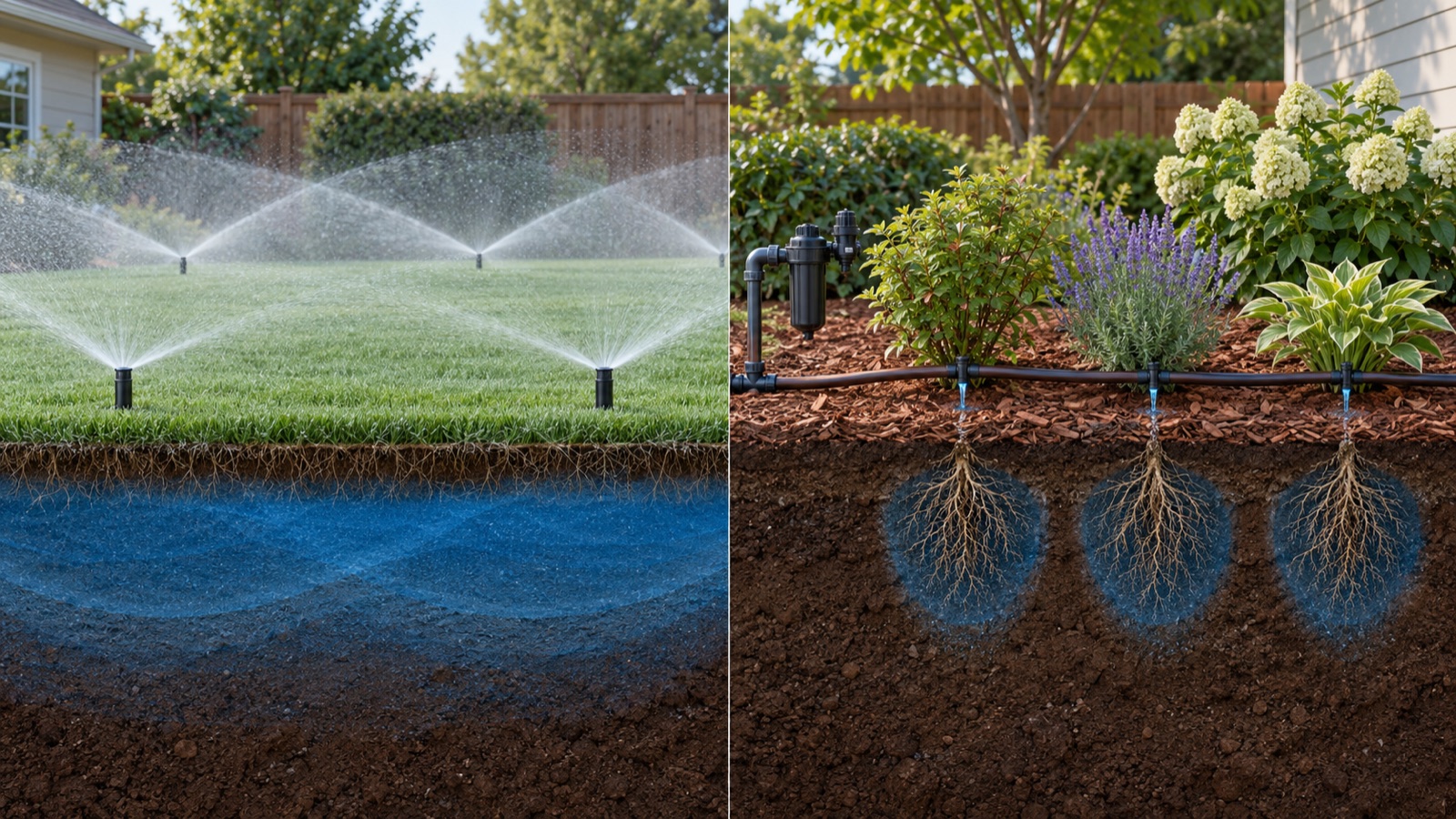
Pop-up spray heads and rotors distribute water through the air over an area. A properly designed turf zone uses head-to-head coverage: each sprinkler reaches the next head so overlapping patterns compensate for the lighter edges of an individual spray pattern.
Sprinklers work best where plants form a broad, continuous surface with similar water needs. Turfgrass is the clearest example. A sprinkler zone can wet the whole root area efficiently when heads are correctly spaced, pressure is regulated, precipitation rates are matched, and the schedule responds to weather and soil.
Spray irrigation becomes a poor fit when water lands on sidewalks, siding, fences, bare soil, or plants with very different needs. Wind, high pressure, tilted heads, blocked spray, mismatched nozzles, and short head spacing can create misting, runoff, and dry spots. Before replacing a system, complete a zone-by-zone sprinkler audit so a repair problem is not mistaken for a technology problem.
How drip irrigation works
Drip is one form of microirrigation. A low-pressure network of tubing carries water to point emitters, inline emitter tubing, bubblers, or micro-sprays. Water enters the soil near selected plants instead of being broadcast through the air.
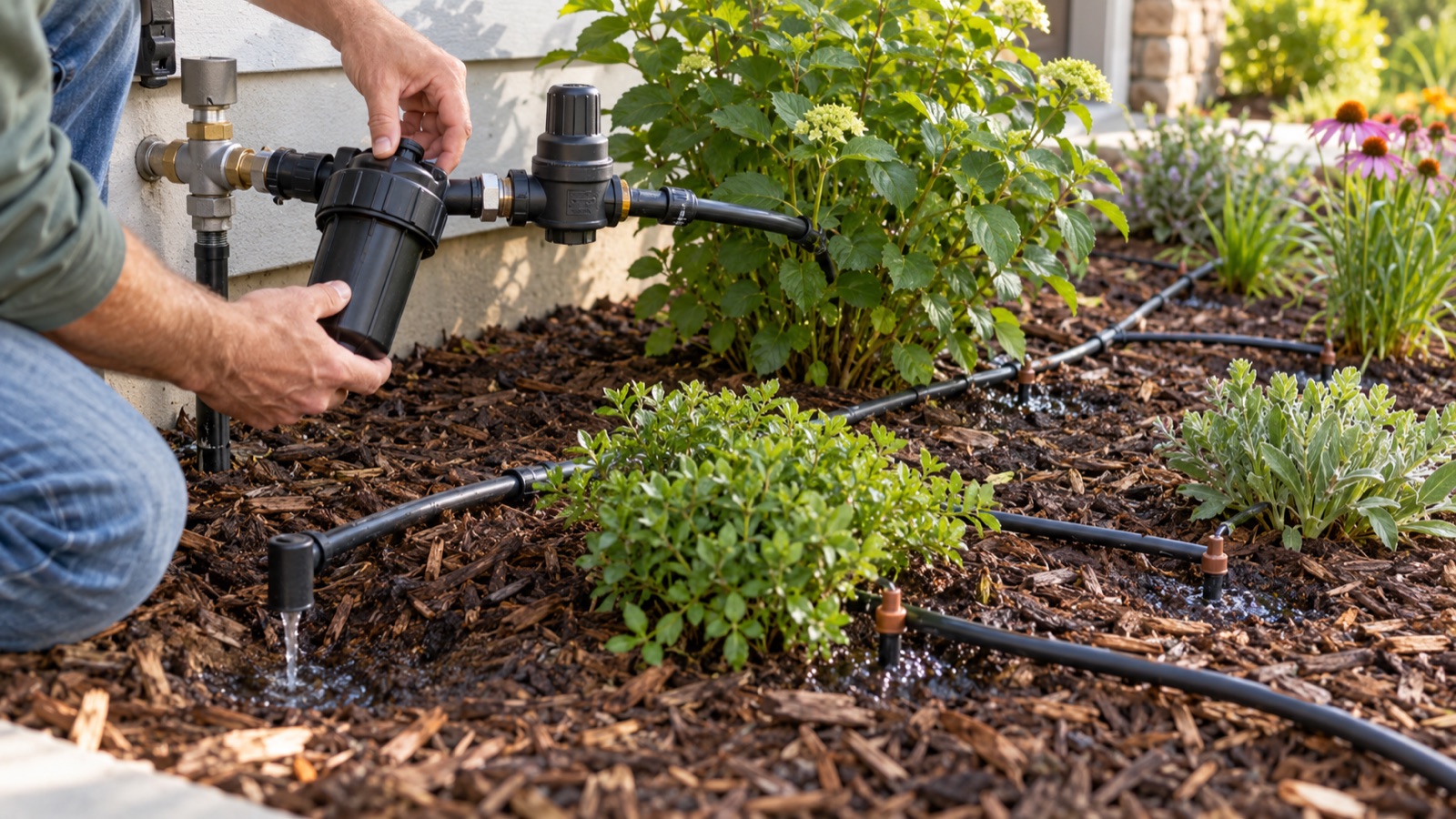
A typical residential drip zone includes:
- a backflow-protected connection that meets local code;
- a valve or zone connection;
- a filter sized for the water source and emitters;
- a pressure regulator compatible with the tubing and devices;
- polyethylene distribution tubing;
- emitters or dripline selected for the plants and soil; and
- accessible flush points at line ends.
Drip is not maintenance-free. EPA’s homeowner guide notes that filters and emitters can clog, tubing can be damaged by landscape work or animals, and exposed lines can be affected by freezing. The system must be inspected while it runs because a failed emitter is much less visible than a broken spray head.
Drip vs. spray: the important differences
| Decision factor | Drip or microirrigation | Spray sprinklers |
|---|---|---|
| Water placement | Localized at or below the soil surface | Broadcast through the air over an area |
| Best landscape pattern | Spaced plants, rows, containers, narrow or irregular beds | Continuous turf or other broad, uniform planting |
| Wind sensitivity | Low for point-source and inline drip | Higher; wind can distort patterns and increase evaporation |
| Runoff risk | Often lower because application is slow | Depends on precipitation rate, soil, slope, and cycle length |
| Visibility while operating | Failures may be difficult to notice | Coverage, misting, broken heads, and overspray are easier to see |
| Filtration | Usually essential | Depends on water source and nozzle type |
| Pressure control | Low pressure; regulation is normally required | Correct operating pressure is essential |
| Scheduling unit | Emitter flow, spacing, wetted area, and plant need | Precipitation rate, distribution uniformity, and area need |
| Foliage wetting | Usually minimal | Common unless heads are carefully positioned |
| Expansion as plants grow | Emitters may need to be moved or added | Broad pattern stays similar, though heads must remain clear of growth |
The biggest mistake is comparing only minutes of runtime. A 20-minute spray cycle and a 20-minute drip cycle do not apply the same depth or volume. Even two drip zones can differ substantially when emitter flow rates and spacing are different.
Where drip irrigation is usually the better fit
Shrubs, perennials, and foundation beds
Drip keeps water within the bed and away from walls, windows, and pavement. Place emitters over active roots rather than against trunks or crowns. As shrubs and trees establish, move or add emitters outward so a larger root area is wetted.
Do not assume one emitter is enough for every plant. Soil texture affects how water spreads: coarse soil tends to move water downward in a narrower pattern, while finer soil often spreads it farther sideways. Observe moisture with a probe at several points and depths before finalizing emitter spacing.
Vegetable gardens and rows
Inline dripline can water consistent rows without routinely wetting foliage. It also reduces the amount of unused soil that is irrigated. The layout must still match row spacing, root depth, soil, and seasonal plant size.
Containers
Individual emitters make automated container watering possible, but containers dry at different rates. Group pots with similar size, sun exposure, and plant needs. Secure emitters so they cannot fall out and confirm that drainage holes remain open.
Narrow, irregular, or windy areas
Drip avoids the geometry problem of trying to fit a spray arc into a narrow strip. It can also operate without wind distorting an airborne pattern. Tubing must be anchored and protected from tools, foot traffic, pets, and ultraviolet exposure where appropriate.
Slopes—with limits
Slow application can reduce surface runoff. Pressure-compensating emitters may help on elevation changes, but they do not correct unsafe grading, active erosion, unstable soil, or failed drainage. For moderate sprinkler slopes, cycle-and-soak irrigation may help. For steep or structural slopes, obtain site-specific professional advice.
Where sprinklers are usually the better fit
Broad turf areas
Turf forms a continuous root zone. Properly spaced sprinklers can distribute a measured depth across that area more predictably than scattered point emitters. Fixed sprays, rotary nozzles, and gear-driven rotors have different precipitation rates and should not be mixed casually on one zone.
Areas that need visible coverage testing
Sprinkler performance can be measured with identical catch cans. The test reveals average precipitation rate and uneven coverage. That makes diagnosis more direct when the target is uniform turf.
Existing healthy, efficient turf zones
Do not replace a functioning sprinkler zone only because drip is often described as more efficient. A correctly designed, pressure-regulated, well-scheduled sprinkler system may be the most practical method for the area. First fix leaks, pressure, head alignment, nozzle compatibility, and scheduling.
Why drip is not automatically right for every lawn
Subsurface drip irrigation can water turf, but it is a specialized design—not simply surface tubing placed under grass. It requires correct line spacing and depth, filtration, pressure regulation, flushing, root-intrusion management, and a plan for repairs that cannot be seen from the surface.
Existing lawns also present installation challenges. Trenching can damage roots and the finished surface, and leaks or clogs may show up only as wet or dry bands. Homeowners considering subsurface drip for turf should use local design guidance and an experienced irrigation professional rather than copying a planting-bed layout.
Never combine drip and spray on the same operating zone
Drip and spray devices normally need different pressures, runtimes, and scheduling logic. If both run from the same valve, the controller cannot independently give turf a measured sprinkler depth and give shrubs the volume required by their emitters.
Mixed zones commonly produce one of two outcomes:
- the sprinkler area looks acceptable while the drip area is under- or overwatered; or
- the drip area appears acceptable while turf receives the wrong depth.
Use separate valves or a properly designed conversion that isolates the new microirrigation zone. Confirm that the converted zone has filtration, pressure regulation, compatible fittings, and a flush point. Check local backflow requirements before altering irrigation plumbing.
How to compare output correctly
Spray zones: measure depth and uniformity
Place identical catch cans across the zone, run it for a measured period, and calculate the average depth. Convert the result to inches per hour:
precipitation rate = average depth ÷ test minutes × 60
If the average is 0.25 inch in 15 minutes, the measured rate is 1 inch per hour. A target of 0.40 inch would take about 24 minutes under those test conditions. Divide that total into shorter cycles if runoff begins sooner.
Drip zones: inventory flow and verify the wetting pattern
Record each emitter’s rated gallons per hour, the number of emitters, and the plants served. A plant with two 1-gallon-per-hour emitters receives a nominal 2 gallons during a one-hour run, assuming the devices operate at the intended pressure and are not clogged.
Rated flow alone is not enough. Dig or probe carefully after irrigation to see how far water moved sideways and downward. Increase wetted area by changing emitter number or placement—not merely by running one point emitter until water moves too deep.
| Check | Spray zone | Drip zone |
|---|---|---|
| Quantify application | Catch-can depth and distribution | Emitter flow, count, spacing, and runtime |
| Inspect during operation | Arcs, pressure, misting, head-to-head coverage | Leaks, clogged/missing emitters, filter, pressure, flush ends |
| Inspect after operation | Soil depth in representative turf locations | Width and depth of wetted soil around representative plants |
| Adjust seasonally | Runtime or controller adjustment | Runtime/frequency plus emitter placement as plants grow |
A practical mixed-yard design
Consider a property with front turf, a side foundation bed, backyard trees, a vegetable garden, and patio containers. A logical starting layout would be:
| Zone | Method | Key design note |
|---|---|---|
| Front turf | Matched sprinklers | Head-to-head coverage and a catch-can test |
| Foundation shrubs | Inline drip or multiple emitters | Keep water away from the foundation and plant crowns |
| Trees | Multiple emitters or dripline loops | Expand the wetted area as roots and canopy grow |
| Vegetable rows | Inline dripline | Match line spacing to crops and soil |
| Containers | Point emitters | Group similar pots and verify drainage |
Each zone needs its own schedule. A weather-based or soil-moisture controller can help avoid unnecessary watering, but it still depends on correct zone information. The WaterSense label for irrigation controllers verifies specific performance criteria; it does not correct poor hydraulic design or misplaced emitters.
Converting a spray zone to drip
- Map the existing zone. Identify the valve, heads, pipe route, elevation changes, and plants served.
- Confirm the whole zone should change. Do not convert heads in a turf zone while leaving other sprinklers on the same valve.
- Calculate plant demand and device capacity. Count emitters and check maximum tubing length and total flow against manufacturer specifications.
- Provide backflow protection, filtration, and pressure regulation. Requirements vary by water source and local code.
- Use approved conversion components. Cap or convert heads as specified; do not bury improvised connections.
- Add accessible flushing points. Lines must be flushed during installation and maintenance.
- Test every outlet. Verify pressure, leaks, and flow at the beginning and end of the zone.
- Program a new schedule. Delete the old sprinkler runtime rather than reusing it.
- Check moisture, not just the surface. Probe representative plants after irrigation and again before the next event.
- Document the layout. Photograph buried routes and record emitter types for future repairs.
Hire a qualified professional when the work involves backflow devices, electrical controls, significant pressure or elevation problems, inaccessible valves, tree-root conflicts, steep slopes, or local permits.
Maintenance comparison
| Frequency | Drip checklist | Spray checklist |
|---|---|---|
| Monthly in the irrigation season | Run the zone; inspect filters, leaks, emitters, and wetting patterns | Run each zone; inspect heads, arcs, leaks, pressure, and overspray |
| After planting or pruning | Move or add emitters as root areas and canopies change | Clear vegetation that blocks spray patterns |
| Seasonally | Flush lines; adjust runtime; prepare exposed components for freezes | Adjust schedule; clean nozzles; check head level and pressure |
| After landscape work | Look for cut, crushed, or disconnected tubing | Look for broken risers, buried heads, and pipe damage |
EPA recommends inspecting irrigation systems regularly and cleaning microirrigation filters as needed. A hidden drip failure can stress a plant without producing an obvious fountain, while a damaged sprinkler can waste a large volume visibly and quickly.
Final decision checklist
- Use sprinklers for broad, uniform turf only when coverage can stay on the landscape.
- Use drip for spaced plants, beds, containers, and awkward narrow areas.
- Put drip and spray on separate valves and schedules.
- Group plants with similar water needs into hydrozones.
- Match pressure, filtration, tubing, and emitters to the design.
- Measure sprinkler precipitation rather than guessing runtime.
- Verify both flow and soil wetting patterns in drip zones.
- Move or add emitters as trees and shrubs grow.
- Inspect both systems while operating at least monthly during the season.
- Follow local watering rules, plumbing codes, and backflow requirements.
The best residential irrigation system is often a combination: sprinklers where uniform surface coverage is genuinely needed and drip where water can be targeted to individual root zones. Efficiency comes from matching the method to the landscape, then maintaining and scheduling each zone correctly.
Frequently asked questions
Is drip irrigation always more efficient than sprinklers?
No. Drip reduces losses from wind, overspray, and broad surface wetting, and EPA reports substantial system-level water savings compared with conventional sprinklers. But leaks, clogged emitters, poor placement, or excessive runtime can make drip ineffective. A well-designed sprinkler zone can be appropriate for uniform turf.
Can I replace one sprinkler head with a drip adapter?
Only if the entire valve zone is being converted or the conversion is engineered to separate the operating requirements. Leaving active spray heads and drip devices on the same valve usually creates incompatible pressure and runtime needs.
How long should I run drip irrigation?
Calculate from emitter flow, number and placement, plant need, soil, and weather. Then verify the wetted width and depth in the field. Do not copy the old sprinkler minutes or a neighbor’s schedule.
Does drip irrigation need a pressure regulator and filter?
Most residential drip systems require both. The exact components depend on the water source, incoming pressure, tubing, and emitters. Follow the component manufacturer’s specifications and local code.
Are rotary nozzles a substitute for drip?
No. Rotary nozzles are still overhead sprinklers. Their slower precipitation rate can help certain turf zones, but they still broadcast water and must be designed for uniform overlapping coverage.
Which system costs less?
There is no universal answer. Cost depends on existing valves and piping, area geometry, trenching, controller capacity, plant count, filtration, pressure regulation, labor rates, and future maintenance. Compare complete designs rather than the price of a sprinkler head versus one emitter.
Editorial note: This general guide for U.S. homeowners was reviewed against EPA WaterSense, Colorado State University Extension, and University of California IPM resources on October 1, 2026. Irrigation rules, backflow requirements, freezing conditions, pressure, water quality, soil, and plant needs vary by location. Follow manufacturer instructions and local requirements, and use a qualified irrigation professional for site-specific design or regulated plumbing work.