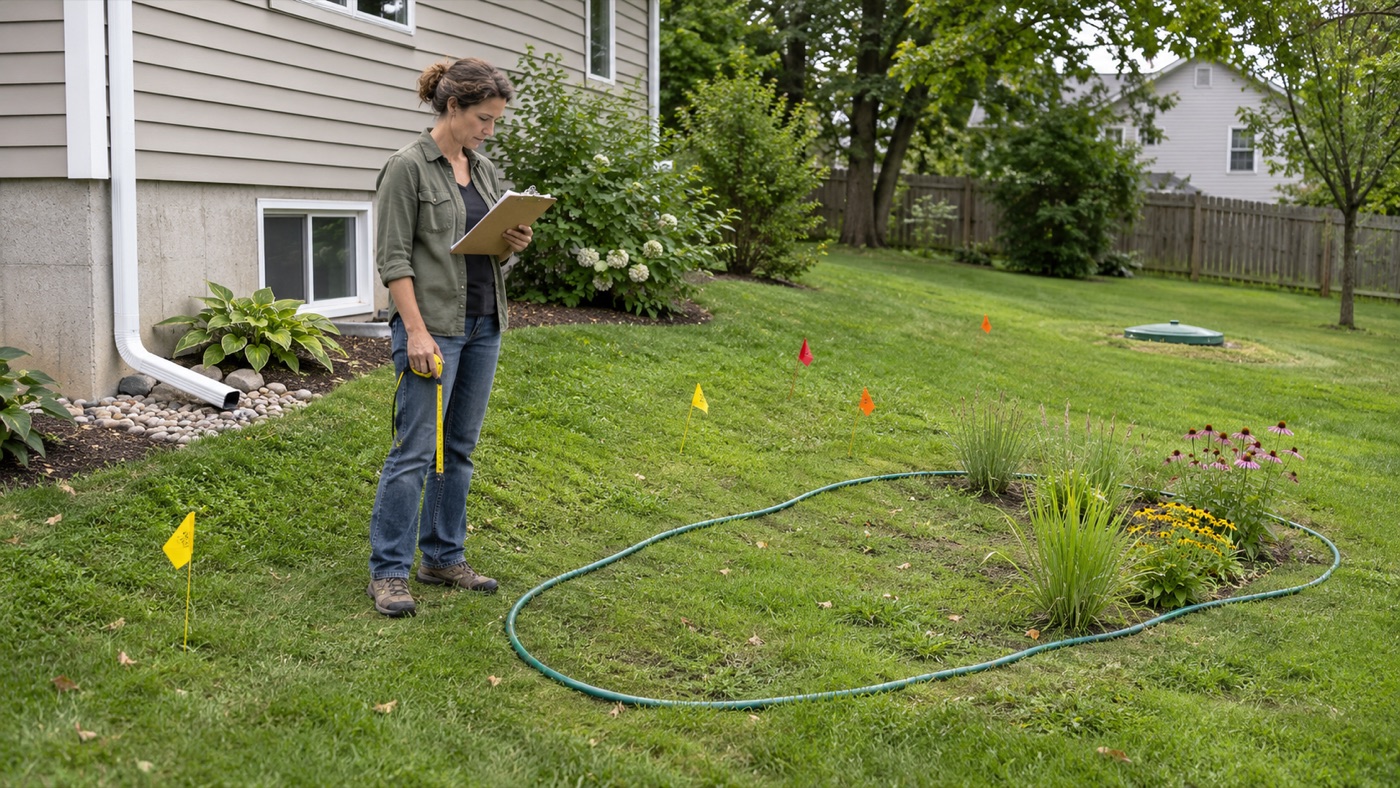
Knowing where not to put a rain garden is as important as choosing plants or calculating its size. A shallow basin that works well in one part of a yard can send water toward a basement, interfere with a septic drain field, expose a buried line or worsen an unstable slope in another.
First, screen the entire site—before you dig an infiltration-test hole. Check buildings, wells, septic components, utilities, groundwater, bedrock, slope, contamination and the overflow route. Then use the setbacks and testing procedure required by your municipality, watershed district, health department or stormwater program.
Why a simple setback number is not enough
For example, Penn State and University of Minnesota Extension both advise placing a residential rain garden at least 10 feet from a building. That is a useful first screen, but distance alone does not control where water moves underground. Soil layers, basement depth, grading, foundation drains, retaining walls, groundwater and the direction of the slope all matter.
However, a basin 12 feet from a house may still be risky if it is uphill from a basement, sits over gravel backfill that leads to the footing or can overflow toward a window well. A closer facility might sometimes be possible as a professionally designed, lined flow-through planter—but that is not the same as a simple infiltration rain garden.
Similarly, the same regional variation appears around septic systems and wells. University of Minnesota Extension recommends at least 35 feet from a septic drain field and describes greater well separation when chemicals or other contamination sources are involved. Other state manuals publish different figures. Do not combine the shortest distances from several guides and call the result compliant.
Where not to put a rain garden: site red flags
| Site condition | Why it is a concern | Best next step |
|---|---|---|
| Near or uphill from a foundation | Infiltration or overflow can reach a basement, crawlspace, wall or footing. | Find a downslope location and confirm the local building setback. |
| On a septic tank, drain field or reserve area | Excavation, roots and extra water can interfere with wastewater treatment. | Map the entire system and use the health department’s setback. |
| Near a drinking-water well | Infiltrating polluted runoff can threaten groundwater quality. | Identify the well type, depth, protection area and applicable separation. |
| Over utilities or inside an easement | Digging can damage lines; infiltration can follow utility bedding toward structures. | Contact 811 and identify private lines and easements too. |
| Shallow groundwater, bedrock or karst | There may be too little soil for drainage and pollutant treatment. | Verify seasonal conditions and required vertical separation. |
| Contaminated soil or polluted runoff hotspot | Infiltration can mobilize pollutants into groundwater. | Stop and obtain environmental and stormwater guidance. |
| Steep or unstable slope | Added water can cause erosion, seepage or slope instability. | Move the basin or obtain geotechnical review. |
| Existing wet spot that drains slowly | The area may have high groundwater, a restrictive layer or incoming seepage. | Investigate the cause; do not assume a rain garden fixes it. |
| Under a valuable tree canopy | Excavation can sever roots and added ponding can stress the tree. | Move outside the protected root zone or consult an arborist. |
| No safe overflow path | Larger storms can overtop the basin and damage property. | Design a stable, lawful overflow route before excavation. |
1. Too close to—or uphill from—a foundation
Keep a basic infiltration rain garden away from buildings. For example, many U.S. homeowner guides use 10 feet as a minimum screening distance, while some require more when the garden is uphill from a structure. Therefore, the grade between the building and basin should not send runoff or subsurface water back toward the foundation.
In addition, look beyond the wall you can see. Mark basement window wells, crawlspace vents, exterior stairs, retaining walls, garage slabs and additions. Ask where footing drains discharge and whether the house has a history of seepage. A rain garden is not a repair for foundation drainage.
Also check what lies downhill. Oregon State University Extension warns that a facility can meet nominal setbacks and still damage a lower structure if it overtops or sends subsurface flow in the wrong direction.
2. Over a septic tank, drain field or reserve area
Similarly, a septic system needs unsaturated soil to treat wastewater. Do not excavate a rain garden over the tank, distribution box, drain field, replacement field or connecting lines. In addition, extra water can interfere with the system, while deep-rooted plants and construction can damage components.
Therefore, do not rely on the visible tank lid to estimate the drain field. Use the property’s septic plan, inspection records or a qualified septic professional to locate the complete system. The required separation varies by jurisdiction and system type; the local health department’s rule controls.
3. Too close to a drinking-water well
Although roof runoff is usually cleaner than runoff from parking or vehicle-service areas, it is not sterile. Atmospheric deposits, roofing materials, animal waste and nearby chemical use can all affect water quality. Infiltration close to a well can create a pathway toward the water supply.
However, well setbacks differ sharply according to state rules, well construction, depth, groundwater direction and runoff source. University of Minnesota Extension, for example, discusses substantially greater separation when fertilizers, pesticides or other contamination sources are anticipated. Oregon guidance treats vehicle runoff in wellhead-protection areas as a sensitive case. Ask the local well or health authority for the correct distance rather than using a national rule of thumb.
4. Over buried utilities or inside an easement
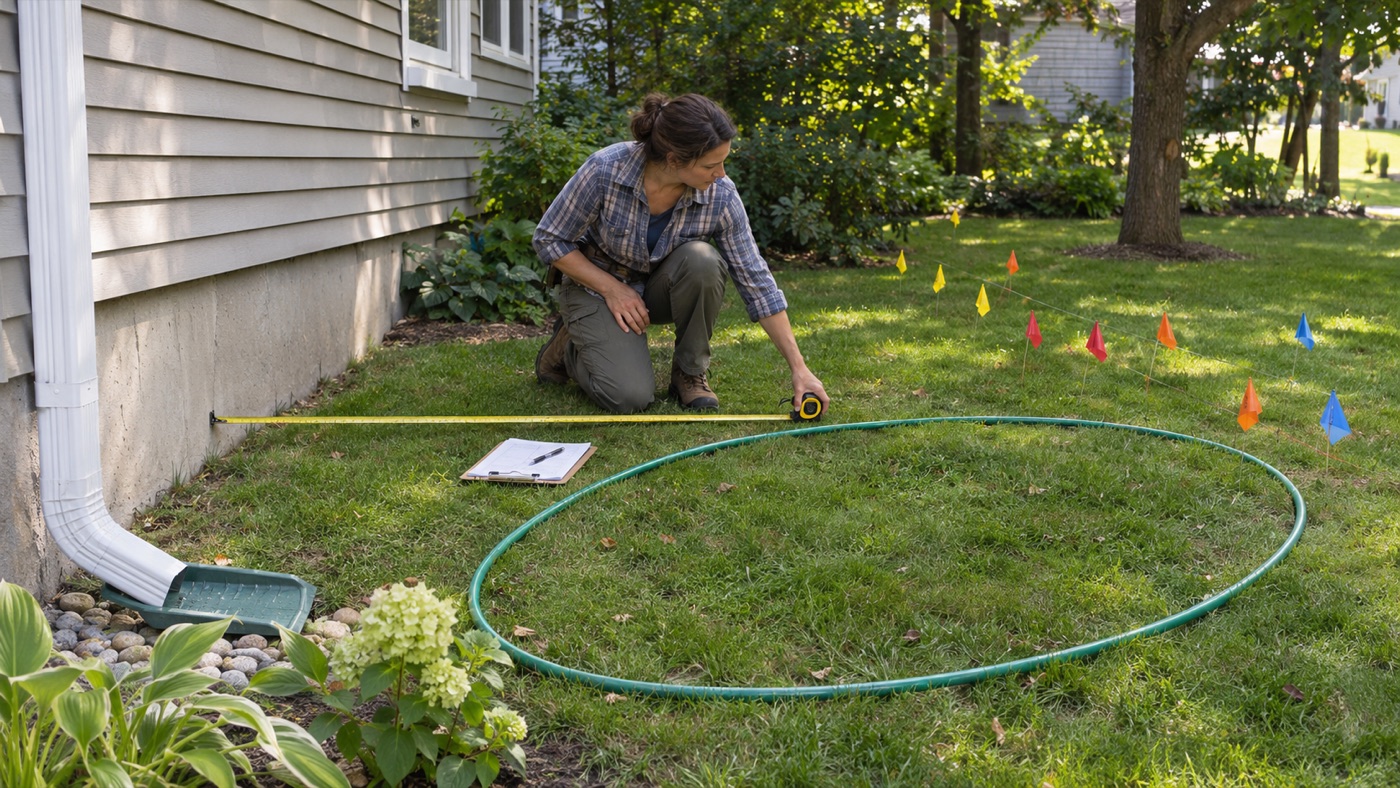
Contact 811 before excavation and follow the instructions for your state. Public utility marking may not identify every privately owned line. Sprinkler pipes, landscape lighting, propane lines, septic connections, private electric service and old drainage pipes may require separate locating.
Avoid planning directly over water, sewer, gas, electric or communications lines. In addition, maintenance crews need access, and a gravel utility trench can act as a fast underground pathway for infiltrating water. Check recorded easements too: even a shallow garden can conflict with access rights or future repairs.
Utility paint and flags are not permission to excavate right up to a line. Respect the tolerance zone and excavation method required by the locator and utility owner.
5. Where seasonal groundwater, bedrock or a restrictive layer is too shallow
An infiltration rain garden needs enough unsaturated soil below its bottom to accept water and help filter pollutants. EPA groundwater guidance says designers should generally aim for at least 2 feet of separation from the seasonal high water table, while specific state and local standards may require different distances.
Therefore, do not measure only from the existing lawn surface. Vertical separation is normally measured from the planned bottom of the facility. Excavating a 12-inch-deep basin reduces the available separation by 12 inches.
Moreover, seasonal groundwater may be invisible during a dry summer. Soil mottling, nearby wetland conditions, well records, test pits and rainy-season observations can provide evidence, but local authorities may require a formal investigation. Shallow bedrock, fragipan, dense fill or karst geology can also make ordinary infiltration unsuitable.
6. In contaminated soil or below a stormwater hotspot
Do not use an ordinary infiltration basin to wash highly polluted runoff into the ground. For example, EPA identifies gas stations, vehicle-maintenance shops, car washes, salt-storage areas, dry cleaners and industrial sites as examples of stormwater hotspots. A residential parcel with a known spill, buried tank, former industrial use or contaminated fill also needs special review.
Therefore, infiltrating clean water through contaminated soil can mobilize pollutants. A designed lined filtration system, rainwater harvesting or another non-infiltrating practice may be more appropriate, but only after environmental and stormwater professionals evaluate the source, soil and lawful discharge.
7. In a wetland, floodplain, riparian buffer or protected habitat
For example, a naturally wet area is not an empty drainage feature waiting to be improved. Wetlands and riparian buffers already provide hydrologic and habitat functions and may be protected by federal, state or local rules. Excavating, filling, redirecting runoff or changing vegetation can require authorization.
Oregon State’s residential decision tool lists floodplains, wetlands, riparian and buffer areas, habitat areas and septic systems as unsuitable for its rain-garden configurations. Other states use different definitions and review processes. Contact the local planning or environmental authority before altering a mapped or suspected sensitive area.
8. Near the top or bottom of a steep, unstable slope
Although a rain garden must have a level basin, that does not make the surrounding hillside safe. Consequently, added infiltration near a bluff, retaining wall or landslide-prone slope can increase pore-water pressure and contribute to seepage, erosion or instability. Overflow over a steep edge can rapidly cut a channel.
Penn State describes slopes greater than 10% as less suitable for a simple homeowner rain garden. Some regional manuals allow carefully terraced cells on moderate slopes; others publish large down-gradient setbacks. If a structure, road or neighboring property lies below the site, use a different location or obtain geotechnical and drainage design.
9. In the lowest soggy spot that already stays wet
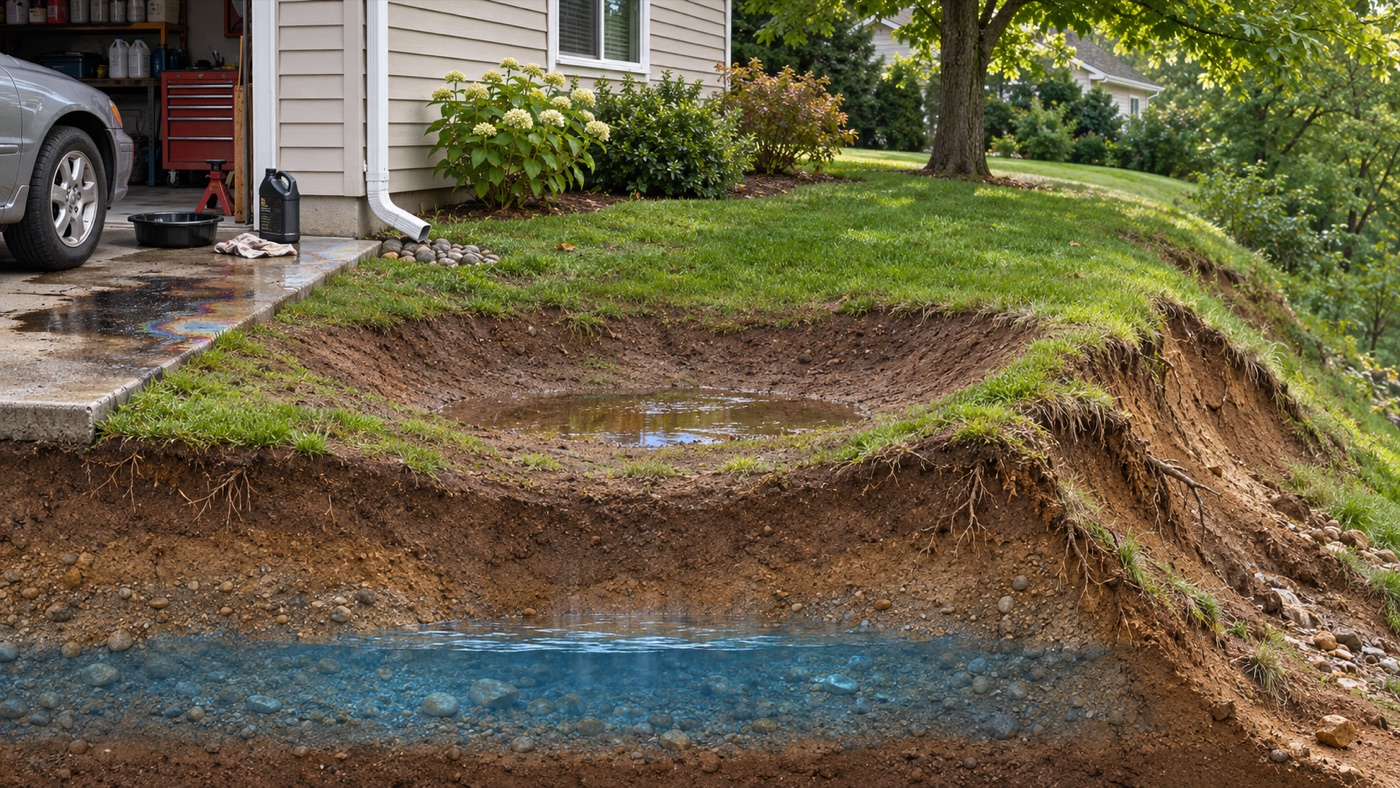
A rain garden receives runoff briefly and then drains. However, a depression that remains wet for days may indicate seasonal groundwater, a restrictive soil layer, a leaking pipe or subsurface flow from uphill. Digging deeper can make the problem worse.
First, observe the area after several ordinary storms and perform the approved infiltration test at the proposed bottom elevation. Penn State homeowner guidance says to consider another site if its screening holes do not drain within 24 hours. Other jurisdictions use 12-, 24- or 48-hour criteria, so use the applicable local test.
If the yard’s problem is groundwater or persistent seepage, compare the functions of a rain garden and a French drain. They manage different water sources.
10. Beneath important tree roots
For example, excavating a basin, changing grade and temporarily ponding water can damage roots. Moreover, large structural roots may extend far beyond the trunk, and repeated compaction during construction can be as harmful as cutting.
Therefore, keep the rain garden outside the protected root zone of valuable mature trees. The drip line is only a basic visual screen; roots may extend farther. If there is no practical route around a tree, ask a qualified arborist to assess excavation limits, soil changes and the future size of proposed rain-garden trees.
11. Against a property line or where water can enter the neighboring yard
However, even when the basin fits physically, it must not create a drainage nuisance. Check property-line setbacks, stormwater easements and local rules about changing runoff. Do not send a swale, pipe or overflow onto adjacent private property without the required right or agreement.
In addition, allow room for the berm, side slopes, maintenance access and an overflow route wholly within the approved area. A garden squeezed against a fence may also be hard to inspect, weed and repair.
12. Anywhere without a stable overflow route
A rain garden is sized for a selected storm or water-quality volume, not every possible event. Therefore, during larger storms—or if the inlet or soil clogs—water must leave without reaching a house, septic system, slope, sidewalk, road or neighboring parcel.
First, set the overflow elevation deliberately. Stabilize the outlet with vegetation, rock or another approved treatment and follow the natural, lawful drainage direction. Check both failure paths: water backing up toward an uphill structure and water overtopping toward a downhill structure.
How to screen where not to put a rain garden
- Draw the property. Mark buildings, pavement, roof downspouts, property lines, wells, septic components, retaining walls, trees and visible drainage routes.
- Check records. Find septic plans, surveys, easements, well information, flood and wetland maps, and any local stormwater manual.
- Walk the yard in rain. Record where runoff originates, where it crosses the site and which areas stay wet afterward.
- Choose several candidate sites. Prefer gently sloping areas downslope from the runoff source and away from sensitive features.
- Confirm setbacks locally. Ask the building, health, well, septic, planning and stormwater authorities as applicable.
- Locate utilities. Contact 811 and identify private lines and easements.
- Check subsurface conditions. Follow the required infiltration, groundwater and bedrock investigation.
- Map the overflow. Trace both the planned outlet and the route water would take if the basin filled completely.
- Calculate the drainage load. Use only the roof and pavement that actually drain to the basin. Our guide explains how to size a rain garden.
- Stop if the site fails. Moving the garden is often safer and cheaper than engineering around multiple constraints.
Example setbacks are not a national code
| Feature | Examples in published guidance | Why you must verify locally |
|---|---|---|
| Building foundation | 10 feet appears in Penn State, Minnesota and other homeowner guidance. | Uphill placement, basements, soil, drainage paths and local codes can require more. |
| Septic drain field | Minnesota Extension uses 35 feet; other state manuals publish different figures. | System design, reserve area, health code and groundwater protection vary. |
| Drinking-water well | Published state examples range widely and can change by well type and runoff source. | Well construction, depth, protection zones and contamination risk control the distance. |
| Underground pipes | Oregon residential guidance uses 5 feet for its specified conditions. | Utility-owner rules, easements and local facility details may require more. |
| Seasonal high groundwater | EPA discusses a general 2-foot design aim; regional specifications vary. | Measurement point, soil treatment, facility type and groundwater rules differ. |
| Down-gradient steep slope | Oregon guidance includes a 100-foot example for slopes of 10% or more. | Geology, slope height, landslide mapping and geotechnical review are site-specific. |
Use these figures to identify questions, not to approve a design. A current local manual, permit condition or licensed professional’s site-specific design overrides a generic article.
What to do when the preferred location fails
However, a failed site screen does not mean stormwater cannot be managed. It means the proposed infiltration rain garden is the wrong tool or in the wrong place. For example, depending on the problem, alternatives may include:
- moving the basin farther from the sensitive feature;
- reducing the connected roof area and using two smaller gardens;
- capturing roof water in a cistern for controlled reuse;
- using a professionally designed lined filtration planter with a lawful outlet;
- installing a vegetated swale that safely conveys rather than infiltrates water;
- adding a rain barrel upstream to reduce small-event flow;
- using permeable pavement only where subgrade and groundwater conditions allow; or
- repairing the actual source of foundation, pipe or groundwater seepage.
Therefore, do not assume an underdrain or imported rain garden soil mix cures every site problem. Neither solves contamination, an unsafe overflow, a septic conflict or an unstable slope by itself.
Rain garden location worksheet
| Question | Your result | Action |
|---|---|---|
| Distance and grade relative to each building | _____ | Confirm the building setback and overflow direction. |
| Septic tank, lines, drain field and reserve field mapped | Yes / No | Obtain records or professional locating. |
| Well type, depth and protection area checked | _____ | Ask the well or health authority for separation. |
| 811 ticket and private utilities complete | _____ | Respect markings, tolerance zones and easements. |
| Seasonal groundwater and bedrock separation | _____ | Compare with the local standard from the basin bottom. |
| Known fill, spills or former commercial use | Yes / No / Unsure | Obtain environmental review if relevant. |
| Slope and downhill consequences | _____ | Move or obtain geotechnical review if risky. |
| Infiltration and drawdown test | _____ | Follow the approved test at the planned depth. |
| Protected tree roots or habitat | _____ | Relocate or seek specialist guidance. |
| Safe stabilized overflow destination | _____ | Do not build until it is defined. |
Where not to put a rain garden: FAQs
How far should a rain garden be from a house?
Many homeowner guides use at least 10 feet as an initial screen, but that is not universal. A garden uphill from a basement, beside a retaining wall or connected to a large drainage area may need greater separation or professional design. Follow the local requirement and ensure overflow travels away from structures.
Can I put a rain garden where water already pools?
Not automatically. A low spot that drains soon after a storm may be workable, but persistent ponding can indicate slow soil, shallow groundwater, seepage or a leak. Identify the cause and use the required infiltration and drawdown test first.
Can a rain garden go over a septic field?
No. Keep excavation, ponding and deep-rooted plants away from the septic tank, drain field, reserve area and pipes. Obtain the system plan and follow the health department’s setback.
Do I still call 811 for a shallow rain garden?
Yes. A shallow basin, inlet trench, edging stake or plant hole can conflict with buried service. Contact 811 before digging and separately identify private lines that the public locating process may not mark.
Can I build a rain garden on a slope?
A gentle slope can sometimes be graded into a level basin, but steep or unstable slopes are poor candidates for simple infiltration. Regional manuals differ on acceptable slope and setbacks. Move the garden or obtain professional review where failure could affect a structure, road or neighboring property.
Does a liner make any location safe?
No. A liner changes the facility to a filtration or flow-through system and requires a designed outlet. It does not remove utility, septic, overflow, easement, slope or permitting conflicts. Use a complete approved design rather than adding liner material informally.
Sources and further reading
- Penn State Extension: How to Make a Rain Garden
- University of Minnesota Extension: Building a Rain Garden
- Oregon State University Extension: Choose the Right Rain Garden
- Oregon State University Extension: Rain Gardens—Low-Impact Development
- U.S. EPA: Green Infrastructure and Groundwater Protection
- U.S. EPA: Semi-Arid Green Infrastructure Toolbox—Rain Gardens
- University of Maryland Extension: Watershed Stewards Academy Rainscaping Manual
- Wisconsin DNR: Rain Garden Manual for Homeowners
Last reviewed: November 13, 2026. This article provides general homeowner planning information, not a site-specific engineering, geotechnical, environmental, septic or well-safety design. Confirm setbacks, groundwater and bedrock separation, utility locations, easements, permits, drainage rights, infiltration tests and overflow requirements with the authorities and qualified professionals responsible for your site.