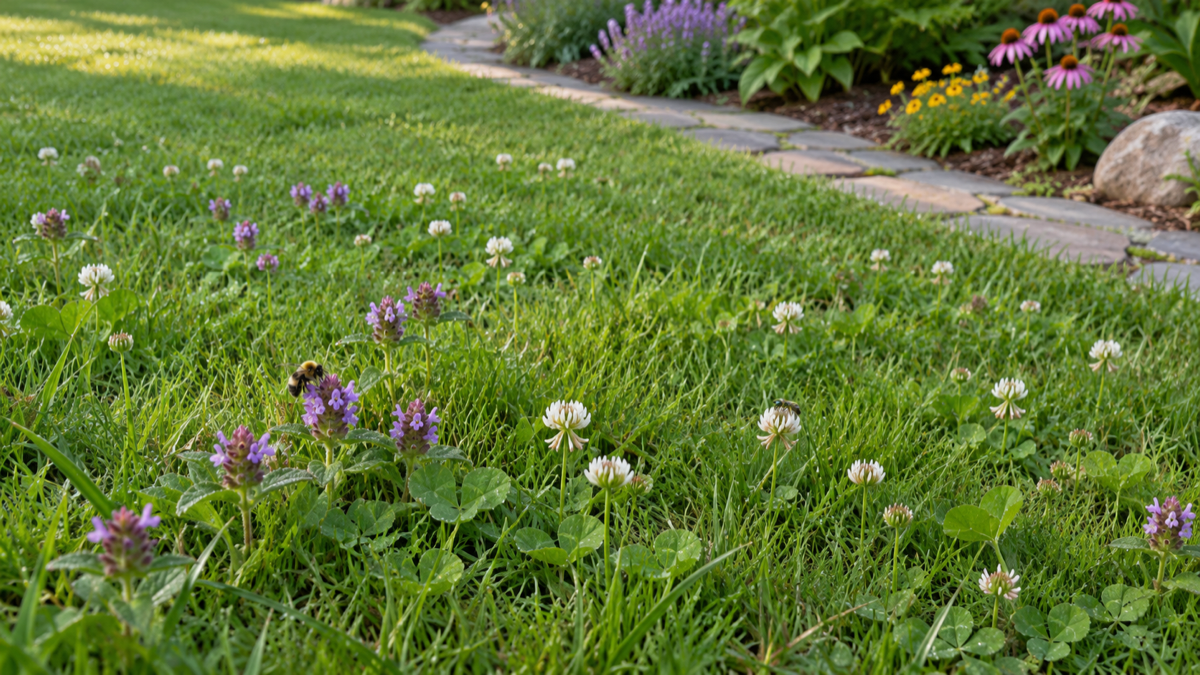
A bee lawn is still a lawn: a mowable surface that combines turfgrass with low-growing flowers able to tolerate mowing and light recreation. Its purpose is to add pollen and nectar while reducing some of the fertilizer, pesticide and mowing inputs associated with a conventional turf-only yard.
That does not mean every packet labeled “pollinator lawn” is suitable for every U.S. climate. The best-researched recipe—fine fescues with Dutch white clover and native self-heal—was developed for cool-season lawns. Warm-season regions, deep shade, compacted dog runs and high-use play areas need a different plan.
What a bee lawn is—and what it is not
A bee lawn sits between conventional turf and a pollinator garden. It keeps the low, open form of a lawn but allows selected flowering perennials to grow among the grass. University of Minnesota research and guidance identify fine fescues, Dutch white clover and self-heal as the most practical core species for Minnesota conditions.
A bee lawn is not a miniature wildflower meadow. Tall annual “wildflower” mixes generally cannot tolerate regular mowing or foot traffic. It is also not equivalent to a native pollinator habitat. A diverse planting of locally native perennials, shrubs and trees can provide more flower types, a longer bloom sequence and nesting structure. Think of the lawn as an extra layer of forage beside those beds, not a replacement for them.
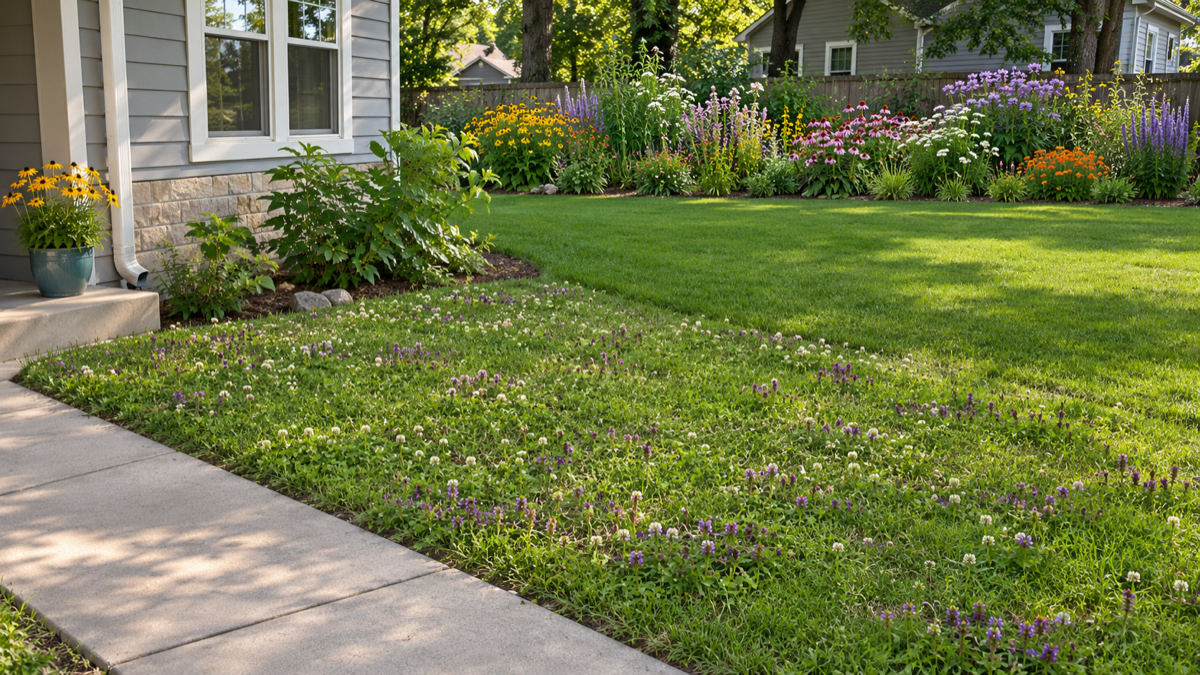
Is your site suitable for a bee lawn?
The idea works only where both the turf and the flowers can persist. Evaluate the site before buying seed.
- Light: choose sun to partial sun. Deep shade produces thin turf and few flowers. Use our guide to shade lawn alternatives for areas without direct sun.
- Traffic: light to moderate household use is realistic. Repeated running, a dog fence line or a daily shortcut can compact soil faster than the flowers recover.
- Existing turf: a healthy lawn with few weeds can be overseeded. A lawn dominated by aggressive weeds, bare patches or severe compaction is a renovation project.
- Soil: the Minnesota mix performs across several soil textures where turf already grows, generally around pH 6.0–7.0. White clover can tolerate somewhat more acidity. Test rather than guess if growth is poor.
- Climate: fine fescues are cool-season grasses. A recipe tested in Minnesota should not be assumed to persist in Florida, the Gulf Coast or the desert Southwest.
- Management: you must be willing to tolerate flowers, some seasonal variation and hand or spot weed control. A broadleaf-herbicide program is incompatible with the desired flowers.
Start with one bounded, lower-traffic section rather than converting every square foot. A front strip, side yard or gentle slope can be easier to manage than the main play area. Hard edging or a sidewalk also limits creeping plants and makes the result look intentional.
What belongs in a bee lawn seed mix?
Read the seed label, including scientific names and percentages. The phrase “pollinator mix” is marketing, not a performance standard. A mix should contain plants that stay low, flower below mowing height, tolerate some traffic and remain compatible with the base grass.
| Component | What it contributes | Important limits |
|---|---|---|
| Fine fescues | Low-input cool-season turf base; compatible with low flowers; lower fertilizer and irrigation needs than Kentucky bluegrass | Not a warm-season solution; individual species and cultivars differ; heavy traffic can thin it |
| Dutch white clover (Trifolium repens) | Long bloom period, strong nectar and pollen value, nitrogen fixation, tolerance of several soil types | Non-native in the U.S.; can spread beyond the intended area; broadleaf herbicides kill it |
| Native self-heal (Prunella vulgaris ssp. lanceolata) | Purple summer flowers, useful to native bees, sun-to-part-sun tolerance | Confirm the subspecies and regional nativity; performs poorly in some sandy sites; seed can be harder to source |
| Kentucky bluegrass | Can coexist with flowering species and tolerates household use | Typically requires more water and fertilizer than fine fescue |
| Creeping thyme | Low nectar-bearing flowers in sunny, well-drained sites | Non-native; UMN’s 2025-reviewed guide no longer recommends it in bee-lawn mixtures because of long-term performance observations and limited seed availability |
| Local low-growing natives | Can extend bloom and improve regional ecological fit | Must be tested for mowing, competition, seed availability and local conditions; native status is regional |
Why older recipes may still list creeping thyme
Many articles and commercial mixes repeat the original four-part recipe of fine fescue, white clover, self-heal and creeping thyme. Current University of Minnesota Extension guidance still discusses thyme but says it is no longer recommended in mixtures after long-term observations and because seed is difficult to obtain. That is a useful reminder to favor recent regional trials over copied ingredient lists.
If thyme is your main goal, treat it as a separate site-specific groundcover project. Our creeping thyme lawn guide explains its drainage, traffic and establishment limits.
How much seed do you need?
For its Minnesota recipe, Extension gives a general rate per 1,000 square feet of 4 pounds of fine fescue, 1.1 ounces of Dutch white clover and 1.2 ounces of self-heal. Premixed products are commonly applied at about 4–5 pounds total per 1,000 square feet. These figures are a regional reference, not a universal formula.
The correct amount changes with the existing lawn density, establishment method, seed purity and supplier instructions. Measure the actual planting area, check the label and avoid doubling the rate in the hope of instant coverage. Excess grass seed can outcompete the much smaller flowering species.
Overseed or start over?
| Current condition | Better approach | Reason |
|---|---|---|
| Healthy turf, few weeds, minor thin areas | Overseed | Less soil disturbance, lower cost and faster return to use |
| Dense turf with no exposed soil | Overseed after close mowing, raking and possibly core aeration | Small seeds need contact with soil, not a layer of leaves or thatch |
| Many bare spots or aggressive perennial weeds | Renovate | Existing weeds can overwhelm slow-establishing flowers |
| Severe compaction, drainage or grading problems | Correct the site, then renovate | Seed does not fix the underlying physical problem |
| Deep shade or constant traffic | Choose another surface or design | Neither the grass nor the flowering plants will thrive |
Solarization, physical sod removal and other nonselective site-preparation methods each have tradeoffs. If you renovate, avoid tilling that brings new weed seed to the surface or damages tree roots. Do not use homemade vinegar or salt mixtures; they can injure soil and surrounding plants and do not provide a reliable renovation plan.
How to establish a bee lawn
1. Choose the regional seeding window
In Minnesota, late-fall dormant seeding is the preferred window: seed is spread after soil is too cold for germination, then freeze-thaw action improves contact before spring growth. Spring seeding after frost risk is the second option but requires frequent establishment water and more weed management.
Do not copy those calendar dates nationally. Cool-season lawns, transition zones and warm-season lawns have different temperature patterns. Ask your state Extension turf program for the correct window for both the base grass and the flowering species. A timing that suits grass alone may not suit the flowers.
2. Create seed-to-soil contact
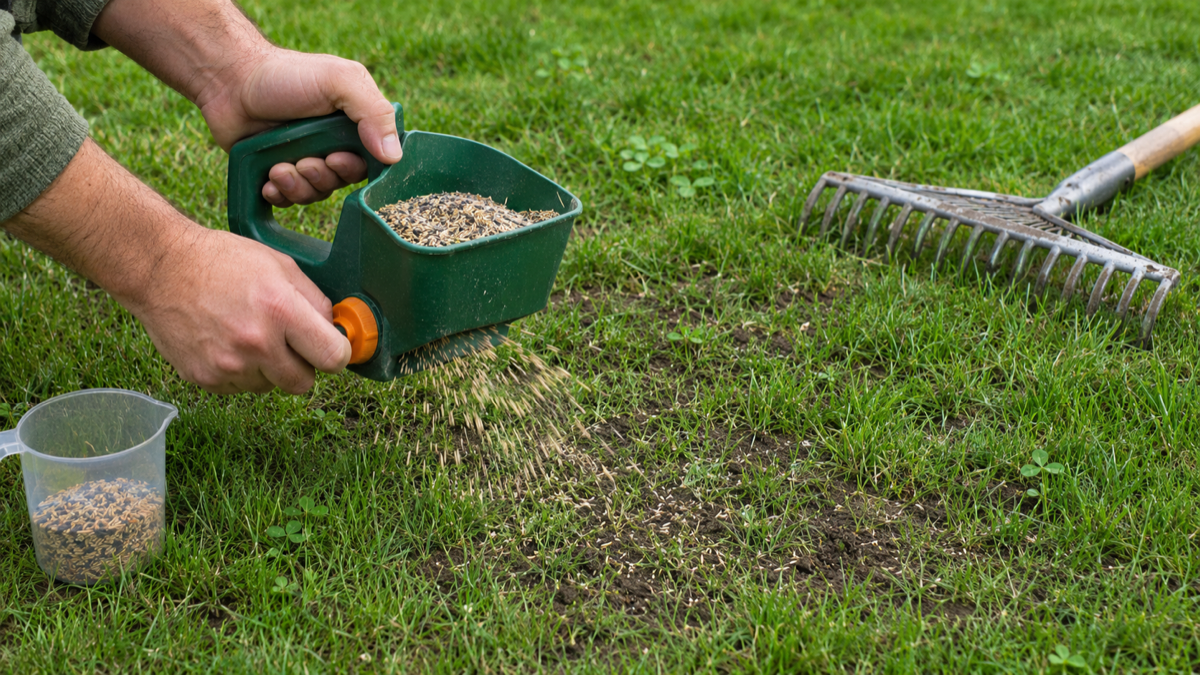
For overseeding, temporarily mow the existing lawn to about 1 inch, remove the clippings and rake enough to expose small areas of soil. Core aeration can help where compaction is moderate. A power rake may be useful in an unusually dense lawn, but unnecessary aggressive disturbance can create more weeds.
3. Measure and distribute the seed evenly
Calibrate a drop or handheld spreader for the labeled rate. Because flower seeds are tiny, split the total into two passes at right angles. In a small area, mixing seed with dry sand can make hand distribution more even. Do not bury the seed deeply; lightly rake spring-sown seed into the surface.
4. Keep spring seed consistently moist
Spring establishment may require light watering two or three times per day for the first few weeks so the surface does not dry out. As seedlings appear and roots develop, reduce frequency. Dormant seeding does not use the same immediate watering routine. Always adapt to rainfall, restrictions, soil and local guidance; saturated soil is not the goal.
Keep people and pets off the new planting. On slopes, a seed blanket can reduce erosion, but verify that the product is wildlife-safe and will not leave persistent plastic mesh.
5. Expect a two-season transition
The first year may look mostly grassy, with some clover foliage and limited bloom. Self-heal and a fuller flower display can take until the second year. A bare-looking month is not a reason to apply more fertilizer: excessive nitrogen favors grass and can reduce flowers.
Mowing and maintaining a bee lawn
Mow high and less often
Once new growth reaches roughly 5–6 inches, remove no more than the top third. For an established bee lawn, University of Minnesota Extension recommends at least a 3-inch mowing height and a general interval of about two to three weeks, adjusted for the season. Pause when flowers are in peak bloom so pollinators can forage, and recycle clippings where they will not form clumps.
Penn State describes some flowering lawns maintained at 4 inches or higher. The exact height depends on the base turf and flower mix, so use the higher compatible setting rather than forcing every species into a short conventional cut.
Use little fertilizer
Established bee lawns generally need little or no supplemental fertilizer. White clover fixes nitrogen, and extra nitrogen shifts the competition toward grass. Base any application on a soil test and local nutrient rules; phosphorus should not be added automatically.
Plan for weeds without blanket broadleaf herbicides
Most lawn broadleaf herbicides cannot distinguish white clover and self-heal from unwanted broadleaf weeds. Hand-pull during establishment and use targeted, label-compliant treatment only when necessary. Never spray blooming plants while pollinators are foraging. “Weed and feed” products can undo the entire planting.
Water for the climate, not the label
Fine-fescue mixes can use less supplemental irrigation than high-input Kentucky bluegrass after establishment, but “bee lawn” does not mean “never water.” Prolonged drought, sandy soil and heat can still require irrigation. Diagnose coverage before increasing run time; our guide to dry spots, runoff and sprinkler overspray can help identify a system problem.
Traffic, children, pets and stings
UMN guidance describes bee lawns as recreational and suitable for light to moderate traffic, while also recommending lower-traffic locations for better foraging. Both statements can be true: an occasional picnic is different from soccer practice or a dog running the same line every day.
Most native bees are docile and unlikely to sting, but a flowering surface intentionally attracts insects. Keep a mown path and a separate turf activity zone where people commonly go barefoot. Households with a known severe sting allergy should discuss risk with a medical professional and may prefer flowering beds beside—rather than within—the usable lawn.
For pets, the bigger establishment issue is trampling and urine concentration, not the seed mix alone. Fence off new seed, provide a durable route, and do not use pesticide products unless their label permits the site and use. A bee lawn is not a substitute for a dedicated high-traffic dog area.
Regional limits across the United States
- Upper Midwest and cool Northeast: the fine-fescue, clover and self-heal model has the strongest direct research basis. Adjust cultivars and seeding dates locally.
- Pacific Northwest: eco-lawn mixes are established in the market, but winter moisture, summer drought and local species lists differ. Oregon State recommends integrating low-growing flowers or converting some turf to perennial habitat.
- Transition zone: heat, humidity and disease pressure can make fine fescues unreliable. Use a turf species adapted to the county and ask whether a flowering mix has actually been trialed with it.
- Southeast and Gulf Coast: warm-season grasses are normally managed differently and are not usually mixed like northern cool-season lawns. Do not add a northern packet to bermudagrass, centipedegrass, zoysiagrass or St. Augustinegrass without local guidance.
- Arid West: irrigation demand, water restrictions and intense heat may make a smaller native planting or reduced turf area more sensible than maintaining a flowering lawn.
Also check municipal weed-height ordinances, HOA rules and state invasive-plant lists. A maintained edge and a simple sign can improve neighborhood acceptance, but they do not override local rules.
Bee lawn versus clover lawn versus pollinator garden
| Option | Best use | Main tradeoff |
|---|---|---|
| Bee lawn | Mowable, lightly used lawn with added floral forage | Limited flower diversity; regional seed compatibility matters |
| Clover-heavy lawn | Low-input lawn where nitrogen fixation and long bloom are priorities | White clover is non-native and may spread; winter appearance and traffic recovery vary |
| Native pollinator bed | Highest habitat value, seasonal diversity and structural cover | Not a play surface; requires design and establishment weeding |
| Conventional turf | High-use, uniform recreation surface when locally adapted and correctly managed | Provides little floral forage and may require more inputs |
If clover is the main decision, compare its strengths and limits in our clover versus microclover lawn guide. Many yards perform best as a mosaic rather than a single surface from fence to fence.
Common mistakes
- Buying by the picture on the bag. Verify scientific names, percentages, region and recommended mowing height.
- Using an outdated four-species recipe. Current UMN guidance no longer recommends creeping thyme in bee-lawn mixtures.
- Seeding deep shade or a compacted route. Fix the site or choose another surface.
- Skipping soil contact. Seed caught in tall turf or thatch will not establish reliably.
- Expecting full bloom in year one. Flower density often improves in the second season.
- Fertilizing for faster growth. Extra nitrogen usually favors grass over flowers.
- Using blanket broadleaf herbicide. It can kill the plants you deliberately seeded.
- Calling it complete pollinator habitat. Add native beds, shrubs, trees and nesting resources.
Frequently asked questions
What is the best bee lawn seed mix?
For a cool-season Upper Midwest lawn, the best-supported core is fine fescues, Dutch white clover and native self-heal. Elsewhere, the best mix is the one tested with your regional turf species and climate. Avoid a product that omits scientific names or seed percentages.
Can I add bee lawn seed to existing grass?
Yes, if the turf is healthy and relatively free of aggressive weeds. Mow closely, remove clippings, expose some soil and apply the measured rate. Renovate instead if the lawn is severely compacted, weedy or bare.
How often should a bee lawn be mowed?
A practical starting point is at least 3 inches high and roughly every two to three weeks, with pauses during peak bloom. Growth rate, turf species and local conditions may require adjustment.
Will a bee lawn attract dangerous bees?
It will attract pollinating insects. Most native bees are docile and unlikely to sting, but no flowering area is risk-free. Keep high-use barefoot routes separate and consider household allergy risk when choosing placement.
Does a bee lawn replace a native pollinator garden?
No. It adds forage to an area that remains functional as lawn, but a diverse native planting offers more flower shapes, seasons and nesting structure. Use both where space allows.
Can a bee lawn grow in the South?
The northern fine-fescue recipe is not automatically suitable for warm-season turf. Select locally adapted grass first, then use only flowering companions tested by your state Extension service or regional turf program.
Sources and further reading
- University of Minnesota Extension: Planting and Maintaining a Bee Lawn
- University of Minnesota Bee Lab: Bee Lawn
- University of Minnesota Extension: Habitat for Pollinators
- Penn State Extension: The Buzz About Bee Lawns
- Penn State Extension: Using Common Weeds to Create a Flowering Lawn
- Oregon State University Extension: Enhancing Urban and Suburban Landscapes to Protect Pollinators
- NC State Extension: Organic Lawn Care
Last reviewed: November 3, 2026. Seed availability, invasive status, pesticide labels, water restrictions and regional recommendations can change; verify them before purchasing or applying a product.