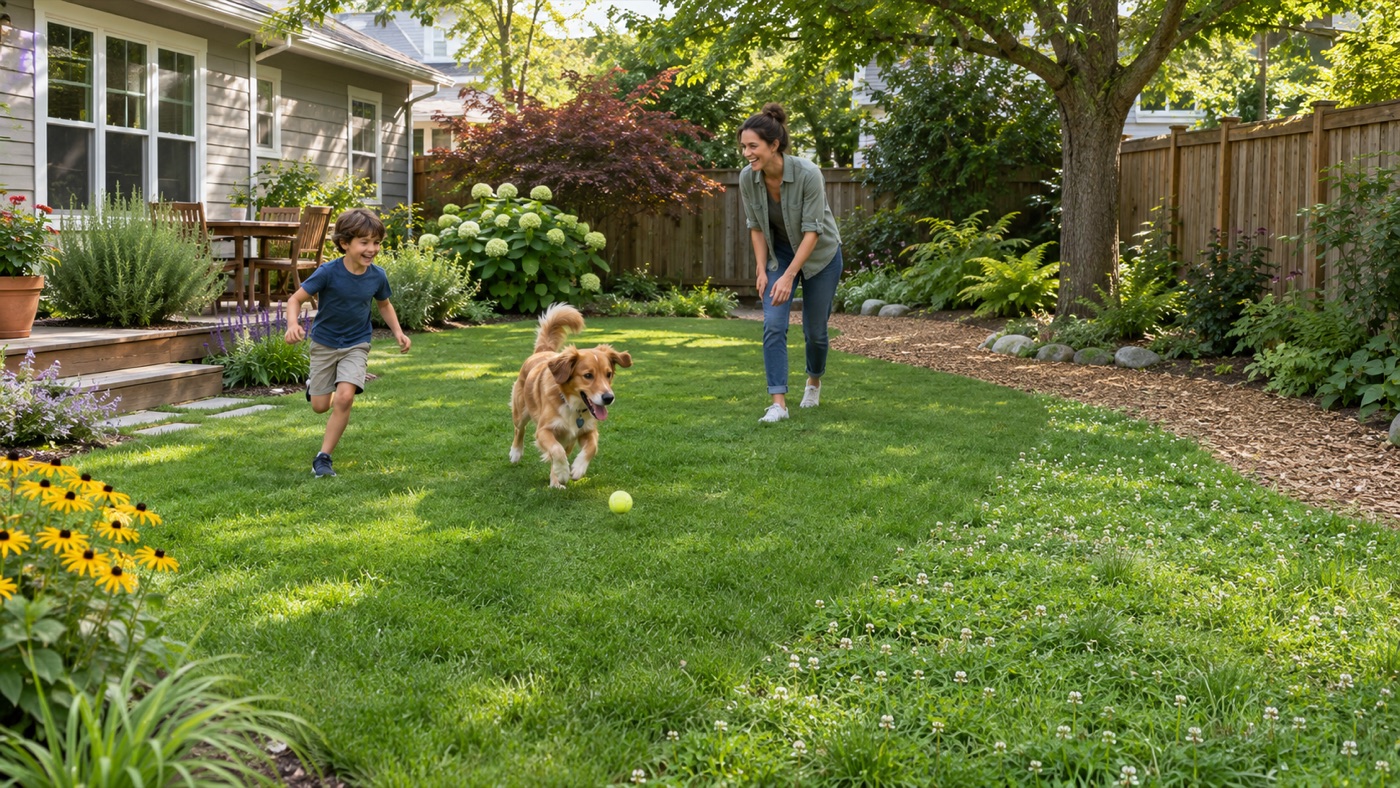
The best lawn alternatives for dogs rarely involve one plant spread from fence to fence. A dog that sprints along a fence, children who play ball and adults who cross the same route every day create concentrated wear that many low-growing alternatives cannot repair quickly. The most reliable design is a mixed-use yard: keep a durable, regionally adapted surface where activity is intense, place lower-input living alternatives in lighter-use areas and turn predictable traffic lines into intentional paths.
This guide compares lawn alternatives for dogs by traffic, urine exposure, shade, climate and maintenance. It also explains why “dog-proof grass” and “urine-resistant seed” claims deserve caution.
Start with use, not a seed packet
University of Maryland Extension notes that lawn remains useful for children’s play, pet runs and sports even when other parts of a property can become gardens, groundcovers or native plantings. That distinction is important. Replacing unused turf can reduce inputs and add habitat; replacing a working play surface with a fragile groundcover usually creates mud, weeds and repeated replanting.
Walk the yard after rain and during a normal week. Mark these four conditions:
- High-use routes: the line from the door to the gate, fence patrols and the turn around play equipment.
- Activity areas: fetch, ball games, outdoor seating and the place where a dog launches or stops.
- Relief areas: repeated urine or feces locations, especially in a small yard.
- Low-use pockets: slopes, side strips, tree edges and corners that are mostly visual.
Those zones do not need the same surface. A path is not a design failure; it is often the honest answer to concentrated traffic.
Best lawn alternatives for dogs at a glance
| Surface | Realistic traffic level | Where it fits | Main limitation |
|---|---|---|---|
| Regionally adapted turf | Moderate to high, depending on species and management | Fetch, children’s play and the main usable lawn | Still needs correct mowing, soil care and water; concentrated urine can injure it |
| Turf plus white clover | Light to moderate | Cool-season lawns where a mixed appearance is acceptable | Clover alone has poor traffic tolerance; flowers attract bees; broadleaf herbicides are incompatible |
| Yarrow or an ecolawn mix | Light to occasional | Sunny, lower-use panels where regional guidance supports it | Not a dog run; flowering and appearance vary by season and mowing |
| Fine fescue | Light | Cool-season, low-input or partly shaded lawn areas | University of Maryland Extension cautions that fine fescues do not handle foot traffic well |
| Buffalograss | Light to moderate, not concentrated | Sunny Great Plains and suitable interior-West sites | Winter dormancy, poor shade performance and slow recovery from constant traffic |
| Sedges and groundcovers | None to light, species-dependent | Protected shade, tree edges and awkward low-use spaces | Many stems break under traffic and compacted soil limits roots |
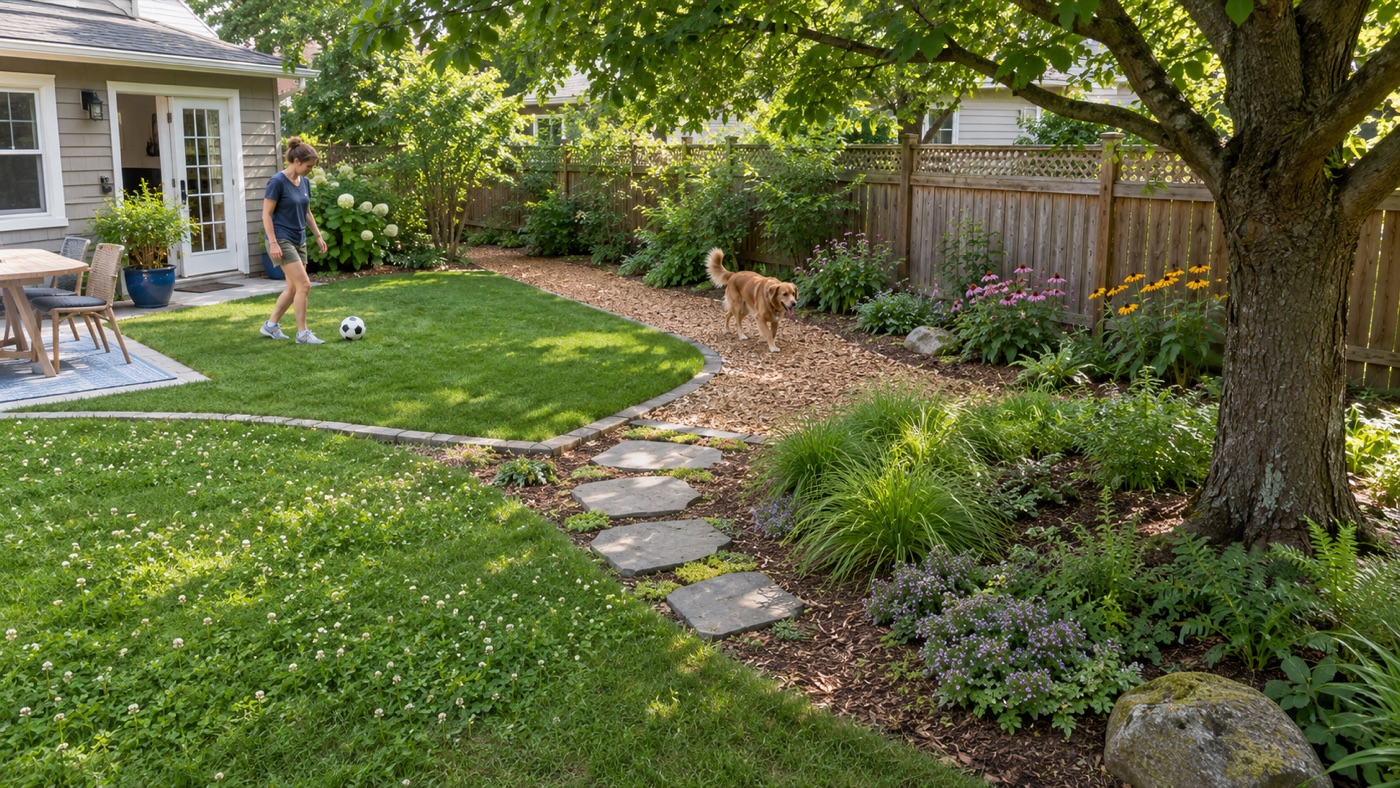
| Natural wood-chip path | High pedestrian and dog-route use | Fence lines, gate routes and designated relief areas | Needs edging and replenishment; cocoa mulch is unsafe for dogs |
| Pavers or permeable hardscape | High | Doorways, narrow passages and outdoor living zones | Cost, heat and drainage must be considered; local rules may apply |
No column means “indestructible.” Wet soil, compaction, poor drainage and a dog repeatedly pivoting in one place can defeat even a traffic-tolerant turf. Select the surface for the county and site, then manage the intensity of use.
Where lawn alternatives for dogs need durable turf
Among lawn alternatives for dogs, a smaller functional turf panel can be the lowest-friction choice for active use. Reducing lawn does not require eliminating every square foot; the rest of the property can become a lower-input landscape.
In cool-season regions, turf-type tall fescue is often selected where traffic and drought tolerance are priorities. Kentucky bluegrass can repair through underground rhizomes, while perennial ryegrass establishes quickly and is commonly used in traffic-tolerant mixtures. The best blend depends on winter cold, summer heat, irrigation expectations, disease pressure and local cultivars.
In warm-season regions, bermudagrass is widely used for high-wear athletic surfaces because compatible cultivars can tolerate traffic and recover during active growth. It also spreads aggressively, becomes dormant in cool weather and performs poorly in meaningful shade. Zoysiagrass forms dense turf but can recover more slowly from injury. St. Augustinegrass, centipedegrass and other regional choices have different shade, cold and traffic limits.
Do not select a national “pet lawn” mix by the picture on the bag. Ask the state or county Extension turf program which species and cultivars are recommended for a home lawn with traffic in your location. Then buy seed with a complete analysis label.
Clover as one of the lawn alternatives for dogs
Clover is frequently promoted among lawn alternatives for dogs, but its limits matter. White clover can remain green with less nitrogen fertilizer, tolerate close mowing and fill some openings in a cool-season lawn. It is useful in a mixed surface with light or moderate household use. It is not a proven solution for a narrow dog run.
University of Minnesota Extension describes white clover as having poor traffic tolerance in lawn guidance. It can also thin in shade and may disappear seasonally in cold climates. A turf-and-clover mixture spreads risk: grass supplies a more continuous wear surface while clover adds nitrogen fixation and flowers. Our clover versus microclover lawn guide explains why microclover is a selected type of white clover, not a separate traffic-proof species.
Flowering clover attracts bees. That can be an ecological benefit, but it may not fit the exact area where children play barefoot or a dog snaps at insects. Mow a separate activity strip before peak flower or keep the flowering mix in a lower-use zone. Households with a severe sting allergy should discuss risk with a medical professional.
Yarrow and ecolawn mixes as lawn alternatives for dogs
Yarrow appears in some lists of lawn alternatives for dogs, yet it belongs in a lighter-use zone. It can form a mowable, drought-tolerant component of some western and cool-season mixed lawns. Its feathery foliage and broad regional range make it attractive, but performance differs among seed sources, climates and mowing regimes. It may spread beyond its intended edge and should not be presented as universally native or universally pet-safe to ingest.
Use it in a sunny panel crossed occasionally, not where a dog brakes hard every day. The same applies to most “ecolawn” blends of fine fescue, clover, yarrow and low flowers. Their strength is diversity under moderate inputs; their weakness is concentrated wear. Compare regional and establishment limits in our yarrow lawn alternative guide.
Native grasses as lawn alternatives for dogs
Native grasses are site-specific lawn alternatives for dogs, not a universal upgrade. A native-grass label does not automatically mean low maintenance under family traffic. Turf-type buffalograss can be a useful warm-season lawn in sunny parts of the Great Plains and interior West, but Colorado State University Extension cautions against small, heavily used sites and constant concentrated traffic. It also turns straw-colored in dormancy and establishes slowly.
A broad buffalograss panel used occasionally is different from a five-foot-wide run between a gate and patio. Put stepping stones or a path in the latter. Review the climate, sun and establishment tradeoffs in our buffalograss lawn guide and the broader comparison of a native lawn versus traditional turf.
Sedges and groundcovers as lawn alternatives for dogs
Sedges and groundcovers can be useful lawn alternatives for dogs only in protected areas. They can replace turf under trees or along shaded borders, but they are usually planting-bed surfaces, not playing fields. University of Maryland Extension warns that not all groundcovers tolerate traffic as well as lawn: stems can break and roots may not tolerate compacted soil.
Create a clear path through the planting instead of expecting people and dogs to weave through it. Never add deep soil over mature tree roots to make a new lawn, and verify every plant against regional invasive lists and a reliable pet-toxicity resource. Our guide to shade lawn alternatives starts with soil moisture, root competition and traffic rather than a generic plant list.
The most reliable high-traffic alternative: an intentional path
For concentrated routes, the most reliable lawn alternatives for dogs may not be living plants. If a bare line reappears after every reseeding, the dog has already designed the path. Formalize it with a material that drains, is comfortable under paws and can be maintained.
- Natural wood chips: forgiving underfoot and useful along fence routes. Install over prepared soil with containment, not against tree trunks, and replenish as the material decomposes.
- Compact gravel: can drain well but angular stone, heat and displaced pieces may be uncomfortable. Choose size and depth carefully and provide shade.
- Permeable pavers: stable for doorways and narrow passages when installed on the correct base. Surface temperature and runoff still matter.
- Conventional hardscape: practical for a patio, but it should not send runoff toward foundations or neighboring property.
Avoid cocoa-bean mulch. The ASPCA and Penn State Extension warn that it contains chocolate-related compounds that can cause serious illness if a dog eats enough. Penn State suggests natural wood chips such as cedar or pine instead, while noting that some pets may be sensitive to dyed products.
How lawn alternatives for dogs handle urine
Dog urine spots are not simply a pH problem. Colorado State University Extension explains that concentrated nitrogen compounds and salts deposited in a small area can injure or kill turf. Any dog that releases a large volume in one place can cause a spot; sex and breed are not reliable explanations.
That evidence leads to practical actions:
- Designate a relief area. Training the dog to use a non-turf surface or a visually unimportant zone is the only sure landscape solution identified by CSU.
- Dilute promptly where practical. Water is the useful treatment for accumulated salts. Do not saturate the whole yard or violate water restrictions.
- Repair with the same turf. Remove dead material, loosen the surface and use the compatible seed or sod recommended for the existing lawn.
- Skip unproven remedies. Gypsum, baking soda, detergents and lawn sprays are not scientifically proven cures and can add salts or injure plants.
- Protect the dog. Do not change food, add salt or give a urine-pH supplement for the lawn. CSU recommends consulting a veterinarian before any dietary additive; such products may cause unintended health problems.
A plant advertised as “urine resistant” may still fail under repeated concentrated deposits. Surface design and behavior are more dependable than a product claim.
How to design zones with lawn alternatives for dogs
1. Draw the traffic map
Observe for at least a week. The winter route may differ from the summer route, and a wet corner may receive more damage than a dry one. Note fence patrols, tight turns, digging sites, shade and standing water.
2. Keep the active zone simple
Put the most wear-tolerant locally recommended surface where play actually occurs. Avoid tiny plant islands in the middle of a fetch line. Rounded edges and generous paths reduce accidental trampling.
3. Convert the persistent route
Make the dog’s preferred line a path before spending money on another bag of seed. A path can connect the door, relief area and gate while also protecting lower-input plantings.
4. Add living alternatives outside the wear corridor
Choose clover mixtures, yarrow, fine fescue, buffalograss, sedges or other groundcovers only after matching light, soil moisture, climate and realistic traffic. Start with one bounded trial area so failure does not affect the entire yard.
5. Separate water needs
A turf play zone, a clover mix and a native planting should not automatically share one sprinkler schedule. Group plants by water need and adjust coverage rather than increasing every zone. If parts of the lawn are dry while paths stay wet, use our guide to diagnose dry spots, runoff and sprinkler overspray.
How to establish or repair without losing the new planting
Traffic control matters as much as seed. A family yard needs a temporary plan while roots establish.
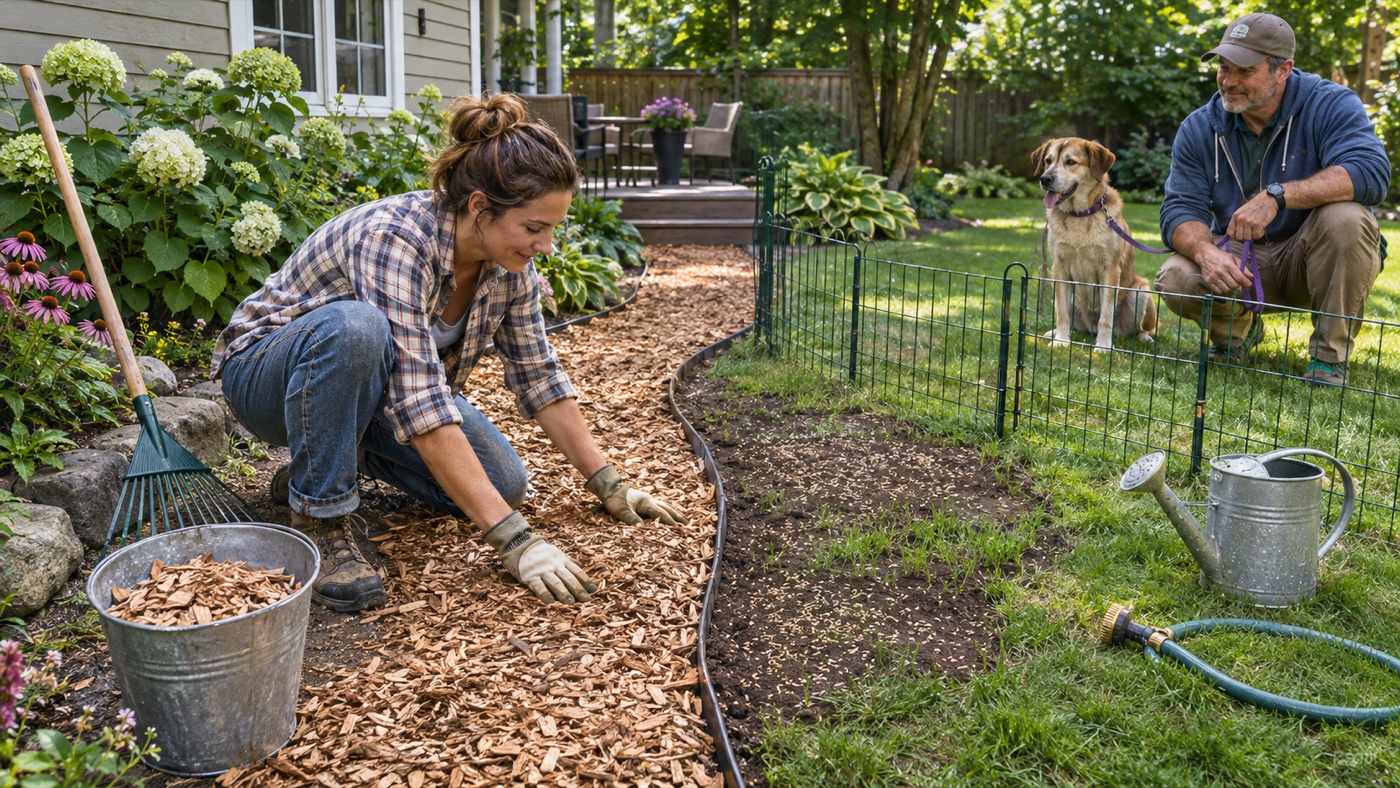
- Use a low temporary fence and provide another route before preparing soil.
- Correct drainage and moderate compaction first; seed does not fix standing water.
- Plant in the regional window for the chosen species, not on an arbitrary national calendar.
- Measure seed and maintain surface moisture during germination without creating puddles.
- Wait for adequate rooting and multiple mowings before returning to normal use.
- Open sections gradually if the dog can be directed to a durable route.
For small urine-killed spots, Colorado State gives species-specific repair advice. Kentucky bluegrass lawns may be spot-seeded with bluegrass or more effectively with perennial ryegrass; turf-type tall fescue should be repaired with compatible turf-type tall fescue; zoysiagrass and bermudagrass are commonly patched with matching sod. Local guidance should override a generic repair mix.
Pet safety beyond the lawn surface
“Natural” does not mean safe to chew. Before planting, check the scientific name against a veterinary toxic-plant database and confirm the exact cultivar when possible. A dog may ignore a plant for years and investigate it after pruning, stress or a change in routine.
- Keep fertilizers, pesticides and compost inaccessible and in their original labeled containers.
- Follow the pesticide label’s pet re-entry directions; do not estimate a drying time.
- Avoid cocoa mulch and discourage chewing of any mulch.
- Remove sharp edging, exposed landscape staples and persistent plastic netting.
- Provide shade and drinking water; gravel, pavers and synthetic surfaces can become hot.
- Consult a veterinarian or animal poison-control service immediately after a suspected ingestion.
Synthetic turf is sometimes marketed as the maintenance-free pet answer, but it is not biologically equivalent to a lawn. Heat, odor, drainage, cleaning, infill migration, installation materials and end-of-life disposal all require evaluation. This guide focuses on living and permeable landscape choices; a synthetic system should be compared as a construction project, not as seed.
Regional decision guide
- Cool, humid North and Upper Midwest: consider a durable cool-season turf panel, with turf-and-clover or an ecolawn in lighter-use areas. Fine fescue belongs in low-traffic zones.
- Transition zone: heat, cold and disease pressure overlap. County-level cultivar guidance is especially important; do not assume a northern or Deep South mix will persist.
- Southeast and Gulf Coast: select among locally adapted warm-season grasses first. Clover and northern fine-fescue recipes are not direct replacements for bermudagrass, zoysiagrass, centipedegrass or St. Augustinegrass.
- Great Plains and suitable Interior West: buffalograss can reduce inputs in sunny, lighter-use panels, while the dog route may still need turf, chips or pavers.
- Arid Southwest: shrinking the active lawn and hardening only the necessary route can be more realistic than maintaining a broad green surface. Verify water rules and heat exposure.
- Pacific Northwest: regionally tested ecolawn mixtures may suit moderate-use sites, but winter wetness, summer dormancy and shade still control performance.
A simple decision checklist
Keep a smaller turf panel if the area is used for fetch, running or regular family play and a locally adapted species can be maintained responsibly.
Try a turf-and-clover or ecolawn mix if traffic is light to moderate, flowers and seasonal variation are acceptable, and the mix is compatible with the region.
Choose sedges or groundcovers if the area is shaded or awkward and can be protected from daily traffic.
Build a path or relief area if the same bare line or urine spots return after every repair.
Do not convert yet if drainage, compaction, irrigation coverage or pet access has not been addressed. The underlying problem will follow the new surface.
Frequently asked questions about lawn alternatives for dogs
What is the most durable grass alternative for dogs?
For the most concentrated dog route, a properly installed wood-chip path, permeable pavers or another suitable nonliving surface is usually more dependable than a groundcover. For a play lawn, locally adapted traffic-tolerant turf may remain the best living surface.
Is clover better than grass for dog urine?
Clover may react differently from turf and can fill some openings, but it is not immune to concentrated urine or trampling. A grass-and-clover mix can be useful under moderate use; a designated relief zone is more reliable for repeated deposits.
Can dogs run on a yarrow lawn?
Occasional crossing may be compatible with an established yarrow or ecolawn mix, depending on climate and cultivar. Repeated sprinting, braking and fence running are likely to thin it. Keep that activity on a durable turf or path zone.
What can neutralize dog urine in grass?
Colorado State University Extension identifies water as the useful way to dilute accumulated salts. Baking soda, gypsum, detergents, dietary supplements and spray-on miracle products are not proven cures. Never change a dog’s diet for the lawn without veterinary guidance.
Is mulch safe for a dog run?
Natural wood chips can be practical when contained and replenished, but dogs should not chew them. Do not use cocoa-bean mulch because it contains compounds associated with chocolate toxicity. Inspect for splinters, mold and foreign material.
How long should dogs stay off new seed?
Until the plants are rooted well enough to resist pulling and have reached the establishment milestone recommended for the species—often after several mowings for turf. Calendar time varies with temperature, moisture and growth. Use temporary fencing and a separate route rather than testing new seedlings too early.
Sources and further reading
- Colorado State University Extension: Dog Urine Damage on Lawns
- University of Maryland Extension: Lawn Alternatives
- University of Maryland Extension: Groundcovers
- University of Maryland Extension: Growing Grass in the Shade
- University of Minnesota Extension: Renovating a Lawn for Quality and Sustainability
- University of Minnesota Extension: Dutch White Clover
- Penn State Extension: Petscaping—Creating a Pet-Friendly Garden
- ASPCA: Expert Tips on Gardening With Pets
Last reviewed: November 4, 2026. Turf recommendations, invasive status, plant toxicity information, water restrictions and pesticide labels can change. Confirm species, products and construction details with your state or county Extension program, veterinarian and local authorities before installation.