
A buffalograss lawn can be an excellent low-water choice for a sunny yard in the Great Plains and parts of the interior West. Once established, this native warm-season grass tolerates heat, cold and drought with less mowing and fertilizer than many conventional lawns. It is not a universal replacement for turf: it greens up late, turns straw-colored after the first hard frost, thins in shade and does not tolerate concentrated, constant traffic.
The lowest-risk approach is to match the grass to the site before buying seed, plugs or sod. Buffalograss works best in full sun, on a well-drained loam or clay-loam soil, where a long winter-brown period is acceptable. A shaded backyard, wet depression, salty soil, narrow dog run or heavily used play area usually needs a different surface.
Buffalograss lawn: the short answer
| Question | Practical answer |
|---|---|
| Is buffalograss native? | Bouteloua dactyloides, formerly Buchloë dactyloides, is native to the North American Great Plains. That does not mean every cultivar or seed source is locally appropriate. |
| How much water does it need? | Established turf can survive drought by going dormant. In Colorado guidance, roughly 1–2 inches of rain plus irrigation every 2–4 weeks can maintain active summer growth. Other climates and soils require local guidance. |
| Will it stay green all year? | No. It is a warm-season grass that greens up in late spring and becomes straw-colored after a hard fall frost. |
| Does it grow in shade? | Poorly. It generally needs at least half a day—and preferably 6–8 hours—of direct sun. |
| Can it handle children and dogs? | Light, dispersed use is reasonable. Repeated running, a fence-line dog route, sports or a daily shortcut can wear it thin. |
| Seed, plugs or sod? | Seed is cheaper but slower and more vulnerable to weeds. Plugs cost more and must spread. Sod gives the fastest, most uniform cover but is usually the most expensive and least available. |
| Is it maintenance-free? | No. It needs intensive establishment care, weed control and occasional mowing. Too much water and nitrogen can make weeds more competitive. |
| Can it replace any existing lawn? | No. Climate, sunlight, drainage, soil salinity, elevation, traffic and desired winter appearance determine whether conversion makes sense. |
Colorado State University Extension describes newer turf-type buffalograss cultivars as capable of remaining attractive with substantially less irrigation than Kentucky bluegrass under Colorado conditions. The same source warns that producing a lawn from seed can be labor-intensive and frustrating. Both statements matter: the long-term savings begin only after a successful establishment period.
What buffalograss actually is
Buffalograss is a low-growing perennial grass adapted to the shortgrass prairie. It spreads through stolons—aboveground runners that root at their nodes—rather than forming isolated bunches. That growth habit allows it to knit into turf and repair small openings during warm weather.
It grows actively from late spring through summer. When soil temperatures and daylight fall, the grass enters dormancy and loses its green color. This is a normal survival strategy, not automatically a sign that the lawn is dead. Spring green-up is later than that of Kentucky bluegrass or tall fescue, so a mixed neighborhood can make buffalograss look brown for weeks after surrounding cool-season lawns have awakened.
Buffalograss plants are commonly dioecious: male and female flowers occur on separate plants. Seeded cultivars normally produce a mixture of male and female plants. Some vegetatively propagated turf cultivars are female selections, which can create a more uniform surface without the taller male pollen stalks. The tradeoff is a higher price and establishment by plugs or sod rather than seed.
Where a buffalograss lawn works best
A sunny Great Plains or interior-West site
The strongest fit is a sunny property within or near the species’ native climatic range: hot summers, cold winters and periodic drought. State Extension recommendations should still guide cultivar selection. A cultivar that survives a Colorado Front Range winter may not be the best choice for Oklahoma heat, and a southern vegetative selection may winterkill farther north.
Well-drained loam or clay-loam soil
Kansas State Research and Extension identifies well-drained loam as ideal and notes that establishment can be slower in clay or compacted soil. Buffalograss is not well suited to wet ground or persistent ponding. Very sandy soil can also be a poor fit without supplemental irrigation because its limited water-holding capacity conflicts with the plant’s need for an adequately moist root zone during establishment.
A lawn with light or dispersed traffic
An established surface can handle normal maintenance and occasional gatherings. It is less reliable where feet or paws repeatedly follow the same line. Use stepping stones from the gate to the patio, keep a durable play surface under goals or furniture, and do not expect a small buffalograss panel to function as both ornamental lawn and dog run.
A household that accepts seasonal dormancy
The lawn will be brown for a meaningful portion of the year in cold-winter regions. Overseeding it with a cool-season grass for winter color adds water, mowing and competition, undermining the low-input goal. If year-round green is essential, compare the real annual maintenance of another regionally adapted turf rather than trying to force buffalograss to look like a different species.
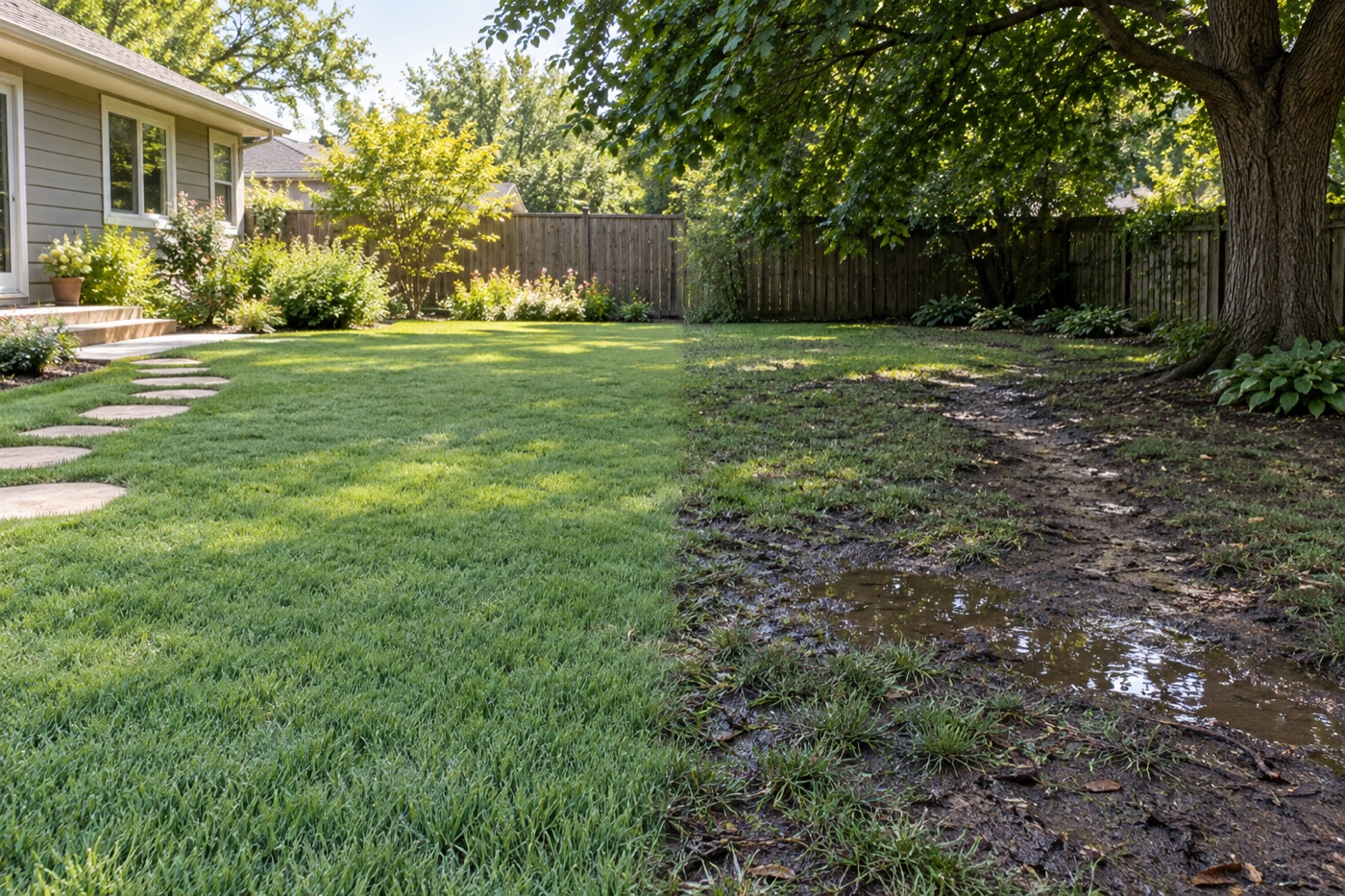
Where buffalograss is likely to fail
Dense shade
Buffalograss has poor to fair shade tolerance. Colorado State recommends at least half a day of full sun, while Kansas State describes 6–8 hours of direct sunlight as enough for acceptable turf. Under a dense tree canopy, the stand becomes thin and weeds gain space. Removing a few low branches may improve light, but irrigation cannot compensate for deep shade.
Wet soil or frequent irrigation
A low-water grass should not be placed in a drainage problem. Frequent irrigation encourages species that grow faster than buffalograss, while saturated soil restricts roots. Diagnose broken heads, overspray and runoff before conversion. Our guide to lawn dry spots, runoff and sprinkler overspray helps distinguish a coverage problem from a plant-selection problem.
Heavy, constant traffic
Colorado State cautions against using buffalograss on small, heavily used lawns and other areas where traffic is both concentrated and constant. A broad lawn crossed occasionally is different from a narrow strip used every day. Put the path where people already walk instead of repeatedly reseeding the worn line.
Coastal humidity, salinity or a climate outside the adaptation range
Native status is regional, not a national performance guarantee. Buffalograss is not automatically the right choice for the humid Southeast, rainy Pacific Northwest or saline coastal soil. High elevation can also shorten the already limited green season; Colorado State generally does not recommend it above about 6,500 feet except in favorable protected exposures.
A formal expectation of instant, dark-green turf
Buffalograss tends toward blue-green or gray-green rather than the saturated color of a heavily fertilized cool-season lawn. Seeded stands can show male flower stalks and slight variation. A turf-type vegetative cultivar can look more uniform, but it still has warm-season dormancy. Decide whether the appearance is acceptable before renovating the entire front yard.
Buffalograss vs. conventional lawn grasses
| Decision factor | Buffalograss | Kentucky bluegrass or tall fescue | Bermudagrass |
|---|---|---|---|
| Growth season | Warm season; late spring green-up and fall dormancy | Cool season; earlier spring and later fall color | Warm season; seasonal dormancy where winters are cold |
| Best regional fit | Great Plains and selected dry interior sites | Cooler regions where summer water is available | Warmer regions with strong sun |
| Summer water after establishment | Low; can survive drought by going dormant | Usually higher to remain green in heat | Low to moderate depending on quality target and climate |
| Shade tolerance | Poor to fair | Varies; tall fescue is generally more useful in partial shade | Poor |
| Traffic recovery | Fair for dispersed use; weak under constant concentrated use | Varies by species and management | Good during active growth with appropriate maintenance |
| Mowing and fertility | Low once established | Moderate to high for a dense green lawn | Moderate to high for premium turf |
| Establishment | Seed, plugs or sod; seeded sites can be slow and weedy | Seed or widely available sod | Seed for some types; plugs, sprigs or sod for others |
Buffalograss is not simply “better grass.” It is a different operating system. It saves inputs when the owner accepts its color, season and use limits. For a broader decision framework, compare native lawn vs. traditional turf.
Seed, plugs or sod: which method is safer?
| Method | Advantages | Limits | Best fit |
|---|---|---|---|
| Seed or seed burs | Lowest material cost; broader availability of seeded cultivars | Slowest visual result; intensive moisture and weed management; male and female plants create a less uniform surface | Large sunny area, patient owner and a clean prepared seedbed |
| Pre-rooted plugs | Allows high-quality vegetative cultivars; easier to verify plant identity | Higher cost; labor to install; open soil must be weeded while runners fill gaps | Small or medium lawn where uniform quality matters |
| Sod | Fastest coverage and erosion protection; least frustrating for many homeowners | Highest cost, limited local supply and still needs careful rooting irrigation | Visible front yard, slope or project where speed outweighs budget |
Seed labels deserve careful attention. Buffalograss is often sold as burs containing seed rather than as clean individual seed. Compare products using pure live seed or the supplier’s stated pure live bur method, not bag weight alone. Buy a named turf cultivar recommended by local Extension and reject a lot that lists problematic weed seed.
Colorado State’s 2025 cultivar guidance separates seeded varieties, which contain male and female plants, from female-only vegetative varieties available as plugs or sod. Recommendations change by region and winter hardiness, so a national list should never replace current local advice.
How to establish a buffalograss lawn
1. Evaluate the site before removing anything
Map direct sun, shade, daily traffic, sprinkler coverage, runoff, drainage and soil texture. Check local watering rules and whether the chosen cultivar is recommended for the state. A small trial panel through one winter and one summer is safer than a full conversion based on a catalog photo.
2. Eliminate incompatible vegetation and perennial weeds
Buffalograss seedlings grow slowly enough that existing turf and perennial weeds can dominate them. Choose a renovation method appropriate to the site, season and label law. Do not use a pre-emergent “crabgrass preventer” when seeding unless the product label and Extension guidance specifically allow it; many products also block the desired grass from establishing.
3. Prepare a clean, firm seedbed
Remove rocks and debris, correct drainage and loosen compaction without leaving deep, fluffy soil. Colorado State describes a dry seedbed firm enough that a person does not sink more than about an inch. Good seed-to-soil or sod-to-soil contact matters more than adding a superficial layer of rich compost.
4. Plant when the soil is warm
Buffalograss germinates and spreads during warm weather. Exact planting windows vary by latitude and cultivar. Colorado State allows spring through late July for seed but warns that seedlings emerging too late can be lost in winter. Oklahoma and Kansas recommendations differ. Use the local Extension window rather than a date copied from another state.
5. Use the recommended rate and depth
Colorado State and the USDA plant guide commonly describe 3–5 pounds of seed per 1,000 square feet and planting roughly 1/4–1/2 inch deep for residential broadcast seeding. That is not a universal rate for every coated product, bur lot or mixture. Follow the named cultivar’s label and local recommendation.
6. Keep the surface consistently moist during germination
Drought tolerance belongs to established turf, not new seedlings. The establishment phase can require as much water as bluegrass or tall fescue. Apply light irrigation often enough to prevent the surface from drying, without causing puddles or runoff. Then reduce frequency as roots form and coverage improves. A seasonal watering schedule by climate explains why minutes alone cannot be copied between systems.
7. Control weeds and traffic while the lawn fills in
Hand removal and timely mowing can prevent weeds from shading young plants. Keep people and pets off bare areas. Do not interpret every open space as a reason to add more fertilizer: extra nitrogen and water can favor weeds more than buffalograss.
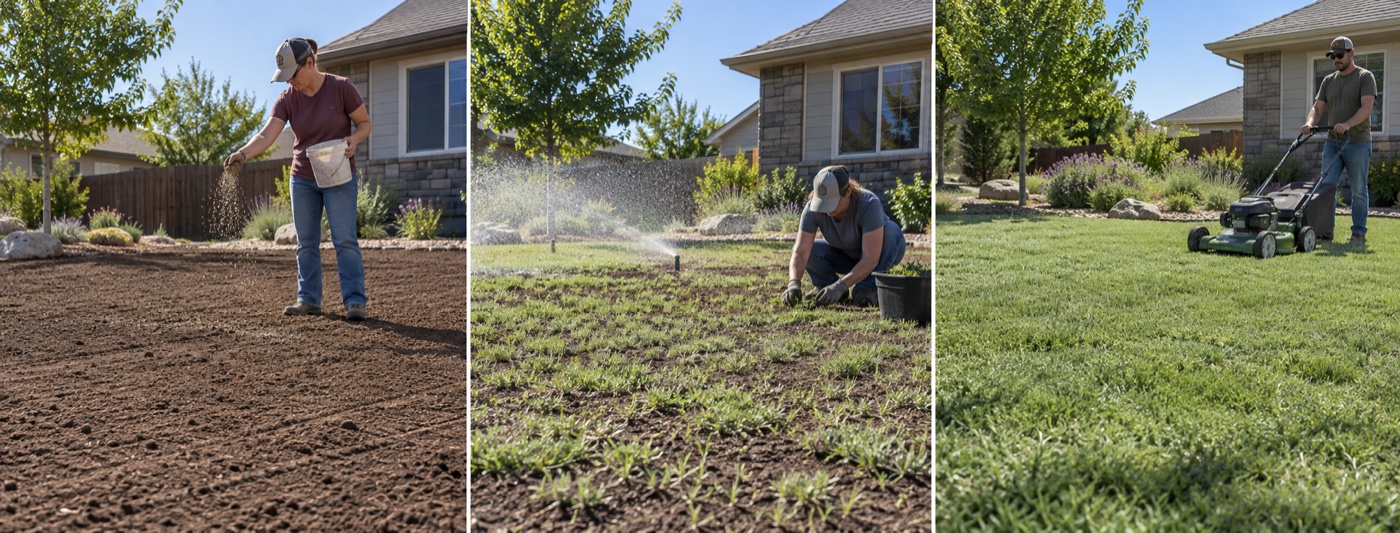
Watering an established buffalograss lawn
The correct schedule depends on the goal. A survival lawn can be allowed to turn brown during drought and recover when moisture returns. A lawn expected to remain actively green requires supplemental water, but normally far less often than a conventional cool-season lawn in the same dry climate.
Colorado State’s buffalograss guidance uses 1–2 inches of rainfall plus irrigation every 2–4 weeks during summer as a regional starting point for acceptable green growth, with deep and infrequent applications preferred. A separate CSU water-wise comparison notes that water demand changes with quality expectations. Treat both figures as Colorado evidence, not a nationwide controller program.
Measure what the system applies. Use catch cups to estimate distribution and inspect the soil before restarting a zone. Begin irrigation after spring growth starts if conditions are dry; watering dormant buffalograss early does not force earlier green-up and can encourage cool-season weeds. Our cycle-and-soak guide can reduce runoff on slowly infiltrating soil.
Mowing, fertilizer and weed control
Mow for use and appearance, not by calendar
Extension recommendations commonly place buffalograss around 1.5–3 inches, but cultivar and purpose matter. Mowing higher usually supports a relaxed lawn and shades some weed seedlings. Infrequent mowing can leave male flower stalks visible in a seeded stand. Use a sharp blade and remove no more than the plant can replace during active growth.
Keep nitrogen modest
Colorado State reports little benefit beyond roughly 2 pounds of total nitrogen per 1,000 square feet per growing season for established buffalograss and warns that excessive fertilizer combined with excessive water promotes weeds. Soil-test recommendations and local cultivar guidance should control the actual program.
Expect the establishment year to be the weedy year
Slow early coverage leaves sunlight and soil for annual weeds. After the stolons form a dense mat, competition improves. Identify a weed before treating it: a product safe for one warm-season grass may injure another, and some herbicides cannot be used on new turf. Follow the current label and ask Extension or a licensed lawn professional when identification is uncertain.
Regional reality check
| Situation | Likely result | Safer next step |
|---|---|---|
| Central or western Great Plains, full sun | Strong candidate when a locally tested cultivar is available | Compare seed, plugs and sod through local Extension |
| Colorado Front Range below the upper elevation limit | Well documented, but winter hardiness differs among cultivars | Use the current CSU cultivar list; do not buy a southern cultivar on name alone |
| Hot, humid Southeast | Native-range claims do not guarantee dense residential turf | Compare locally adapted warm-season species and disease pressure |
| Pacific Northwest wet winter or deep shade | Long dormancy, moisture and light can conflict with the species | Use regionally adapted groundcovers or cool-season low-input turf |
| Very sandy, droughty soil | May require more supplemental irrigation than expected | Test soil water-holding capacity and consider adapted grass mixtures |
| Saline soil or reclaimed-water exposure | Buffalograss has only fair salt tolerance | Test salinity and obtain a species recommendation before planting |
| Small lawn with constant play or dog traffic | High risk of worn paths and bare soil | Keep a durable turf or surfaced activity zone |
Common buffalograss claims checked
| Claim | More accurate expectation |
|---|---|
| “It never needs irrigation.” | Established plants can survive drought by going dormant. A green summer lawn and all new installations require water. |
| “Because it is native, it grows anywhere in the United States.” | It is native to a defined climatic and ecological range and has clear limits involving shade, moisture, salinity and elevation. |
| “It is maintenance-free.” | Mowing and fertilizer can decline, but weed control, edge management and establishment work remain. |
| “Seed is the same as sod.” | Seeded stands contain male and female plants and establish slowly. Vegetative female cultivars can be more uniform but cost more. |
| “Brown winter grass is dead.” | Seasonal straw color is normal. Check stolons and wait for warm conditions before declaring failure. |
| “Extra fertilizer will make it establish faster.” | Excess nitrogen and irrigation can increase weed competition; follow a staged establishment recommendation. |
Who should choose a buffalograss lawn?
Choose buffalograss when the property is sunny, drainage is adequate, the region and cultivar are compatible, water reduction is a priority and seasonal brown color is acceptable. It is especially useful for broad, lightly used lawn panels where conventional irrigation and weekly mowing provide little practical benefit.
Use it selectively when only part of the yard has the right conditions. Keep a durable activity surface near doors, play equipment or a dog route, and place buffalograss in the sunny low-traffic hydrozone. This follows the same function-first principle used when deciding between a yarrow lawn and an ecolawn mix.
Choose another surface for deep shade, persistent wetness, high salinity, concentrated constant traffic or a homeowner who requires green turf from early spring through late fall. No amount of smart irrigation can turn an unsuitable site into the plant’s preferred habitat.
Frequently asked questions
How much water does a buffalograss lawn need?
Established buffalograss can survive with little supplemental water by becoming dormant. To maintain active green growth, Colorado State uses about 1–2 inches of combined rainfall and irrigation every 2–4 weeks as a regional guide. Soil, heat, wind and desired appearance change that requirement.
How long does buffalograss take to establish?
Warm soil and consistent moisture can produce seedlings in roughly 7–21 days, but uniform coverage takes much longer and weed pressure can delay it. Closely spaced pre-rooted plugs can cover in a matter of weeks under favorable conditions; seed may require most of a growing season or longer to look complete.
Can buffalograss grow in shade?
It tolerates only limited shade. Aim for at least half a day and preferably 6–8 hours of direct sunlight. A thinning stand under dense trees is a site mismatch, not necessarily an irrigation failure.
Is buffalograss good for dogs?
It can tolerate occasional use across a broad lawn, but it is not ideal for a small dog run or repeated fence-line route. Concentrated traffic and urine can create thin areas. Provide a durable designated pet zone and distribute normal traffic with paths.
Should I plant buffalograss from seed or sod?
Seed is best when budget and area matter more than speed and uniformity. Sod is the fastest and least frustrating but costs more and may be hard to source. Plugs provide access to vegetative female cultivars and balance cost with quality for smaller projects.
Why is my buffalograss brown?
Fall and winter browning is normal dormancy. Summer browning can also be drought dormancy. Confirm the season, soil moisture and whether stolons remain firm before assuming death. Persistent wetness, herbicide injury, poor establishment or an unsuitable cultivar require a different diagnosis.
Can buffalograss be mixed with blue grama?
Regional native-lawn programs sometimes recommend buffalograss and blue grama mixtures, but proportions and management vary. A mix can change texture, establishment and mowing. Use a locally designed mixture rather than combining two bags without compatibility guidance.
Editorial note: This general U.S. guide was reviewed on October 28, 2026 using Colorado State University Extension’s peer-reviewed buffalograss guidance, its turfgrass selection guidelines and 2025 cultivar recommendations; Kansas State Research and Extension; Oklahoma State University Extension; and the USDA-NRCS Buffalograss Plant Guide. Water needs, planting dates, cultivar hardiness, pesticide options and invasive status of contaminants vary locally. Confirm the plan with Cooperative Extension, the seed label and the local water utility.