You can replace turf without herbicides, but the right method depends on the grass, season, sun, project size and what will be planted next. A sod cutter is the fastest option for an ordinary lawn. Sheet mulching is slower but keeps the soil covered. Solarization can work in hot, sunny weather. Opaque tarps, repeated digging and carefully timed cultivation fill narrower roles. None is a universal shortcut.
This guide compares the methods by speed, labor, soil disturbance and their ability to control persistent grasses. It also explains what to do with irrigation, tree roots and the exposed site before installing a new lawn alternative. Before choosing a method, compare removal, establishment and maintenance expenses in our lawn alternatives cost guide.
Before you replace turf without herbicides
Start with the destination, not the removal tool. A seeded clover mix, native grass, shrub bed, vegetable garden and permeable path need different preparation. If the lawn is still useful for play or dog traffic, retain a smaller functional section instead of removing it by default. Our guide to lawn alternatives for dogs and active families explains why concentrated use often belongs on durable turf or an intentional path.
Map these conditions before work begins:
- Grass and weeds: Determine whether the lawn is bunch-forming or spreads by stolons and rhizomes. Bermudagrass can regrow from small fragments and requires a more persistent plan.
- Sun and season: Solarization needs strong solar radiation and close soil contact. Sheet mulch and opaque covers take longer in cool weather.
- Tree roots: Do not run a sod cutter or tiller through major roots, add a deep soil layer over them or cover a broad root zone with impermeable plastic.
- Slope and drainage: Bare soil and plastic can redirect runoff. A steep site may require staged work, erosion protection or professional design.
- Irrigation: Locate heads, valves and drip lines. Decide which components will be capped, moved or reused before covering them.
- Buried utilities: Use the required local utility-location service before stakes, trenching or excavation, and follow municipal, HOA and rebate rules.
Also inspect the lawn while it is actively growing. A dormant warm-season lawn can look dead while its stolons and rhizomes remain viable. Removing turf before identifying it is one of the most expensive ways to create a recurring weed problem.
Methods to replace turf without herbicides at a glance
| Method | Typical working window | Best fit | Main limitation |
|---|---|---|---|
| Sod cutter or flat spade | Immediate removal | Conventional turf; projects that must be replanted soon | Heavy work, disposal and loss of some surface soil; does not reliably eliminate deep rhizomes |
| Sheet mulch | Several months to a season or more | Future shrub, perennial or mulched planting beds | Cardboard can restrict air and water temporarily; persistent grasses may escape through seams |
| Clear-plastic solarization | Often about 4–6 weeks under optimal summer conditions | Small, level, full-sun sites during the hottest local period | Weak in shade or cool weather; requires plastic disposal and exclusion of people and animals |
| Opaque tarp or occultation | Longer than solarization | Sites where light exclusion is practical but solar heat is inadequate | Timing is variable; perennial weeds may survive; water and gas exchange are restricted |
| Repeated dry-season cultivation | Multiple passes over weeks or months | Selected rhizomatous grasses where fragments can dry completely | Can spread the grass if soil is moist or rain/irrigation returns; disturbs soil and is not appropriate around roots |
The fastest method is not automatically the best. Match the removal method to the future planting date. If the replacement will be seeded, allow time to settle the site and control regrowth before sowing. If it will become a deep mulched bed, the turf may decompose in place.
Method 1: replace turf without herbicides with a sod cutter
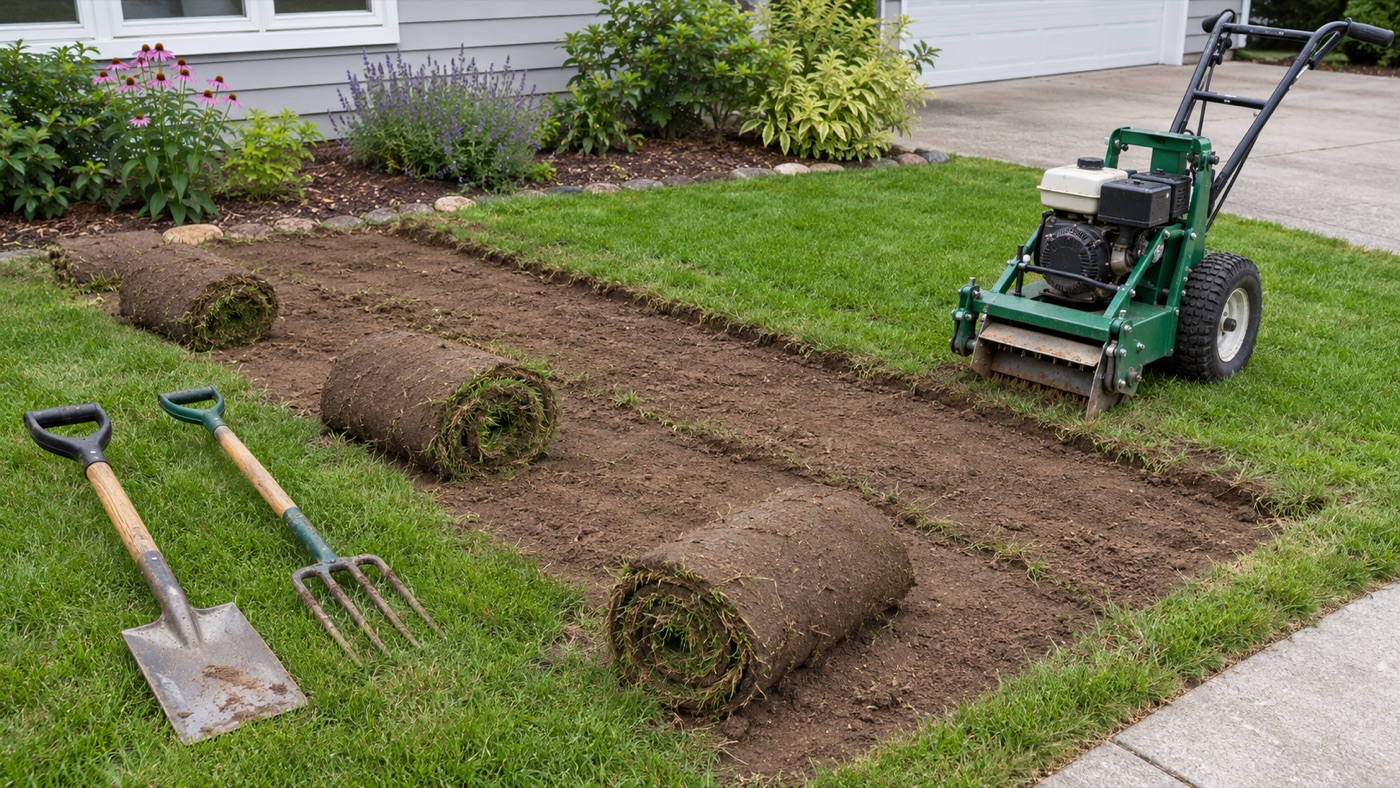
Physical removal gives the most predictable schedule. A powered sod cutter slices beneath the root zone so the turf can be rolled or lifted. A flat spade does the same job on a small patch. University and Extension guidance generally describes this as the quickest nonchemical approach, but it is not effortless.
Mow first and moisten dry soil enough to make cutting practical without turning it muddy. Mark irrigation components and protected roots. Set a rented cutter shallowly, following its manual and rental-company training, and test a short strip. Removing more soil than needed increases weight, disposal volume and the amount of topsoil lost from the site.
What to do with the sod
Healthy sod may be reusable if it is moved promptly and is free of regulated weeds, pests and herbicide residues. Local green-waste rules determine whether it can be collected. It can also be turned grass-side down and composted in an appropriate part of the property, but that changes a fast removal method into a slower decomposition project.
Do not move bermudagrass or another aggressive spreading grass to a clean area. UC Integrated Pest Management notes that fragments of bermudagrass stolons and rhizomes can root and produce new plants. Keep suspect material contained and follow local disposal guidance.
Where a sod cutter is a poor choice
- Over exposed or shallow tree roots.
- On a steep, wet or irregular site where the machine cannot be controlled safely.
- Where irrigation lines and utilities have not been located.
- Where deep rhizomes will immediately recolonize the cleared soil.
- When there is no plan for heavy rolls of sod and displaced soil.
Method 2: replace turf without herbicides using sheet mulch
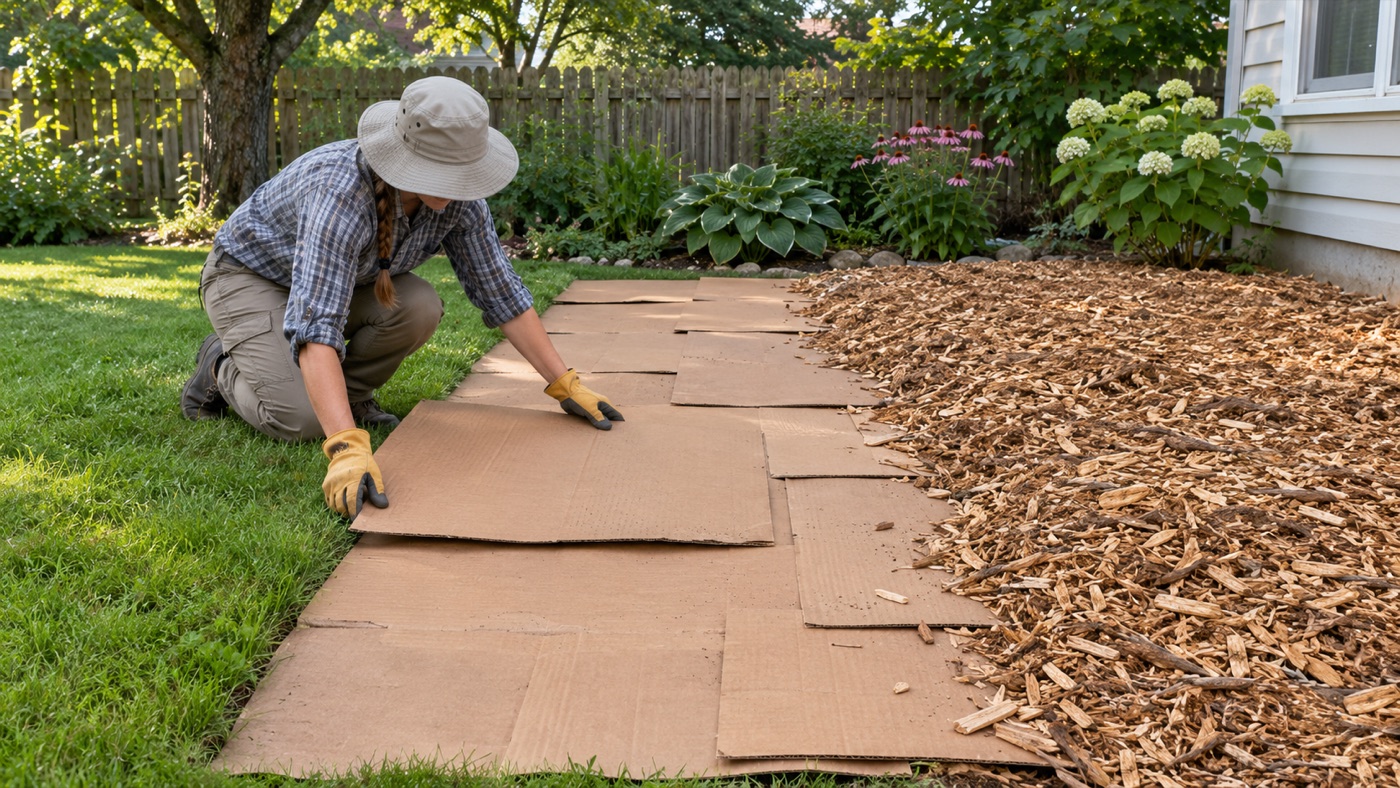
Sheet mulching excludes light while keeping the dead turf and much of its organic matter in place. It is most compatible with a future planting bed that will remain mulched—not with a lawn-like surface that must be seeded immediately. The method is inexpensive, but the details and limitations matter.
Begin by mowing low and removing invasive seed heads. Define a clean edge next to sidewalks so the finished material does not spill onto pavement or direct water toward structures. Address irrigation before applying the barrier. If plain brown corrugated cardboard is used, remove tape, labels and staples, overlap seams, wet it thoroughly and avoid creating an unnecessarily thick layer. Cover it promptly with a stable layer of arborist chips or another locally appropriate organic mulch.
Oregon State University Extension cautions that cardboard creates an interface that can temporarily limit water and air flow. The effect depends on soil, precipitation, thickness and the condition of plants whose roots extend beneath the area. UC IPM likewise notes that it can be difficult to judge soil moisture below sheet mulch. Do not assume that “more cardboard” is better.
Planting through sheet mulch
For a few shrubs or perennials, installation can be staged. Place irrigation first, allow the turf to decline, then pull mulch aside and cut only the opening needed for each plant. Plant into the underlying soil rather than a pocket of loose mulch. Keep cardboard and wood chips away from trunks and crowns, and restore the mulch without piling it against stems.
For closely spaced plugs, groundcovers or seed, waiting until the barrier has broken down is usually more practical. A seedbed needs soil contact; seed scattered over intact cardboard and coarse wood chips will not create a lawn alternative. This matters for a clover or microclover lawn, a yarrow lawn or any fine-textured mixture.
When sheet mulch is likely to fail
Persistent grasses can find edges, irrigation openings and planting holes. UC guidance warns that ordinary wood-chip mulch alone is not reliable against established bermudagrass. Bindweed, nutsedge and other perennial weeds also need species-specific management. Inspect edges regularly and remove escapes before they rebuild underground reserves.
Sheet mulch is also a poor fit where it could smother existing desirable plants, redirect runoff, cover a broad mature-tree root zone or remain exposed in a windy area. Check local rules and rebate requirements before starting; some programs specify acceptable materials, inspection stages and minimum converted area.
Method 3: replace turf without herbicides by solarization
Solarization uses clear transparent plastic to trap solar energy and heat moist soil. It is not the same as covering a lawn with black plastic. UC IPM explains that clear film transmits solar radiation and holds heat near the surface, while effective treatment depends on moisture, close contact, high solar radiation and sealed edges.
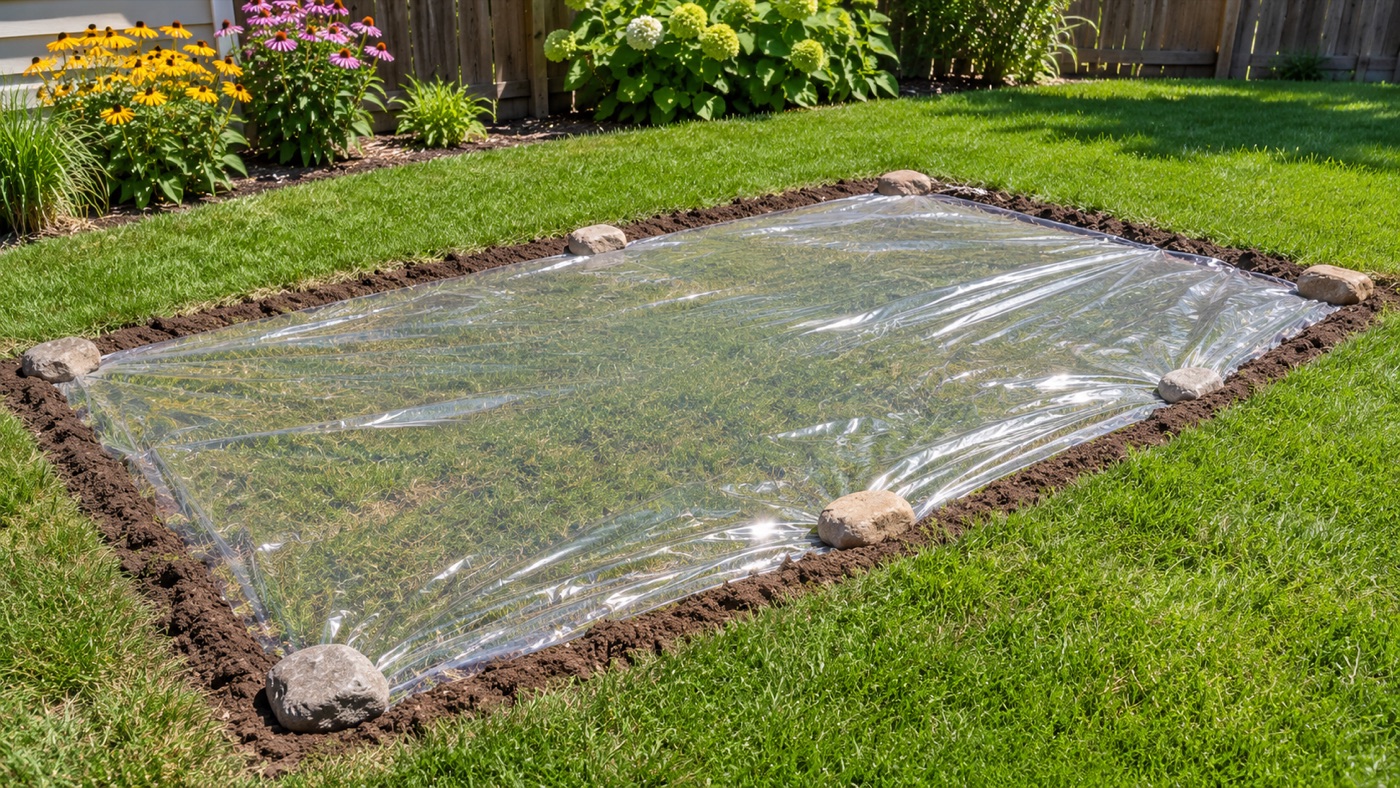
Closely mow and remove bulky clippings so the plastic lies near the surface. Irrigate the soil, then cover the entire area with clear plastic and bury or securely seal the perimeter. Patch tears promptly. Keep children, pets and wildlife away from the covered area. Remove the film before it becomes brittle and fragments, and dispose of it according to local rules.
Many Extension sources describe a roughly four-to-six-week treatment under favorable summer conditions, but this is not a universal calendar promise. Cloud, coastal fog, shade, latitude, slope orientation and air temperature all change performance. A site that receives only morning sun may never reach a useful temperature.
What solarization can and cannot do
Solarization can kill ordinary turf and reduce some weed seeds and soilborne pests. UC IPM reports that shallow bermudagrass rhizomes may be controlled under optimal conditions, while deeper rhizomes and some perennial weeds are less predictable. A suboptimal early-season treatment can fail and should not be presented as guaranteed eradication.
Heat also affects nontarget soil organisms and any small animals trapped beneath the sheet. Do not use the technique in an intact native habitat or over roots that must remain healthy. Once the cover is removed, avoid deep cultivation that brings buried weed seed back to the surface, and replant promptly so bare soil does not erode or refill with weeds.
Method 4: replace turf without herbicides using occultation
Occultation excludes light with an opaque tarp rather than heating the soil through clear plastic. University of Minnesota Extension distinguishes it from solarization and notes that it generally takes longer. It can be useful where a reusable tarp can remain undisturbed for an extended period, but the exact duration varies with grass species, temperature, soil moisture and season.
Use a durable, intact cover that can be secured without creating trip hazards or directing runoff toward buildings. Avoid flimsy material that will shred. Because an opaque cover restricts light, water and gas exchange, do not extend it over plants or roots that must survive. Check periodically for edge growth, damage and animal activity without repeatedly uncovering the treatment.
Occultation is not a promise that every rhizome is dead. After removal, wait for a flush of regrowth before investing in plants. Dig recurring shoots and reassess whether another treatment cycle is needed.
Before you replace turf without herbicides over bermudagrass
Replacing a cool-season bunchgrass is different from removing bermudagrass. UC IPM describes bermudagrass as extremely difficult to control because its aboveground stolons and underground rhizomes root at their nodes; cut fragments can regrow in moist soil. A shallow sod cut may improve the surface while leaving the system that produced it.
Nonchemical control can require repeated removal, summer drying, solarization under optimal conditions or an opaque barrier installed without gaps. Cultivation is a special strategy, not a default recommendation. In dry summer conditions, repeated cultivation can bring rhizomes to the surface to desiccate. If the soil is wet or rain and irrigation return, chopped fragments may root and spread the problem.
Do not till bermudagrass once and immediately install an irrigated garden. That combines fragmentation with the moisture needed for regrowth. For a heavily infested site, consult the state or county Extension program and build follow-up monitoring into the project schedule.
Why not rototill when you replace turf without herbicides
A tiller can make the surface look finished while creating several problems: it mixes living turf pieces into the soil, brings weed seed upward, breaks soil structure when used wet and can damage irrigation and roots. With rhizomatous grass, one pass may multiply the number of viable fragments.
Use cultivation only when it serves a defined purpose, the soil moisture is appropriate, underground hazards are known and follow-up is planned. A broad conversion project does not automatically need deep tillage. After sod removal, many sites need only minor grading, compaction correction where documented and preparation appropriate to the new plants.
Prepare the site after you replace turf without herbicides
1. Wait and watch for regrowth
Water lightly if appropriate for the intended planting and observe the site. New shoots show where stolons, rhizomes or roots survived. Remove them before planting tightly around them. The observation period is especially valuable after mechanical removal.
2. Protect soil and drainage
Do not leave a slope bare through a rainy season. Use an erosion-control approach compatible with the final design. Preserve the existing grade away from foundations, keep soil and mulch below siding and weep screeds, and avoid blocking drainage paths.
3. Convert irrigation by hydrozone
Cap or move spray heads correctly rather than burying active components under mulch. Trees, shrubs, native grasses and a retained turf panel should not automatically share one schedule. Inspect valves and pressure, then design the new zones around plant water needs.
4. Match preparation to the replacement
- Seeded lawn alternative: create a firm, fine seedbed and follow the regional sowing window. A bee lawn seed mix or native lawn still needs establishment water and traffic protection.
- Plugs or groundcovers: improve only documented constraints and select plants for sun, moisture and traffic. Our shade lawn alternatives guide explains why groundcovers are not universal walkable surfaces.
- Shrub or perennial bed: plant into native soil, use climate-appropriate species and maintain a stable organic mulch layer without burying crowns.
- Buffalograss or another warm-season grass: confirm regional adaptation and wait for its active establishment season. Review the limitations in our buffalograss lawn guide.
- Path or hardscape: treat it as a drainage and construction project. Base depth, slope, heat and permeability matter more than the appearance of the top material.
A practical no-herbicide timeline
Several months before planting: choose the final use, identify turf and weeds, check local rules and rebates, locate irrigation and utilities, and select the removal method.
During the best treatment window: install the sheet mulch, solarization film or opaque tarp, or remove sod mechanically. Photograph hidden irrigation locations and keep records required by any rebate program.
Before planting: inspect for regrowth, correct drainage issues, finalize irrigation, obtain plants or seed from an appropriate source and protect the soil.
During establishment: exclude heavy traffic, water according to the species and weather, and remove turf escapes while they are small. “Drought tolerant” describes mature performance, not permission to skip establishment watering.
Common mistakes when replacing turf without herbicides
- Choosing a method before identifying bermudagrass or another persistent perennial.
- Starting solarization in shade or during a cool, cloudy period.
- Using black plastic and calling it solarization.
- Applying excessive cardboard or mulch over existing tree roots.
- Tilling moist rhizomatous grass and immediately irrigating the fragments.
- Removing sod without a disposal or reuse plan.
- Burying sprinkler heads instead of properly converting the irrigation system.
- Leaving bare soil exposed to runoff, weeds and compaction.
- Planting seed over intact cardboard or coarse chips.
- Assuming one treatment eliminates the need to monitor regrowth.
Frequently asked questions
What is the fastest way to replace turf without herbicides?
A sod cutter is usually the fastest method for an accessible conventional lawn. A flat spade works on small areas. Neither guarantees control of deep rhizomes, and both require a safe operating and disposal plan.
Will cardboard kill a lawn?
Overlapped cardboard under mulch can suppress ordinary turf by excluding light, but results vary with grass species, climate, seams and treatment time. Cardboard can temporarily restrict air and water movement, and aggressive perennial grasses may escape. Use plain material, remove tape and keep the layer no thicker than necessary.
Is clear or black plastic better for solarization?
Clear plastic is used for solarization because it transmits solar energy and traps heat near moist soil. Black or opaque material excludes light and is better described as occultation. It generally follows a different and often longer timeline.
Can I plant immediately after removing sod?
You can prepare and plant immediately when the turf and weeds were fully removed and the season fits the new plants. Waiting briefly for regrowth is safer where spreading grasses or perennial weeds were present. Seeded projects also need the correct regional planting window.
Should I remove old sprinkler lines?
Not necessarily, but active heads should not be buried and forgotten. Decide which zones will remain, cap or reroute components correctly, document underground locations and test the system. Hire a qualified irrigation professional when valves, pressure, wiring or backflow protection are involved.
Does replacing turf automatically save water?
No. Savings depend on climate, converted area, replacement plants, establishment water and irrigation management. A poorly designed shrub bed can be overwatered. EPA WaterSense recommends matching plants to site conditions, grouping water needs and maintaining efficient irrigation.
Sources and further reading
- University of California Agriculture and Natural Resources: Grass Removal Methods
- UC Statewide IPM Program: Sheet Mulching
- UC Statewide IPM Program: Soil Solarization for Gardens and Landscapes
- UC Statewide IPM Program: Bermudagrass
- University of Minnesota Extension: Solarization and Occultation
- Oregon State University Extension: Sheet Mulching With Cardboard
- Oregon State University Extension: Removing Lawns for New Landscapes
- EPA WaterSense: Home Maintenance and Landscape Transformation
Last reviewed: November 5, 2026. Turf species, invasive-plant rules, waste requirements, water restrictions, rebates and approved conversion materials vary by location. Confirm the method and planting plan with your state or county Extension program, utility, municipality and HOA before work begins.