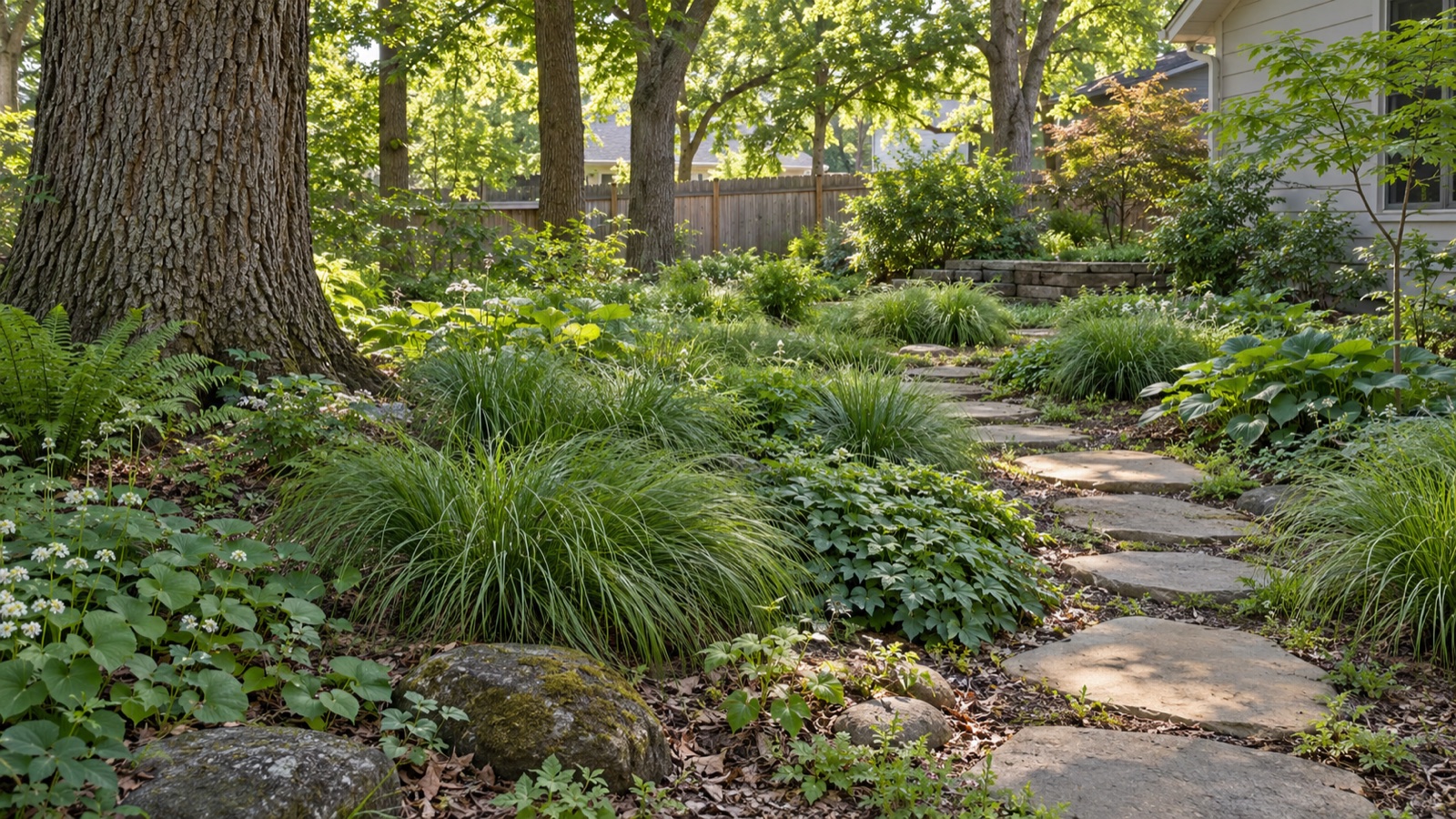
Shade lawn alternatives work best when they solve the reason turf is thinning—not merely cover the bare soil. Under a tree, limited light may be only part of the problem. Roots compete for water, leaves alter rainfall, soil can be compacted, and a daily walking route can wear out plants that otherwise tolerate shade.
This guide helps U.S. homeowners decide whether to keep a small area of shade-tolerant turf, create a sedge lawn, plant a layered groundcover bed, or install a path through the area. Plant recommendations are regional: a species that behaves well in Pennsylvania may be unsuitable in California, and “native” only has meaning when tied to a location.
Why grass fails in shade
Shade reduces photosynthesis, but it also changes how turf grows. Penn State Extension explains that shaded turf develops shorter roots, lower shoot density and less wear tolerance. Tree and turf roots also compete for moisture and nutrients. The result is often an upright, thin lawn that cannot recover quickly from traffic.
Before buying plants, observe the site for at least several days during the growing season:
- Light: record direct sun, bright filtered light and deep shade. Repeat after trees leaf out.
- Moisture: check the soil a few inches down after rain and during a normal dry period. “Shade” can be dry beneath maple roots or wet beside a downspout.
- Traffic: map the route to gates, hoses, trash bins and play areas.
- Drainage: note ponding, erosion and runoff. A groundcover will not repair a leaking valve or bad grading.
- Tree roots: locate large surface roots and avoid cutting, tilling or raising the soil grade over them.
University of Maryland Extension reports that turf-type tall fescue needs at least about four hours of direct sun, while fine fescues need a bare minimum of about two hours and do not handle foot traffic well. These are useful screening thresholds, not guarantees. Local climate, cultivar, soil and canopy density still matter.
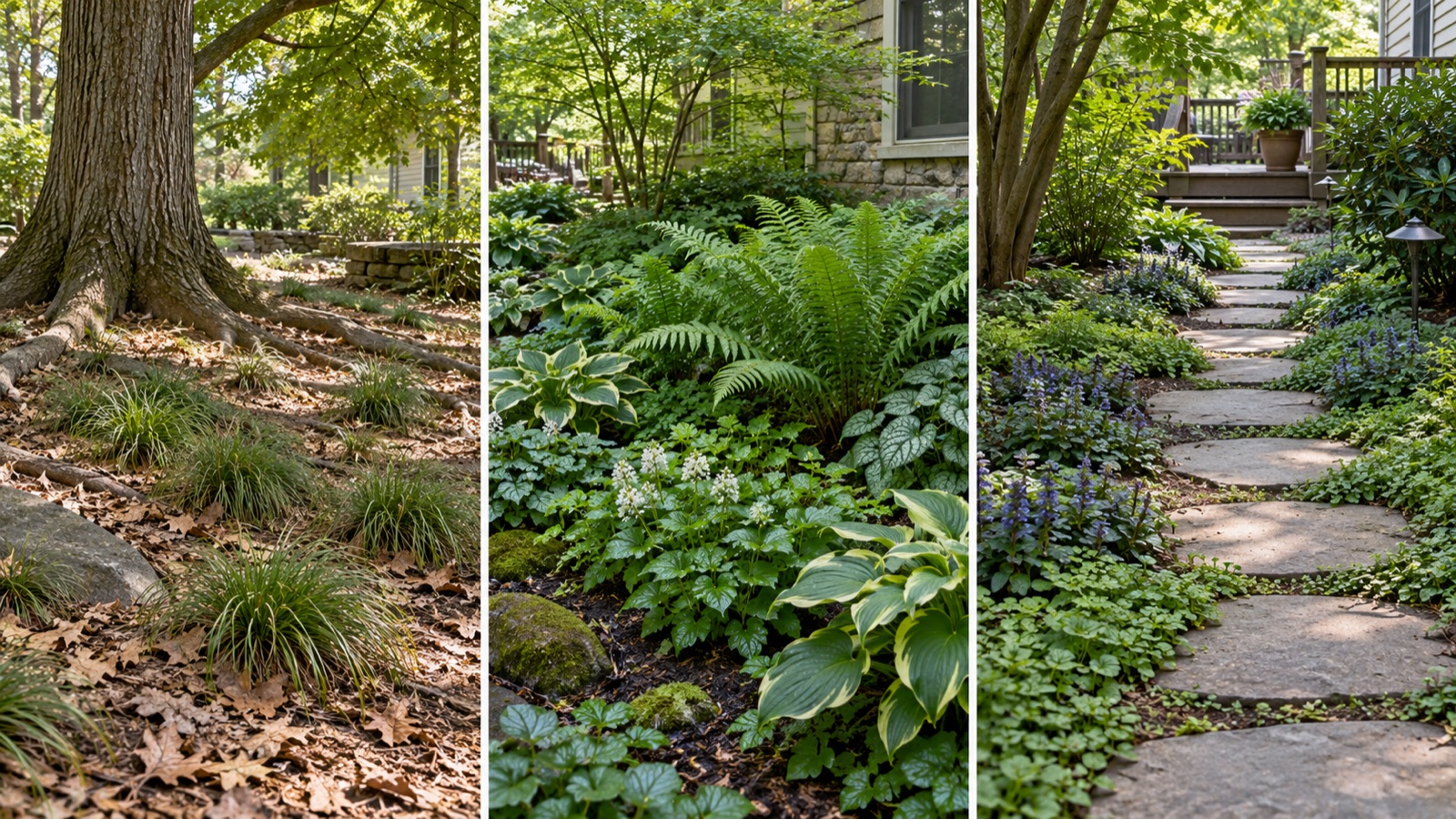
Choose shade lawn alternatives by function first
| Site and goal | Best starting point | Main limitation |
|---|---|---|
| Light shade; you still need a mowable lawn | Locally recommended fine-fescue mix in cool-season regions | Needs some direct sun; weak under repeated traffic |
| Dry shade under established trees | Regionally appropriate dry-shade sedges and woodland groundcovers | Establishment water is still required; avoid root damage |
| Moist, well-drained shade | Moisture-loving sedges, foamflower, woodland phlox or other local natives | Do not confuse moist soil with stagnant, poorly drained soil |
| Seasonally wet or ponding ground | Wet-site sedges or a correctly designed drainage/rain-garden solution | Plant selection does not correct structural drainage hazards |
| Daily foot or pet route | Permeable stepping stones, gravel or another suitable path with plants at the edges | Most shade groundcovers are not sports turf |
| Uniform evergreen carpet | Use a locally vetted species and reset expectations | Many native woodland plants are seasonal, patch-forming or mixed in texture |
Option 1: keep turf only where it still fits
A total conversion is not always necessary. If the site receives enough light and is not a worn route, a fine-fescue lawn may remain the simplest surface in northern and transition-zone climates. Fine fescues generally prefer well-drained soil and should be mowed higher and less aggressively than sun-loving turf. Rough bluegrass can tolerate moist shade in some cool-season regions, but it performs poorly in hot, dry exposure and may look different from surrounding grass.
Do not compensate for shade by watering every day. Shallow irrigation encourages shallow roots and can increase disease pressure. Correct broken sprinklers, overspray and runoff first. Our guide to lawn dry spots, runoff and sprinkler overspray helps separate an irrigation defect from a plant-selection problem.
If overseeding fails repeatedly, the canopy is dense, or traffic cannot be moved, more seed is unlikely to change the site. Convert that section and keep functional turf only where it has a realistic chance of persisting.
Option 2: use sedges as a textured lawn substitute
Sedges are grass-like plants in the genus Carex. Some spread gradually and can form a soft, flowing cover; others stay in distinct clumps. Their height, moisture needs, mowing response and traffic tolerance vary greatly. A label that says “sedge” is not enough information.
In the eastern United States, Pennsylvania sedge (Carex pensylvanica) is frequently recommended for dry shade. Penn State describes it as a low-maintenance lawn substitute with a soft, weeping appearance. A late-winter cut to roughly three inches can refresh the foliage, but it is not a weekly-mowed, high-traffic turf.
Other eastern choices depend on moisture and location. Wood’s sedge (Carex woodii) and Eastern star sedge (Carex radiata) appear in Mid-Atlantic guidance; plantain-leaf sedge (Carex plantaginea) favors shade and more organic, often moister soil; tussock sedge (Carex stricta) belongs in moist to wet conditions, not dry soil under a tree.
In parts of California, clustered field or meadow sedge (Carex praegracilis) can be mowed or left meadow-like and tolerates sun to partial shade. California guidance also warns that true foothill sedge (Carex tumulicola) is sometimes mislabeled in nurseries as the invasive Carex divulsa. Verify the botanical name and regional behavior before buying.
A practical regional shortlist
| Region and condition | Examples to investigate locally | What to verify |
|---|---|---|
| Eastern/Mid-Atlantic dry shade | Pennsylvania sedge, Wood’s sedge, Eastern star sedge | Native range, mature spread and whether the planting will be a colony or individual clumps |
| Eastern moist shade | Plantain-leaf sedge, spreading sedge, selected woodland sedges | Drainage, summer moisture and local deer pressure |
| Northern/Upper Midwest shade | Pennsylvania sedge, long-stalked sedge and locally native woodland sedges | Winter hardiness and state-specific native status |
| California sun to partial shade | Clustered field/meadow sedge; locally appropriate California sedges | Summer water, inland versus coastal performance and correct nursery identification |
| Pacific Northwest woodland shade | Local sedges plus Oregon oxalis and other regional woodland groundcovers | Moisture, spread rate and whether a species goes dormant |
This table is a research list, not a national planting prescription. Confirm selections with your state Extension service, a native-plant society or a nursery that can identify plants by scientific name and source.
Option 3: create a mixed woodland groundcover layer
A mixed planting often covers soil more reliably than one species because it can occupy different root depths and seasonal niches. It also looks intentional when foliage textures and bloom times vary. The goal is not to recreate a flat putting green in deep shade; it is to create a stable planted floor.
For the Mid-Atlantic and parts of the East, extension lists commonly include combinations such as:
- Dry shade: Pennsylvania sedge, wild ginger, green-and-gold, partridgeberry and woodland stonecrop.
- Moist, well-drained shade: plantain-leaf sedge, foamflower, wild blue phlox, woodland strawberry and selected ferns.
- Seasonal structure: spring ephemerals and bulbs among longer-lasting sedges and groundcovers.
Use local species rather than copying this eastern list elsewhere. Western Oregon Extension, for example, includes Oregon oxalis as a rapidly spreading cover for moist shade and explicitly notes that it can be aggressive in a garden. A plant can be native to a broad region yet still spread farther than you want in a small bed.
Avoid the “fast carpet” trap
Some familiar shade groundcovers escaped cultivation and invade natural areas. University of Maryland advises against English ivy, creeping euonymus and vinca in shaded lawn conversions. Other aggressive non-native plants may be regulated only in certain states. Check your state invasive-plant list rather than relying on a national store label.
Also distinguish native Allegheny spurge (Pachysandra procumbens) from Japanese pachysandra (Pachysandra terminalis). Common names and one-word labels can hide important ecological differences.
Traffic changes the design
Terms such as “walkable” and “tolerates foot traffic” are relative. Occasional access for weeding is not the same as children playing, a dog running a fence line or a household crossing the same route twice a day.
Where traffic is predictable, give it a durable route:
- Mark the natural path people already use.
- Choose a permeable surface that is safe for the slope and accessibility needs.
- Keep stepping stones stable and spaced for a comfortable stride.
- Plant sedges or groundcovers beside the route, not in the wear line.
- Use a small functional turf area elsewhere if the yard still needs a play surface.
This hybrid approach usually performs better than forcing every square foot to be a living carpet. It follows the same function-first decision used in our comparison of a native lawn and traditional turf.
How to replace thin turf without damaging trees
1. Start with a small test area
Trial the plant through one growing season before converting the whole yard. Observe summer stress, winter appearance, wildlife browsing and how quickly it fills gaps. A small test also reveals whether irrigation from an adjacent turf zone is compatible.
2. Remove competition gently
Do not rototill among tree roots. Hand-remove small patches of remaining turf and weeds where practical, working around major roots. Sheet-mulching under mature trees can alter oxygen and moisture at the root zone if applied too deeply or against the trunk. Keep mulch shallow, leave the root flare visible and obtain advice from an ISA Certified Arborist when root protection is uncertain.
3. Plant plugs at the spacing for that species
There is no universal plug count. A spreading sedge and a clump-forming sedge can have very different mature widths. Follow the grower’s mature-spread guidance, lay out plants in a staggered pattern, and resist planting against the trunk or cutting large roots to make holes. Wider spacing costs less but requires more weeding and more time to close.
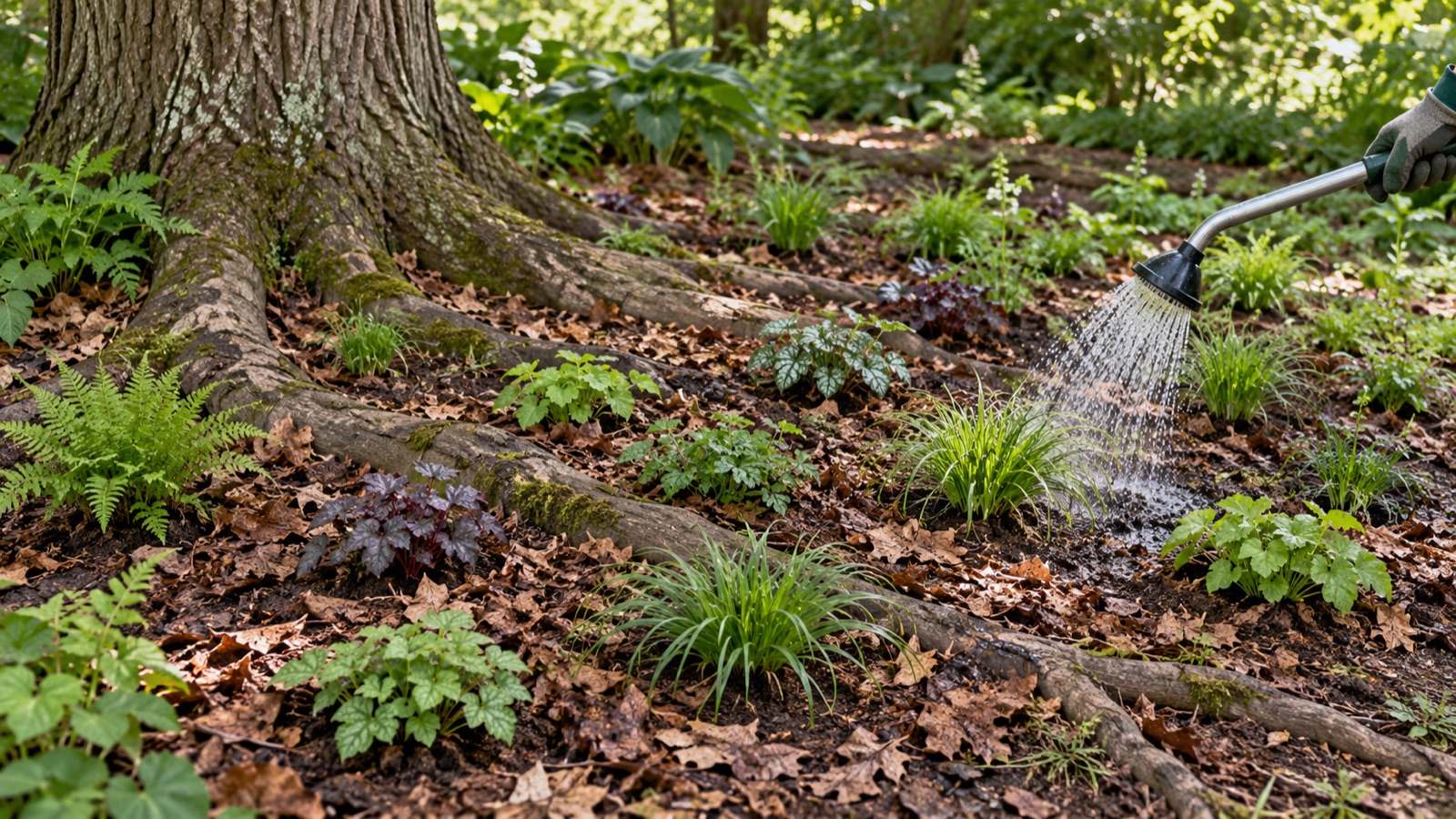
4. Water for establishment, then taper
Shade does not eliminate establishment water. New plugs have small root systems and can dry quickly in root-filled soil. Water the root balls thoroughly after planting, then monitor the soil rather than following a fixed daily timer. Reduce frequency as roots expand. Established native plants may need much less supplemental irrigation, but drought tolerance varies by species, tree competition and climate.
If the converted area remains on a spray zone with turf, one schedule may overwater the groundcovers or underwater the grass. Consider hydrozoning and compare drip irrigation with spray sprinklers. Any new drip line around trees should wet a useful portion of the root zone, not only a few tiny spots beside trunks.
5. Weed before the canopy closes
The first one or two growing seasons require more attention than the finished planting. Pull weeds before seed set, replenish a thin layer of appropriate mulch between plugs, and keep fallen leaves from smothering very small new plants. Once coverage improves, allow suitable leaf litter to remain where it will not bury crowns or create a slippery path.
6. Use species-specific maintenance
Some sedges benefit from a single late-winter cut before new growth. Others should not be mowed. Broadleaf woodland plants may be evergreen, semi-evergreen or dormant. Create a short maintenance note for each species instead of treating the planting like turf.
Budget and coverage: what actually drives cost
Plug price is only one part of the project. Total cost depends on area, spacing, site preparation, path construction, irrigation changes and how quickly you expect full coverage. A phased conversion can be more economical:
- Convert the worst shaded zone first.
- Install the permanent path before plants.
- Use smaller plugs and accept a longer fill-in period.
- Divide suitable spreading plants later rather than overbuying at the start.
- Keep healthy, functional turf elsewhere until the trial succeeds.
Avoid bargain seed mixes that omit scientific names, regional origin or percentages. Many woodland sedges are more predictably established from plugs than from generic “shade lawn” seed.
Common mistakes
- Choosing by shade tolerance alone. Moisture, soil, traffic and region matter just as much.
- Calling every sedge a no-mow lawn. Some clump, some spread, and many are unsuitable for repeated traffic or low mowing.
- Adding soil over roots. Grade changes and deep mulch can harm mature trees.
- Planting an invasive carpet. Check state and local lists before using fast-spreading non-natives.
- Expecting instant closure from wide spacing. Bare soil will need weed control until plants fill in.
- Using turf irrigation forever. Establishment water and long-term water needs are different.
- Ignoring the wear line. A path is often the correct solution for daily traffic.
Decision checklist
A shade conversion is ready to plan when you can answer all of these:
- How many hours of direct or filtered light reach the area after trees leaf out?
- Is the soil dry, moist but drained, or seasonally wet?
- Does irrigation or stormwater create the problem?
- How often do people or pets cross the area?
- Which plants are native or well adapted locally?
- Are any candidates invasive in your state?
- Can the irrigation zone serve the new planting without overwatering adjacent areas?
- How will you protect roots and manage weeds during establishment?
If those answers point in different directions, use a mosaic: a path for movement, sedges for dry shaded expanses, broader woodland plants in moister pockets, and turf only where light and use justify it.
Frequently asked questions
What is the best grass alternative for a shady yard?
There is no single best plant. Fine fescue can work in light shade in cool-season regions. Pennsylvania sedge is a common dry-shade option in parts of the East. Moist shade, wet soil and western climates require different species. Match plants to light, moisture, traffic and region.
Can you walk on a sedge lawn?
Some sedges tolerate occasional or moderate use, but many perform best as low groundcover rather than recreation turf. Install a path for repeated traffic and confirm the selected species’ use tolerance with a regional source.
Does Pennsylvania sedge need mowing?
It can be left flowing and meadow-like. Penn State suggests a late-winter cut to about three inches for a tidier appearance. It should not be managed like a frequently mowed conventional lawn.
Will groundcovers grow under a mature tree?
Yes, if they tolerate the site’s light and moisture, but tree roots make establishment more difficult. Use small plugs, protect large roots, avoid deep soil or mulch, and water new plants until their roots expand.
Can I seed a sedge lawn?
Availability and germination vary by species. Many homeowners use plugs because they provide known plants and predictable spacing. If buying seed, use the scientific name, a reputable regional supplier and species-specific establishment instructions.
What should I plant in deep shade with heavy foot traffic?
A planted surface alone is unlikely to be durable. Use a safe permeable path for the traffic and plant shade-tolerant species beside it. If the area must support play, relocate the activity or use a purpose-built surface.
Sources and further reading
- University of Maryland Extension: Groundcovers
- University of Maryland Extension: Growing Grass in the Shade
- Penn State Extension: Growing Turf Under Shaded Conditions
- Penn State Extension: Native Groundcovers Can Solve Tough Challenges
- University of Minnesota Extension: Ornamental Grasses for Shady Sites
- University of Georgia Extension: Native Grasses and Sedges
- UC Agriculture and Natural Resources: Lawn Alternatives
- UC Master Gardeners of Sonoma County: Native Grasses
Last reviewed: November 1, 2026. Plant availability, invasive status, water restrictions and local recommendations can change; verify them before purchasing or planting.